BGP History: From EGP and the Napkins to BGP-4 Today
Every packet that crosses the Internet today follows a route chosen by a protocol that two engineers sketched on lunch napkins in January 1989. BGP history is not just trivia: almost every odd rule you meet when you configure BGP (the AS_PATH loop check, the attribute flags, the OPEN capabilities, the empty-policy behaviour) is the answer to a specific problem from the last 37 years. This first part of our 26-part BGP Deep Dive follows the protocol from the ARPANET's EGP, through the napkins and BGP-1 to BGP-4, to the incidents that changed how we run it. Every step is backed by the original RFCs, and we add real data: RIPE RIS history of two famous incidents, today's RouteViews table and a GoBGP lab whose OPEN message we decode byte by byte.
- Before BGP: EGP (RFC 827, 1982) was built for autonomous systems "connected in a tree, with no cycles" and could not prevent loops in a mesh.[1] By 1989 the NSFNET had backdoor links everywhere.[3]
- The napkins: Kirk Lougheed (cisco) and Yakov Rekhter (IBM) designed BGP over lunch at the IETF meeting in Austin, January 1989.[10][11][12] RFC 1105 followed in June 1989.[4]
- Versions: BGP-1 (RFC 1105, 1989), BGP-2 (RFC 1163, 1990), BGP-3 (RFC 1267, 1991), BGP-4 (RFC 1654, 1994; RFC 1771, 1995; RFC 4271, 2006).[4][5][6][7][8]
- Why it lasted: TCP transport, the AS path as a loop check, policy instead of a metric, and attributes plus capabilities that let new features ride on the same version 4.[4][19][22]
- Scale: the inventors expected a few thousand routes;[10] the IPv4 table held 1,049,757 entries in January 2026.[18]
- Incidents: AS7007 (1997), YouTube (2008) and Facebook (2021) each taught a lesson that is now in every BGP checklist.[13][15][17]
Before BGP: GGP and EGP · Why EGP failed · The napkins, January 1989 · BGP-1: RFC 1105 · BGP-2, BGP-3, BGP-4 · CIDR and BGP-4 · Path vector in a real lab · Why BGP is timeless · Three incidents · What changed after them · Common misconceptions · FAQ
BGP history starts before BGP: GGP and EGP
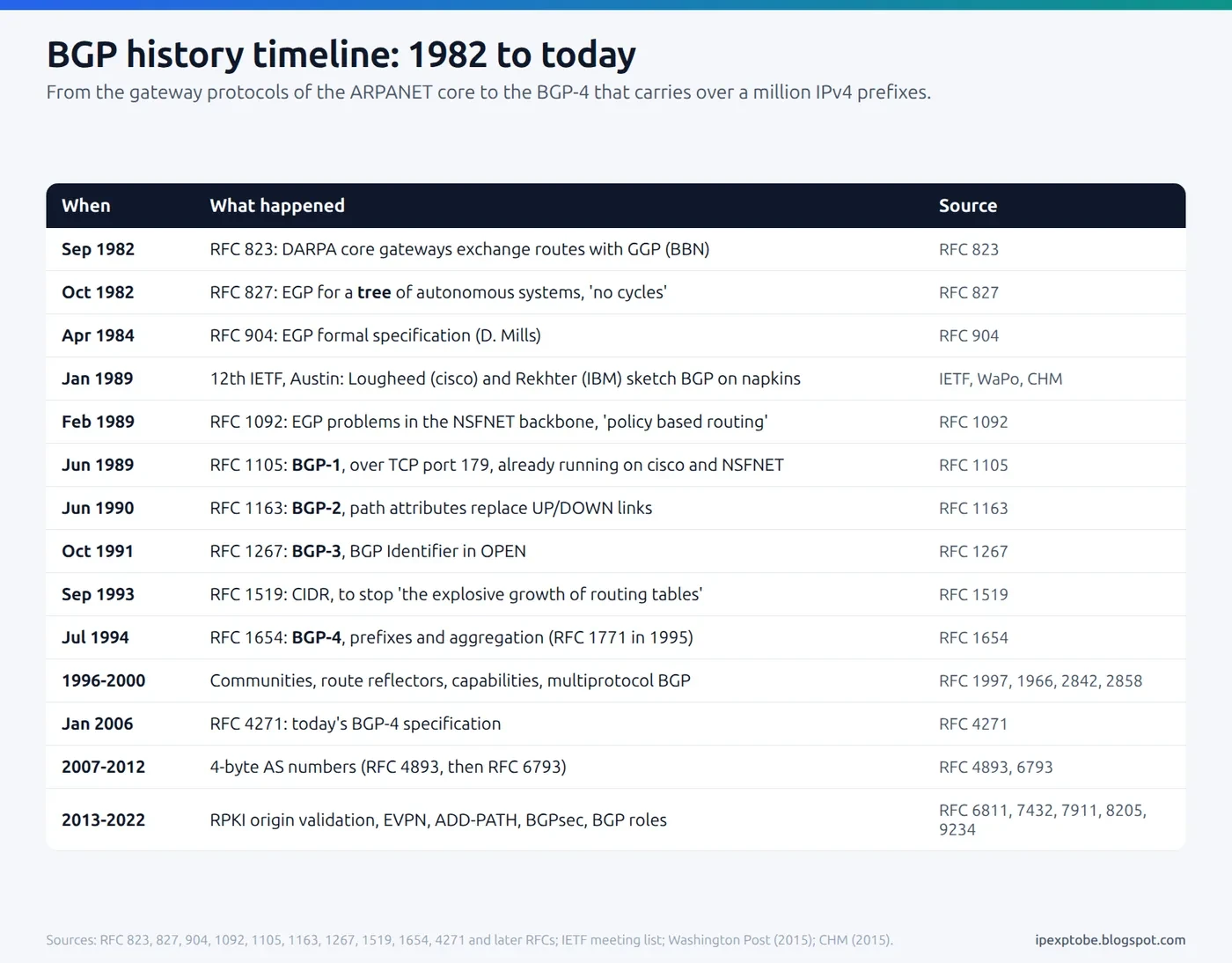
In the early 1980s the ARPANET and SATNET were connected by a set of "core" gateways run by BBN. Inside that core the gateways exchanged routes with the Gateway-to-Gateway Protocol (GGP), described in RFC 823 in September 1982.[25] The core was one administration. Everything else, a university or a military network, was a separate autonomous system that had to tell the core which networks it could reach.
That job went to the Exterior Gateway Protocol (EGP). Eric Rosen of BBN described it in RFC 827 (October 1982), and David Mills wrote the formal specification, RFC 904, in April 1984.[1][2] EGP has three parts: neighbour acquisition, neighbour reachability (Hello and I-H-U, "I heard you") and network reachability (Poll and Update messages).[2] An Update lists networks grouped by gateway and by distance. That is all: a list of networks and a number.
RFC 827 is very honest about the limits. EGP "is NOT intended to provide information which could be used as input to a completely general area or hierarchical routing algorithm. It is intended for a set of autonomous systems which are connected in a tree, with no cycles. It does not enable the passing of sufficient information to prevent routing loops if cycles in the topology do exist."[1] RFC 904 expected that "EGP evolves to include topologies not restricted to tree-structures".[2] It never did. BGP replaced it instead.
Why EGP failed in the NSFNET
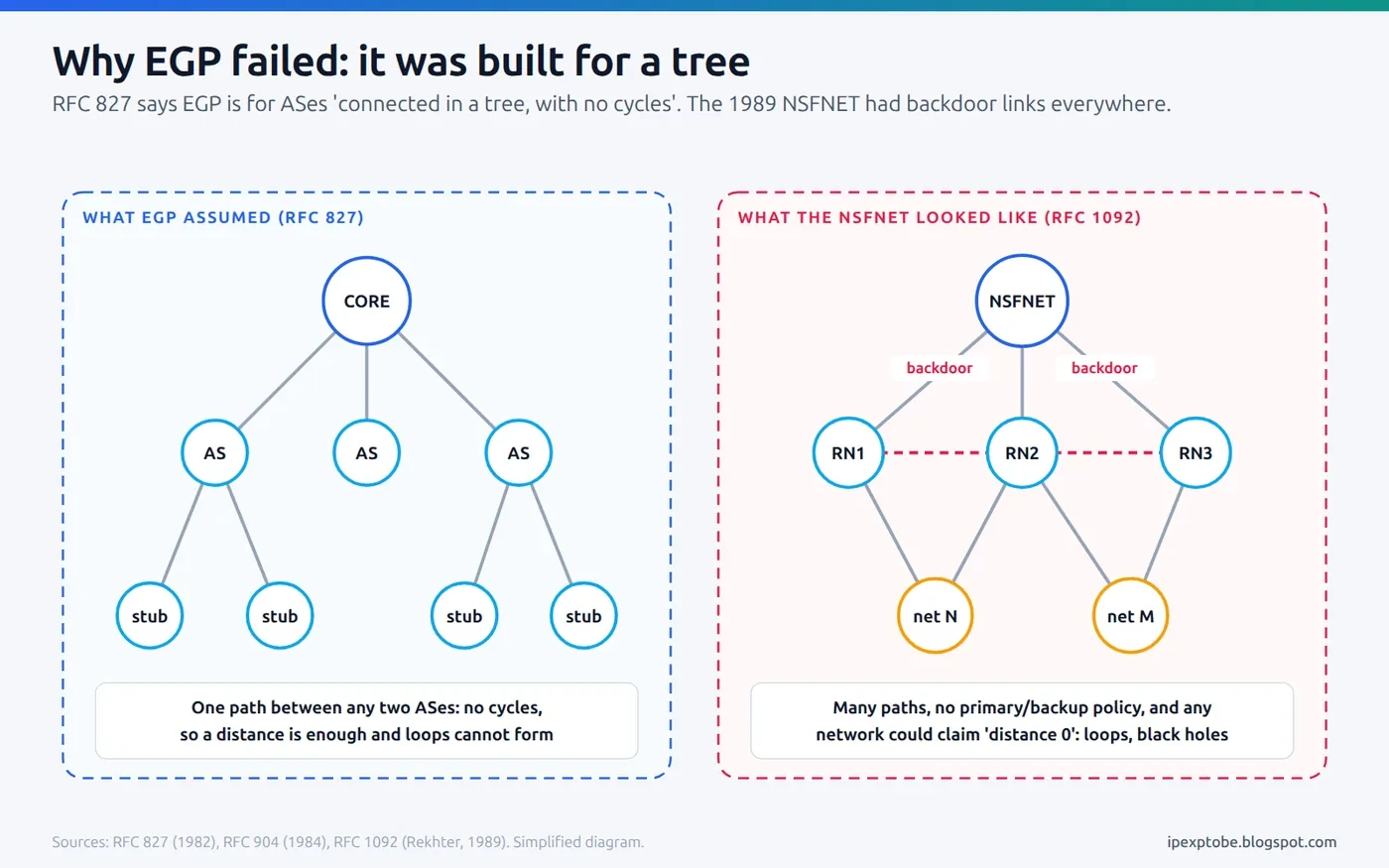
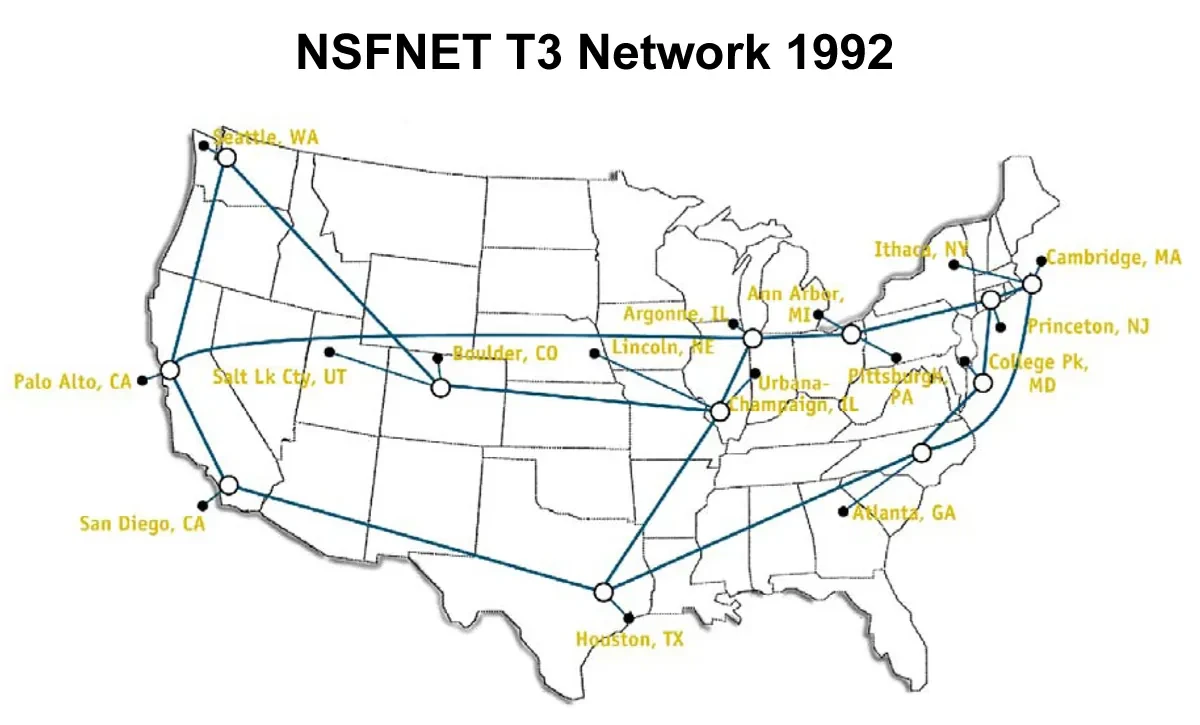
By 1988-89 the NSFNET backbone connected regional networks across the United States, and many regionals had their own links to each other: "backdoor" routes. In February 1989 Yakov Rekhter, then at IBM's T.J. Watson Research Center, wrote down the problems in RFC 1092, EGP and Policy Based Routing in the New NSFNET Backbone:[3]
- "The EGP model assumes an engineered spanning tree topology, however, the NSFNET (due to the presence of backdoor routes) does not fit into this model. In the NSFNET the same network may be advertized as reachable by more than one regional network."
- If a network is reachable through two regionals, "EGP has no provisions to specify one of these paths as a primary and one as a secondary, since there is not generally accepted interpretation of EGP metrics today".
- "There is nothing in EGP which can prevent one or more regional networks from advertizing other networks (in particular, networks which belong to other regional networks) as reachable with zero distance. This could result in the creation of a 'black hole' or at least in suboptimal IP routing."
Rekhter's conclusion became BGP's design goal: "some kind of a rudimentary Policy Based Routing method becomes imperative." He also wrote that EGP was "only viewed as an interim measure until better inter autonomous system protocols are defined and widely deployed".[3] The Washington Post's later account adds that EGP "could handle only a fixed number of network addresses", and that the network was growing fast towards that limit.[10]
Notice the pattern. A distance (a hop count or a metric) cannot stop a loop in a meshed graph, and it cannot express "I prefer this neighbour for business reasons". Both missing pieces, the path and the policy, are exactly what BGP added.
The napkins: Austin, January 1989
The two main published accounts agree on the scene and differ on one detail:
- The Computer History Museum (2015), which preserves Cisco's archive: "It was 1989. Kirk Lougheed of Cisco and Yakov Rekhter of IBM were having lunch in a meeting hall cafeteria at an Internet Engineering Task Force (IETF) conference." It calls BGP the "Two Napkin Protocol" and shows napkin notes as an artefact of the archive.[11]
- The Washington Post (Craig Timberg, 31 May 2015), which interviewed both inventors: they sat down for lunch in Austin in January 1989 and "began scribbling ideas for a solution onto the back of a ketchup-stained napkin. Then a second. Then a third." The inventors jokingly called it the "three-napkins protocol" and saw it as a "hack" or "kludge", a short-term fix.[10]
The date and the city match the 12th IETF meeting, held on 18-20 January 1989 in Austin, Texas, at the University of Texas, with 120 attendees.[12] So: two napkins or three, depending on who tells it; the plan title of this series says two, the inventors told the Post three.
The quotes in the Post explain a lot about BGP's later security story. Rekhter said security "wasn't even on the table". Lougheed: "In the early days of the Internet, getting stuff to work was the primary goal. There was no concept that people would use this to do malicious things." And on why the industry adopted it so quickly: "We needed to sell routers... When Yakov and I showed up with a solution and it seemed to work, people were quite willing to accept it because they didn't have anything else."[10] Rekhter's own summary, 26 years later: "Short-term solutions tend to stay with us for a very long time. And long-term solutions tend to never happen."[10]
BGP-1: RFC 1105, June 1989
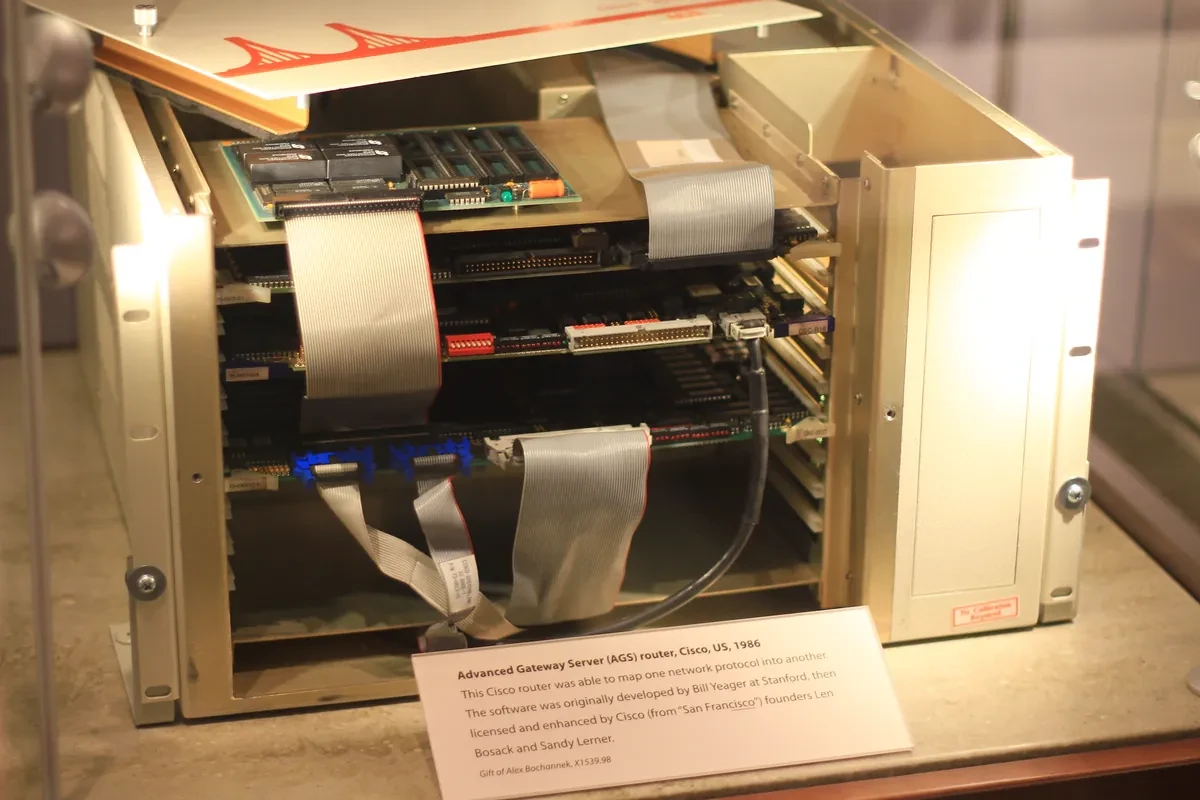
Five months after the lunch, RFC 1105, A Border Gateway Protocol (BGP), by K. Lougheed (cisco Systems) and Y. Rekhter (T.J. Watson Research Center, IBM), was published. It was not a paper design: "At the time of this writing, the Border Gateway Protocol implementations exist for cisco routers as well as for the NSFNET Nodal Switching Systems. A public domain version for 'gated' is currently being implemented."[4]
The introduction states the idea that still defines BGP: it is "built on experience gained with EGP", and the reachability information "includes information on the autonomous systems (AS's) that traffic must transit to reach these networks. This information is sufficient to construct a graph of AS connectivity from which routing loops may be pruned and policy decisions at an AS level may be enforced."[4]
The TCP decision
The second big decision was the transport. EGP had to fragment large Update messages itself; RFC 827 spends pages on numbering NR message fragments.[1] BGP simply runs over TCP: "BGP runs over a reliable transport level protocol. This eliminates the need to implement explicit update fragmentation, retransmission, acknowledgement, and sequencing." The authors even say that a message protocol such as VMTP "might be more natural for BGP. TCP will be used, however, since it is present in virtually all commercial routers and hosts." And: "BGP uses TCP port 179 for establishing its connections."[4] Port 179 has not changed since.
That choice explains BGP's character to this day. Because TCP delivers everything in order and reliably, BGP sends each route once and then only changes. There is no periodic refresh. Geoff Huston points out the consequence: "BGP has no inherent periodic refresh capability, so when information is dropped, the router and its neighbors fall out of sync."[18] It is also why applying a new inbound policy needs either a stored copy of everything the neighbour sent or a way to ask for it again: the ROUTE-REFRESH message (RFC 2918, 2000), covered in part 24.[25]
What BGP-1 looked like on the wire
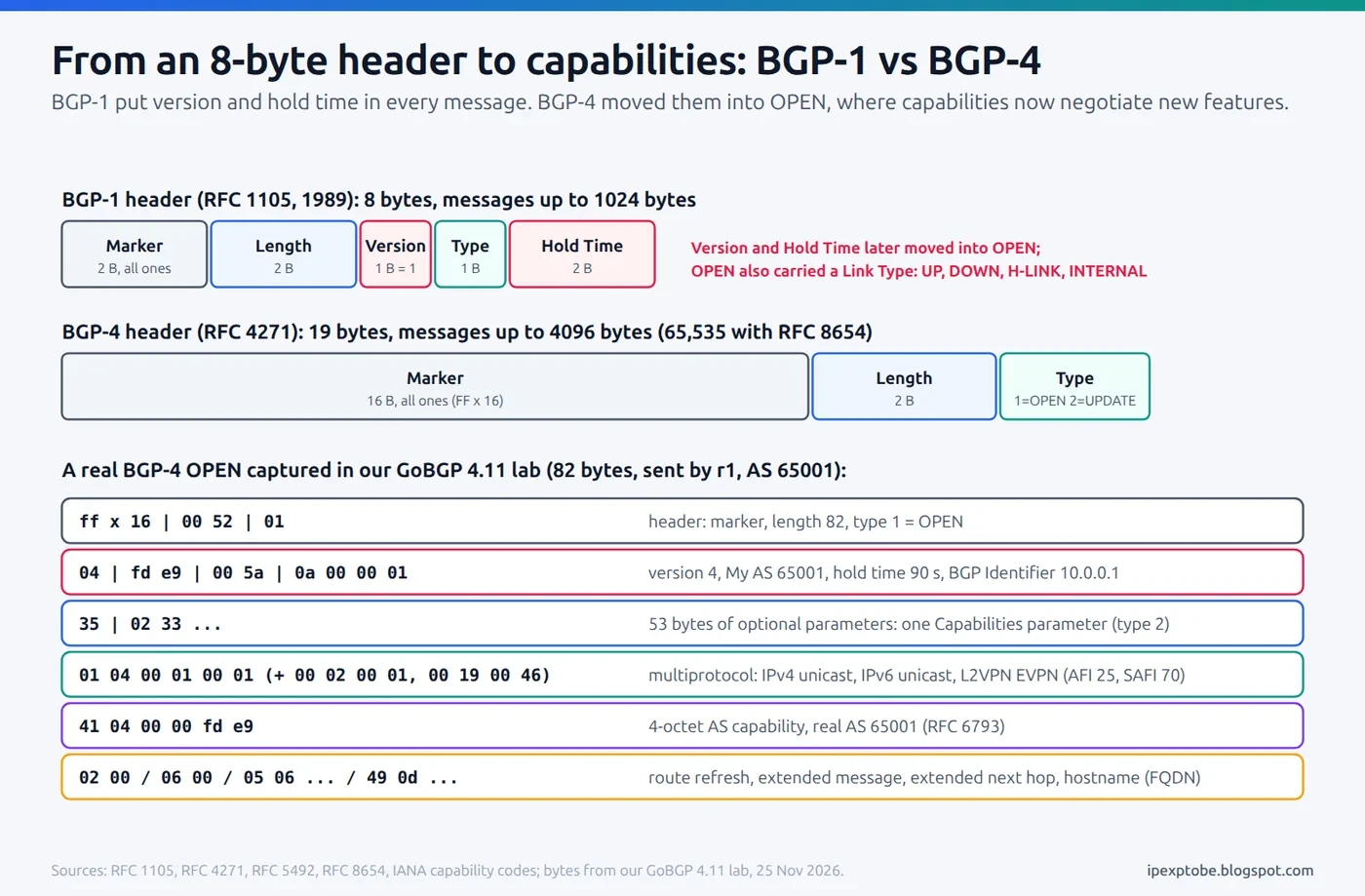
BGP-1 used an 8-byte header: a 16-bit Marker of all ones, a 16-bit Length, an 8-bit Version (1), an 8-bit Type and a 16-bit Hold Time. Messages were limited to 1024 bytes.[4] The OPEN message carried a Link Type that described where the peer sat in a hierarchy: INTERNAL, UP ("the peer is higher in the AS hierarchy"), DOWN or H-LINK (same level). In UPDATEs, every AS in the path was paired with a Direction: UP, DOWN, H_LINK, EGP_LINK or INCOMPLETE.[4] In other words, BGP-1 still assumed something like the NSFNET hierarchy. The next versions dropped that idea.
BGP-2, BGP-3 and BGP-4: what each version changed
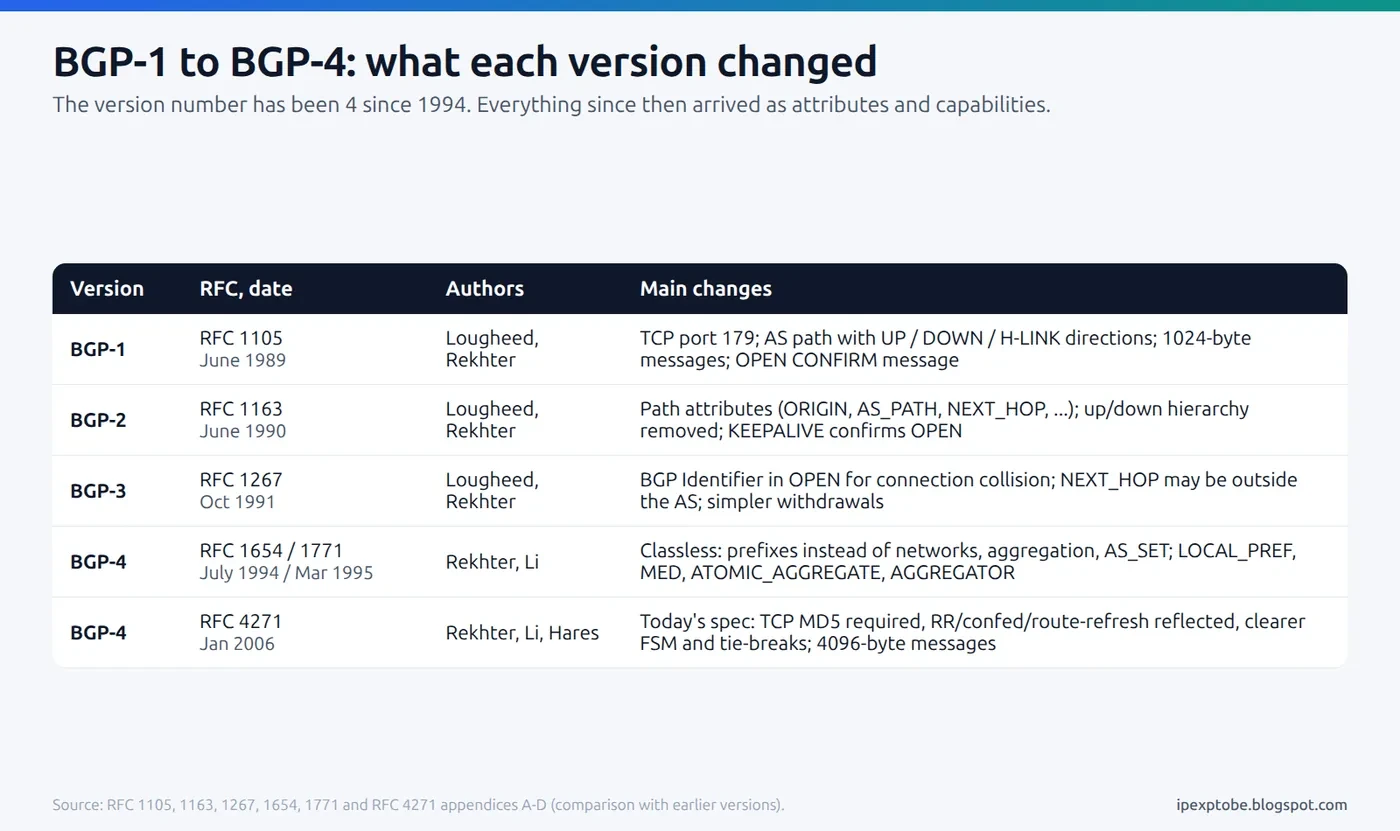
RFC 4271 conveniently contains four appendices that compare it with each predecessor, which lets us reconstruct the history from the standard itself.[8]
- BGP-2, RFC 1163 (June 1990). Published together with RFC 1164 (Application of BGP in the Internet) as a Proposed Standard.[5] The UP/DOWN/Horizontal relations were removed, Version and Hold Time moved from the header into OPEN, the Link Type disappeared, the OPEN CONFIRM message was replaced by a KEEPALIVE that confirms the OPEN, the Marker grew to 16 bytes, and the UPDATE got its modern shape with a list of path attributes.[8][5]
- BGP-3, RFC 1267 (October 1991). A BGP Identifier was added to OPEN to detect and resolve connection collisions, and NEXT_HOP no longer had to be inside the sender's AS.[8] RFC 1267 defines five path attributes: ORIGIN (1), AS_PATH (2), NEXT_HOP (3), UNREACHABLE (4) and INTER-AS METRIC (5).[6]
- BGP-4, RFC 1654 (July 1994), RFC 1771 (March 1995). Classless routing and aggregation (next section). INTER_AS_METRIC was renamed MULTI_EXIT_DISC, LOCAL_PREF was introduced "to simplify configuration", ATOMIC_AGGREGATE and AGGREGATOR were added, and the hold time became negotiated per connection, with zero allowed.[8][7]
- BGP-4, RFC 4271 (January 2006). Same version number, many clarifications: TCP MD5 support became mandatory, route reflectors, confederations and route refresh were reflected in the text, an upper bound on accepted prefixes was described, the FSM and the tie-breaking rules were clarified, and the maximum message size is 4096 bytes.[8]
A detail that later confuses people: type code 4 meant UNREACHABLE in BGP-3 and means MULTI_EXIT_DISC in BGP-4, and type code 5 moved from INTER-AS METRIC to LOCAL_PREF.[6][7] The attribute codes you know from BGP-4 (1 ORIGIN to 7 AGGREGATOR) were fixed in RFC 1654.[7][19] Each of them gets its own part in this series.
CIDR and the birth of BGP-4
BGP-1 to BGP-3 advertised classful networks. In the early 1990s that design hit a wall. RFC 1519 (September 1993), the CIDR specification, listed three problems: "Exhaustion of the class B network address space", "Growth of routing tables in Internet routers beyond the ability of current software, hardware, and people to effectively manage", and the "Eventual exhaustion of the 32-bit IP address space". Its aim was to "conserve the address space and stem the explosive growth of routing tables in default-route-free routers".[9]
CIDR needed a routing protocol that could carry a prefix of any length and aggregate many prefixes into one. RFC 1654 says it directly: "BGP-4 provides a new set of mechanisms for supporting classless interdomain routing. These mechanisms include support for advertising an IP prefix and eliminates the concept of network 'class' within BGP. BGP-4 also introduces mechanisms which allow aggregation of routes, including aggregation of AS paths."[7] Aggregating AS paths is why AS_SET exists, and why ATOMIC_AGGREGATE and AGGREGATOR were added in the same version. RFC 4271 later summarises it in one line: "The concept of network classes, or subnetting, is foreign to BGP-4."[8]
The version number has stayed at 4 since then. In RFC 4271 the OPEN version field still says: "The current BGP version number is 4."[8]
Path vector in a real lab: why the AS path beat the metric
BGP is usually called a path-vector protocol. Each route carries the list of autonomous systems it has crossed (AS_PATH); each AS prepends its own number before it passes the route on; and an AS that finds its own number in a received path drops the route. That one rule removes loops between ASes, in any topology, without a metric. It is exactly what EGP lacked.[1][4] (Geoff Huston, who has measured the BGP table for decades, describes BGP as "an instance of the Bellman-Ford distance vector routing algorithm": the algorithm is distance-vector, the path list is what makes it safe.[18])
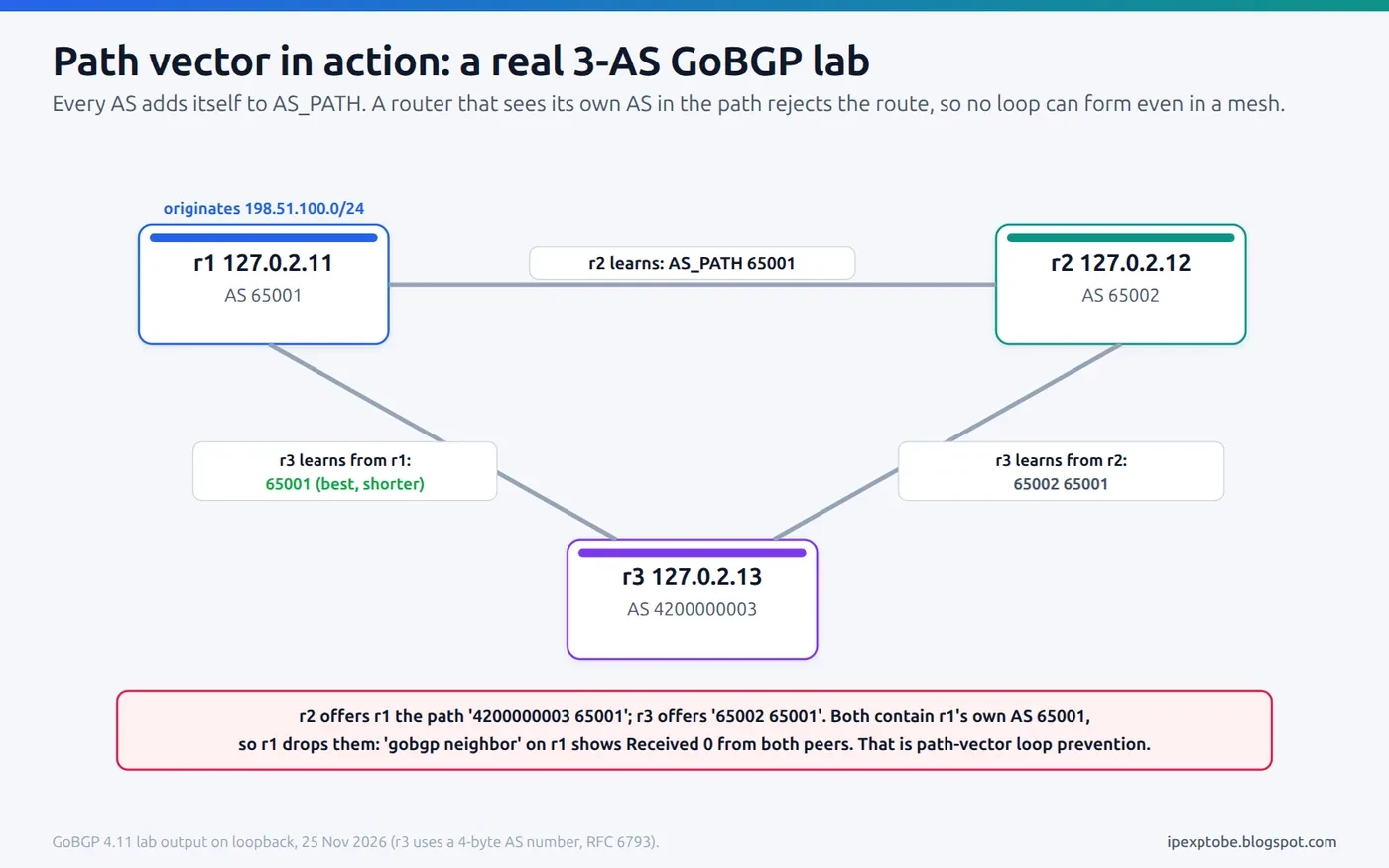
To show it with real software we built three GoBGP 4.11 routers on loopback addresses: r1 in AS 65001, r2 in AS 65002 and r3 in AS 4200000003 (a 4-byte AS number), fully meshed with eBGP, and let r1 originate 198.51.100.0/24 and 2001:db8:100::/48.[26] This is the real output on r3, which has two paths:
$ gobgp global rib -a ipv4          # on r3, AS 4200000003 (GoBGP 4.11 lab output)
   Network              Next Hop             AS_PATH              Age        Attrs
*> 198.51.100.0/24      127.0.2.11           65001                00:00:04   [{Origin: i}]
*  198.51.100.0/24      127.0.2.12           65002 65001          00:00:04   [{Origin: i}]
r2 learns the prefix from r3 with r3's 4-byte AS in front:
$ gobgp neighbor 127.0.2.13 adj-in -a ipv4    # on r2
   ID  Network              Next Hop             AS_PATH              Age        Attrs
   0   198.51.100.0/24      127.0.2.13           4200000003 65001     00:00:04   [{Origin: i}]
Both r2 and r3 advertise their paths back to r1, and both paths contain 65001. r1 accepts none of them:
$ gobgp neighbor                     # on r1
Peer               AS  Up/Down State       |#Received  Accepted
127.0.2.12      65002 00:00:16 Establ      |        0         0
127.0.2.13 4200000003 00:00:16 Establ      |        0         0
In a triangle of three ASes, the route could circulate forever if each AS only looked at a distance. With the AS path, the loop is cut at the first hop that would close it. Part 7 of this series covers AS_PATH, AS_SET, AS4_PATH and the loop check byte by byte.
Why BGP is timeless
A "kludge" designed for the NSFNET in 1989[10] now carries over a million IPv4 prefixes. Huston's annual report for APNIC counted 1,049,757 IPv4 entries in January 2026 (814,000 in January 2020), about 241,800 IPv6 entries, and 77,900 ASes in the IPv4 table.[18] The inventors "had imagined BGP sorting through a few thousands possible routes", the Post wrote in 2015.[10] Why did the design survive that growth? Four reasons stand out in the documents.

1. Policy, not a metric
BGP was born from Rekhter's demand for "Policy Based Routing".[3] A BGP route is chosen by local policy first (LOCAL_PREF, filters), and only then by tie-breakers such as AS path length. That fits a network of independent businesses, and it is why the Internet's routing follows contracts more than geography. Parts 16-18 cover best-path selection and traffic engineering.
2. Self-describing path attributes
Since BGP-2 every UPDATE carries a list of attributes, each with flags, a type code and a length.[5] The flags say whether an attribute is optional and whether it is transitive: a router that does not know an optional transitive attribute passes it on. That is how communities (RFC 1997, 1996), route-reflector attributes (RFC 4456), extended and large communities, AS4_PATH (RFC 6793) and the EVPN-related attributes were deployed across a network where most routers were older than the extension.[25][20] The IANA registry now lists 34 non-deprecated path attribute codes, two of them temporary, compared with the seven of RFC 1654.[19][7]
3. Capabilities in OPEN
RFC 2842 (May 2000), now RFC 5492, added the Capabilities optional parameter to OPEN. Two speakers announce what they support and use only what both understand.[22] Here is the real OPEN that r1 sent in our lab, captured with a small Python peer (82 bytes):[26]
ff ff ff ff ff ff ff ff ff ff ff ff ff ff ff ff   marker (16 bytes of ones)
00 52 01                                          length 82, type 1 = OPEN
04 fd e9 00 5a 0a 00 00 01                        version 4, AS 65001, hold 90 s, BGP ID 10.0.0.1
35 02 33                                          53 bytes of parameters: Capabilities (type 2), 51 bytes
   02 00                                          route refresh (RFC 2918)
   49 0d 0b ...                                   FQDN / hostname (draft-walton), 11-byte hostname
   06 00                                          extended message (RFC 8654)
   01 04 00 01 00 01                              multiprotocol: AFI 1 IPv4, SAFI 1 unicast
   01 04 00 02 00 01                              multiprotocol: AFI 2 IPv6, SAFI 1 unicast
   01 04 00 19 00 46                              multiprotocol: AFI 25 L2VPN, SAFI 70 EVPN
   41 04 00 00 fd e9                              4-octet AS, real AS 65001 (RFC 6793)
   05 06 00 01 00 01 00 02                        extended next hop: IPv4 unicast over an IPv6 next hop (RFC 8950)
Compare that with the 8-byte BGP-1 header in Figure 3. The version byte is still 4, but this session negotiates IPv6 and EVPN (multiprotocol BGP, RFC 2858 in 2000 and RFC 4760 in 2007; EVPN uses AFI 25 and SAFI 70 per RFC 7432), 4-byte AS numbers, 65,535-byte messages and IPv4 routes with IPv6 next hops.[21][19][25] IANA lists 22 non-deprecated capability codes today.[19] The UPDATE that followed in the same capture is a textbook BGP-4 message: ORIGIN IGP (40 01 01 00), AS_PATH with one 4-byte AS (40 02 06 02 01 00 00 fd e9), NEXT_HOP 127.0.2.11 (40 03 04 7f 00 02 0b) and the prefix (18 c6 33 64 = 198.51.100.0/24). Part 3 decodes all message types in detail.
4. One transport, many address families
With multiprotocol extensions, the same session carries IPv4, IPv6, VPN routes, EVPN MAC/IP routes, flow specifications (RFC 5575), link-state topology (BGP-LS, RFC 7752) and more.[21][25] The Computer History Museum put it plainly: BGP "can now carry routes for Multicast, IPv6, VPNs, and a variety of other data".[11] Part 26 of this series is devoted to MP-BGP and its applications.
Three incidents that shaped BGP operations
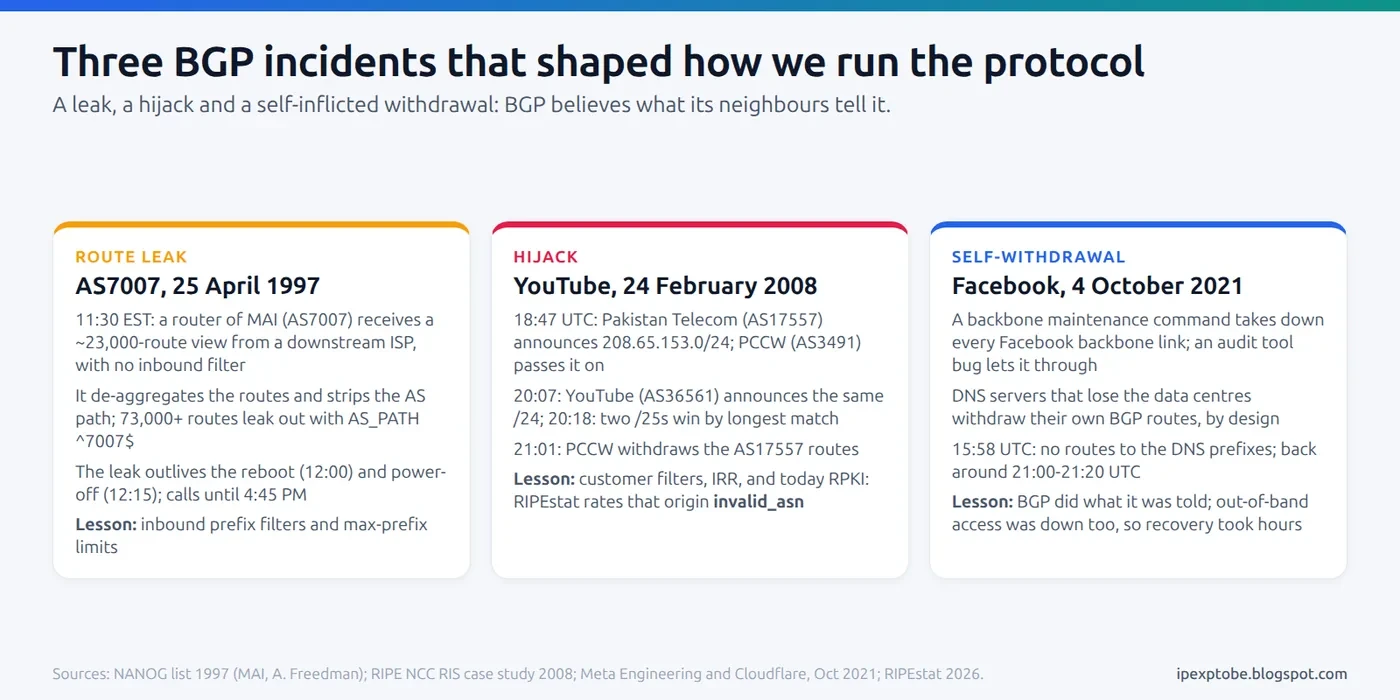
The same openness that made BGP easy to extend also means that, in the Post's words, it is "built to automatically trust".[10] Three incidents show what that means in practice.
AS7007, 25 April 1997: the leak that would not die
MAI Network Services explained on the NANOG list the next day what had happened. At 11:30 EST its border router, "stamped with AS 7007", received a full routing view of about 23,000 routes from a downstream ISP. "There was no distibute list imposed on the downstream", the operator wrote; "Not having a filter imposed on the inbound side was our error." The router then began "to de-aggregate the 23K route view and strip the AS path out of it". MAI's MAE-East router saw "73,000+" routes. MAI disabled the session at 11:45, rebooted the router at 12:00 and "unlugged everything at 12:15", yet other networks kept seeing the routes: according to the Sprint NOC they "just keep appearing again". The calls went on until about 4:45 PM.[13]
Avi Freedman's report from the same day adds the view from outside: the more-specifics carried "an AS_PATH of ^7007$", and "72,000 is the number of routes the Sprint router took before it melted".[14] Short AS paths and more-specific prefixes are exactly what BGP prefers, so the leaked routes won everywhere. The lesson, inbound prefix filters and a maximum-prefix limit on every customer session, is now standard; RFC 4271 itself added procedures for "imposing an upper bound on the number of prefixes".[8]
YouTube, 24 February 2008: a hijack by more-specific prefix
The RIPE NCC reconstructed this one from its Routing Information Service (RIS):[15]
- YouTube (AS36561) normally announced 208.65.152.0/22.
- 18:47 UTC: Pakistan Telecom (AS17557) started announcing 208.65.153.0/24, the more-specific block containing youtube.com's addresses, and its upstream PCCW Global (AS3491) passed it on. Within two minutes the route had reached its largest extent in RIS.
- 20:07: YouTube announced the same /24. With two identical prefixes, AS-path length decided, so part of the Internet still went to Pakistan.
- 20:18: YouTube announced 208.65.153.0/25 and 208.65.153.128/25. Longest match won, wherever the /25s reached (21 RIS peers, against 105 for the /24).
- 21:01: PCCW withdrew the prefixes originated by AS17557.
We looked at the same prefix with today's RIPEstat API. Its 8-hour routing-history view shows YouTube's /22 throughout, and YouTube's own /24 and /25s from the first bin after the event; the roughly two-hour hijack falls between two RIB dumps (16:00 and 00:00) and is not visible at that granularity, which is why the RIPE NCC used update-level tools for its analysis.[23][15] The most interesting check is what would happen today. RIPEstat's rpki-validation call rates a route for 208.65.153.0/24 with origin AS17557 as invalid_asn: ROAs exist for that space, for AS36040 and AS43515, and none for AS17557.[23] A network that drops RPKI-invalid routes (RFC 6811, 2013) would reject that announcement.[25] RouteViews today shows 208.65.152.0/22 originated by AS43515 (registered to YouTube, Google Ireland) with an RPKI state of valid:[24][23]
route-views>show ip bgp 208.65.153.238 bestpath      (route-views.routeviews.org, 25 Nov 2026 02:04 UTC)
BGP routing table entry for 208.65.152.0/22, version 1496529573
Paths: (15 available, best #15, table default)
  Not advertised to any peer
  Refresh Epoch 1
  2497 15169 43515
    202.232.0.2 from 202.232.0.2 (58.138.96.254)
      Origin IGP, localpref 100, valid, external, best
      path 7F15682BEF28 RPKI State valid
Facebook, 4 October 2021: BGP did exactly what it was told
Meta's engineering post describes the cause. During routine maintenance "a command was issued with the intention to assess the availability of global backbone capacity, which unintentionally took down all the connections in our backbone network". An audit tool should have stopped it, "but a bug in that audit tool prevented it from properly stopping the command". Facebook's DNS servers are designed to "disable those BGP advertisements if they themselves can not speak to our data centers", so they withdrew their routes, and "our DNS servers became unreachable even though they were still operational." Even the out-of-band access was down, so engineers had to go on site.[17]
From the outside, Cloudflare saw a peak of BGP updates from Facebook at about 15:40 UTC; at 15:58 Facebook "had stopped announcing the routes to their DNS prefixes", and RouteViews answered % Network not in table for 185.89.218.0/23 and 129.134.30.0/23. Renewed BGP activity started around 21:00 UTC, and facebook.com resolved again on 1.1.1.1 at about 21:20.[16]
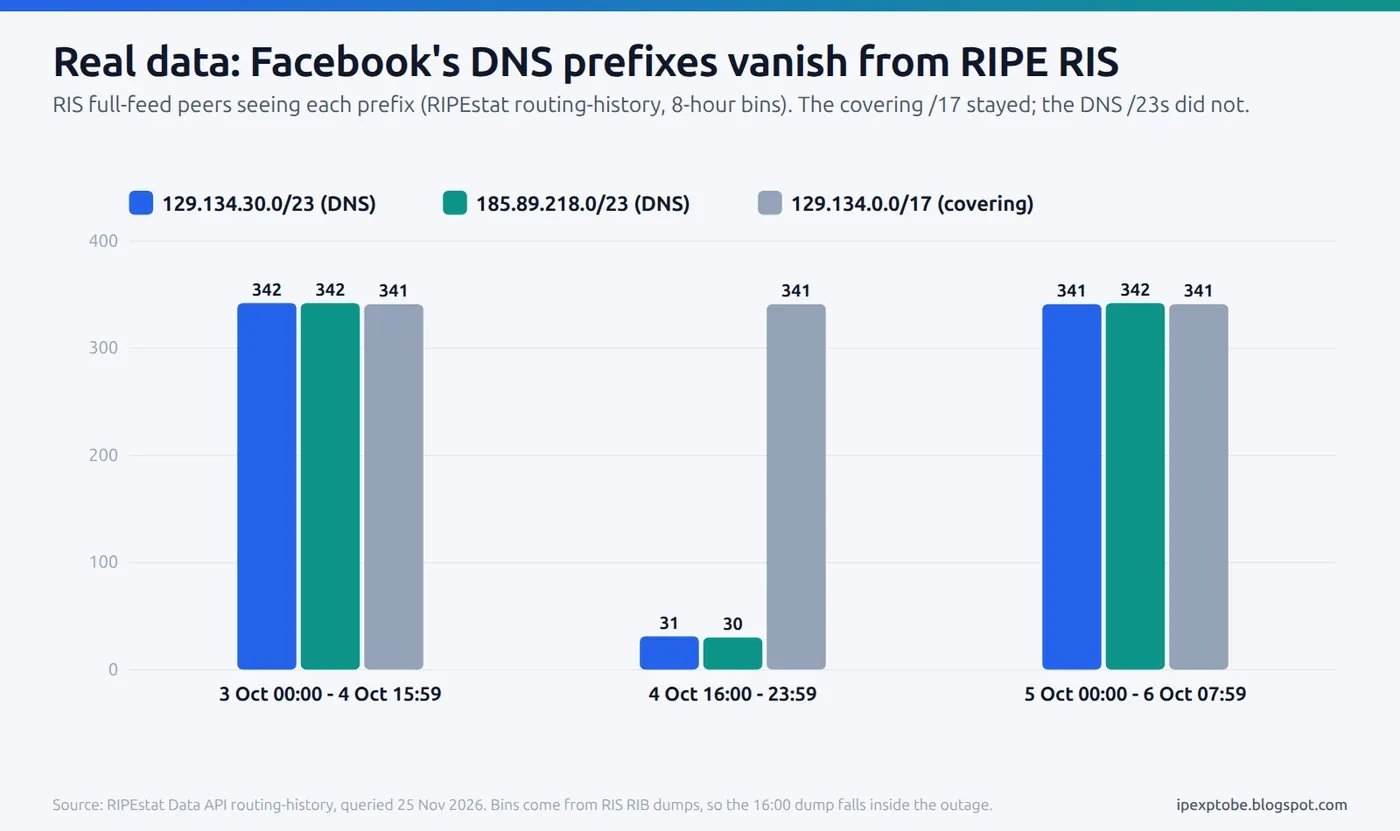
RIPEstat's routing-history makes the withdrawal visible in one query. Both DNS /23s were seen by 342 RIS full-feed peers before the event, by 31 and 30 peers in the bin that starts at 16:00 UTC on 4 October, and by 341-342 again on 5 October. The more-specific 185.89.218.0/24 and 185.89.219.0/24 dropped to 23 peers. Meanwhile the covering 129.134.0.0/17 stayed at 341 peers the whole time, which matches Cloudflare's observation that "other Facebook IP addresses remained routed" but were useless without DNS.[23][16] Today the prefix is back to normal, RPKI-valid for AS32934:[24][23]
route-views>show ip bgp 129.134.30.0 bestpath        (route-views.routeviews.org, 25 Nov 2026 02:04 UTC)
BGP routing table entry for 129.134.30.0/24, version 1493109292
Paths: (14 available, best #14, table default)
  2497 32934
    202.232.0.2 from 202.232.0.2 (58.138.96.254)
      Origin IGP, localpref 100, valid, external, best
      path 7F1688183B38 RPKI State valid
If you want to run the same checks yourself, our BGP Route Lookup tool shows the origin AS, AS paths and the RPKI state of any prefix, and How to Read a Real BGP Table Entry explains every line of the RouteViews output above.
What changed because of these incidents
None of these fixes changed the BGP-4 version number. They are policies, attributes and companion systems added around the 1989 design:
| Problem | Answer | Where defined |
|---|---|---|
| A customer leaks a full table (AS7007) | Inbound prefix filters per customer; maximum-prefix limit on the session | RFC 4271 (upper bound on prefixes)[8] |
| A session with no policy passes everything | eBGP sessions without configured policy must not import or export routes | RFC 8212 (2017)[25] |
| Someone originates your prefix (YouTube) | Route Origin Validation against RPKI ROAs; drop invalids | RFC 6811 (2013)[25] |
| Forged AS paths | Cryptographically signed paths (BGPsec), still rarely deployed | RFC 8205 (2017)[25] |
| Routes leaked from one provider to another | BGP roles in OPEN and the Only-to-Customer attribute | RFC 9234 (2022)[25][19] |
| Self-inflicted withdrawal (Facebook) | Operational: change auditing, out-of-band access, drills; BGP itself behaved as designed | Meta post-mortem[17] |
Most of these live in later parts: filtering and RPKI in part 23, AS-path filters in part 22, policy changes without session resets in part 24, and monitoring with BMP, RIPE RIS and BGPStream in part 25. Our older posts on BGP max-prefix limits and BGP filtering cover the practical configuration today.
A modern eBGP session, for contrast
This is what the RFC 1105 idea looks like in 2026, as a configuration example in FRRouting syntax (not output from our lab). Note the explicit policy in both directions and the prefix limit; since RFC 8212, platforms that follow it will not exchange routes on an eBGP session without policy.[25]
router bgp 65001
 bgp router-id 192.0.2.1
 neighbor 203.0.113.2 remote-as 64511
 neighbor 203.0.113.2 description transit-provider
 address-family ipv4 unicast
  network 198.51.100.0/24
  neighbor 203.0.113.2 prefix-list OWN-PREFIXES out
  neighbor 203.0.113.2 route-map FROM-TRANSIT in
  neighbor 203.0.113.2 maximum-prefix 1100000 90
 exit-address-family
!
ip prefix-list OWN-PREFIXES seq 10 permit 198.51.100.0/24
!
route-map FROM-TRANSIT permit 10
 set local-preference 100
Common misconceptions about BGP history
| Claim | What the sources say |
|---|---|
| "EGP and eBGP are the same thing" | No. EGP is a separate, older protocol (RFC 827/904). eBGP is simply BGP between different ASes.[1][2] |
| "BGP-4 dates from 2006" | BGP-4 dates from RFC 1654 (July 1994). RFC 4271 (2006) is the current specification of the same version.[7][8] |
| "BGP picks the shortest path" | It picks the path preferred by local policy; AS path length is a tie-breaker after that. EGP had only a distance, and that was the problem.[3][8] |
| "BGP was designed without loop prevention, like EGP" | Loop pruning was the first stated goal of RFC 1105.[4] |
| "It was exactly two (or three) napkins" | CHM says two, the Washington Post quoting the inventors says three.[11][10] |
| "A 4-byte ASN needed BGP-5" | No. It is a capability plus the AS4_PATH and AS4_AGGREGATOR attributes, with AS_TRANS 23456 for old speakers (RFC 6793).[20] |
For the older background posts on this blog, see BGP Message Types and BGP Neighbor States (both from 2011), and our more recent BGP AS_PATH Explained. This series goes deeper than all of them, one topic per part.
FAQ
Who invented BGP and when?
Kirk Lougheed of cisco Systems and Yakov Rekhter of IBM's T.J. Watson Research Center. They sketched it over lunch at an IETF meeting in Austin in January 1989 and published it as RFC 1105, A Border Gateway Protocol (BGP), in June 1989.
Why is BGP called the two-napkin or three-napkin protocol?
Because the first design was written on lunch napkins. The Computer History Museum calls it the 'Two Napkin Protocol'; the Washington Post, quoting the inventors, says three napkins and the 'three-napkins protocol'. Accounts differ on the number.
What protocol did BGP replace?
The Exterior Gateway Protocol (EGP, RFC 827 and RFC 904). EGP was designed for autonomous systems connected in a tree with no cycles, and could not prevent routing loops or express policy once the NSFNET and regional networks were meshed.
Why is the current version BGP-4 and not BGP-5?
Since BGP-4 (RFC 1654, 1994) new features are added as path attributes and capabilities that are negotiated in the OPEN message (RFC 5492). Old speakers ignore or pass on what they do not understand, so the version number never had to change. RFC 4271 (2006) is the current BGP-4 specification.
Is BGP a distance-vector or a link-state protocol?
Neither in the classic sense: it is called a path-vector protocol, because each route carries the full list of ASes it has crossed (AS_PATH). Geoff Huston describes it as an instance of the Bellman-Ford distance-vector algorithm; the path list is what prevents loops.
What were the most famous BGP incidents?
The AS7007 route leak (25 April 1997), the YouTube hijack by Pakistan Telecom (24 February 2008) and the Facebook outage of 4 October 2021, when Facebook's DNS servers withdrew their own BGP routes after the backbone went down.
Series hub: BGP Deep Dive: The Complete Guide in 26 Parts (2026)
Previous: —
Next: BGP Fundamentals: Path-Vector Routing, eBGP vs iBGP, Full Mesh and Synchronization (coming soon)
References (all read on 25 November 2026)
[1] E. Rosen (BBN), "RFC 827: Exterior Gateway Protocol (EGP)," October 1982.
[2] D. Mills, "RFC 904: Exterior Gateway Protocol Formal Specification," April 1984.
[3] J. Rekhter (IBM), "RFC 1092: EGP and Policy Based Routing in the New NSFNET Backbone," February 1989.
[4] K. Lougheed, Y. Rekhter, "RFC 1105: A Border Gateway Protocol (BGP)," June 1989.
[5] K. Lougheed, Y. Rekhter, "RFC 1163: A Border Gateway Protocol (BGP)," June 1990 (BGP-2).
[6] K. Lougheed, Y. Rekhter, "RFC 1267: A Border Gateway Protocol 3 (BGP-3)," October 1991.
[7] Y. Rekhter, T. Li, "RFC 1654: A Border Gateway Protocol 4 (BGP-4)," July 1994; and RFC 1771, March 1995.
[8] Y. Rekhter, T. Li, S. Hares (eds.), "RFC 4271: A Border Gateway Protocol 4 (BGP-4)," January 2006 (appendices A-D compare it with RFC 1771, 1267, 1163 and 1105).
[9] V. Fuller, T. Li, J. Yu, K. Varadhan, "RFC 1519: Classless Inter-Domain Routing (CIDR)," September 1993.
[10] C. Timberg, "The long life of a quick 'fix'," The Washington Post, 31 May 2015.
[11] P. Jabloner, "The Two-Napkin Protocol," Computer History Museum, 4 March 2015.
[12] IETF, "Past meetings" (12th IETF, 18-20 January 1989, Austin, Texas).
[13] MAI Network Services, "7007 Explanation and Apology," NANOG mailing list, April 1997.
[14] A. Freedman, "7007: FROM THE HORSE'S MOUTH," NANOG mailing list, 25 April 1997 (archived).
[15] RIPE NCC, "YouTube Hijacking: A RIPE NCC RIS case study," 17 March 2008.
[16] C. Martinho, T. Strickx, "Understanding how Facebook disappeared from the Internet," Cloudflare blog, 4 October 2021.
[17] S. Janardhan, "More details about the October 4 outage," Engineering at Meta, 5 October 2021.
[18] G. Huston, "BGP in 2025," APNIC Blog, 8 January 2026.
[19] IANA, "Border Gateway Protocol (BGP) Parameters" (last updated 2026-09-09) and "Capability Codes" (last updated 2026-04-03).
[20] Q. Vohra, E. Chen, "RFC 6793: BGP Support for Four-Octet Autonomous System (AS) Number Space," December 2012 (obsoletes RFC 4893, May 2007).
[21] RFC 2858 (June 2000) and RFC 4760 (January 2007), Multiprotocol Extensions for BGP-4; RFC 7432 (February 2015), BGP MPLS-Based Ethernet VPN.
[22] RFC 2842 (May 2000) and RFC 5492 (February 2009), Capabilities Advertisement with BGP-4.
[23] RIPE NCC, RIPEstat Data API: routing-history, rpki-validation and as-overview calls, queried by Network freak on 25 November 2026.
[24] University of Oregon, RouteViews route-views.routeviews.org, queried on 25 November 2026, 02:04 UTC.
[25] Further RFCs, all at rfc-editor.org: RFC 823 (GGP / DARPA gateway, Sep 1982), RFC 1997 (Communities, Aug 1996), RFC 1966 (Route Reflection, Jun 1996) and RFC 4456 (Apr 2006), RFC 2918 (Route Refresh, Sep 2000), RFC 5575 (Flowspec, Aug 2009), RFC 6811 (Origin Validation, Jan 2013), RFC 7752 (BGP-LS, Mar 2016), RFC 7911 (ADD-PATH, Jul 2016), RFC 8205 (BGPsec, Sep 2017), RFC 8212 (Default EBGP behaviour, Jul 2017), RFC 8654 (Extended Message, Oct 2019), RFC 8950 (IPv4 NLRI with IPv6 next hop, Nov 2020), RFC 9234 (BGP Roles, May 2022).
[26] Network freak lab: three GoBGP 4.11 routers on loopback addresses plus a Python socket peer that recorded the raw OPEN, KEEPALIVE and UPDATE bytes, 25 November 2026.
Figures 1-8: Network freak, drawn from the sources above and our own lab and RIPEstat queries. Photos: Wikimedia Commons, credited in the captions.
Try it: BGP Route Lookup: origin AS, AS paths and RPKI check - free, runs in your browser.
Related reading
- How to Read a Real BGP Table Entry: Communities, AS-Path and RPKI on a Public Cisco Route Server
- BGP AS_PATH Explained: Loop Prevention, Path Selection and Traffic Engineering
- BGP Max-Prefix and Prefix-Limit: Stop Route Leaks Before They Take Down Peering
- BGP Filtering Explained: Prefix Lists, AS-Path Filters and Maximum-Prefix
- BGP Message Types


Comments
Post a Comment