IS-IS Protocol Explained: History, Levels and NET Addresses
Open the routing table of a large service-provider backbone and the interior routes very often carry an i L2 tag, not O. The IS-IS protocol was written for an OSI network stack that hardly anyone runs any more, its addresses look like 49.0001.0000.0000.0001.00, and its standard is written in what Dave Katz called "arcane ISOspeak".[5] Yet it became the IGP that big ISPs choose, and every major routing extension of the last 20 years (traffic engineering, IPv6, multi-topology, Segment Routing, Flex-Algo, SRv6) was defined for it. This first part of our 26-part series explains where IS-IS came from, how its architecture works, and why providers love it, using a real packet capture decoded byte by byte.
- Origin: IS-IS came from DEC, was picked by ANSI in 1987 as the OSI intradomain routing protocol and became ISO/IEC 10589 (1st edition 1992, 2nd edition 2002).[5][3][1]
- IP support: RFC 1195 (December 1990) turned it into Integrated IS-IS, one protocol for IP, OSI or both.[2]
- Transport: IS-IS is its own network-layer protocol carried straight in layer-2 frames (LLC SAP 0xFE, first byte 0x83), not inside IP.[4][16]
- Hierarchy: Level 1 inside an area, Level 2 between areas; area borders sit on links, and the L2 routers must stay connected.[2][13]
- Addressing: every router has a NET: area address + 6-byte system ID + NSEL 00.[12]
- The secret: everything is a TLV, and routers flood TLVs they do not understand. That is what lets the same "locomotive" pull new "wagons" for decades.[5][7]
What is the IS-IS protocol? · History: from DECnet to the ISP core · Integrated IS-IS (RFC 1195) · The locomotive and its wagons · Why it runs on layer 2 · Levels and areas · NET addresses · Configuration on three platforms · A real adjacency, decoded · Why providers love it · Common mistakes · FAQ
What is the IS-IS protocol?
IS-IS stands for Intermediate System to Intermediate System. In OSI language a router is an intermediate system (IS) and a host is an end system (ES). The full name of the standard says exactly what it does: an "intra-domain routeing information exchange protocol for use in conjunction with the protocol for providing the connectionless-mode network service (ISO 8473)".[1] ISO 8473 is CLNP, the OSI counterpart of IP, and ISO 9542 (ES-IS) is the counterpart of ARP and router discovery.[2]
Technically IS-IS is a link-state interior gateway protocol, like OSPF. Every router:
- discovers neighbours with Hello PDUs (IIHs),
- describes itself in Link State PDUs (LSPs): its neighbours, its prefixes and anything else it wants to say,
- floods those LSPs unchanged to every other router of the same level, and keeps the databases in sync with Sequence Number PDUs (complete CSNPs and partial PSNPs),
- runs Dijkstra's shortest-path-first algorithm once per level on the resulting database.[13]
Cisco's configuration guide sums up the design goal in one line: ISO/IEC 10589 defines support for CLNP, "however, the protocol was designed to be extensible to other network protocols".[13] That sentence is the key to everything in this series.
History: from DECnet to the ISP core
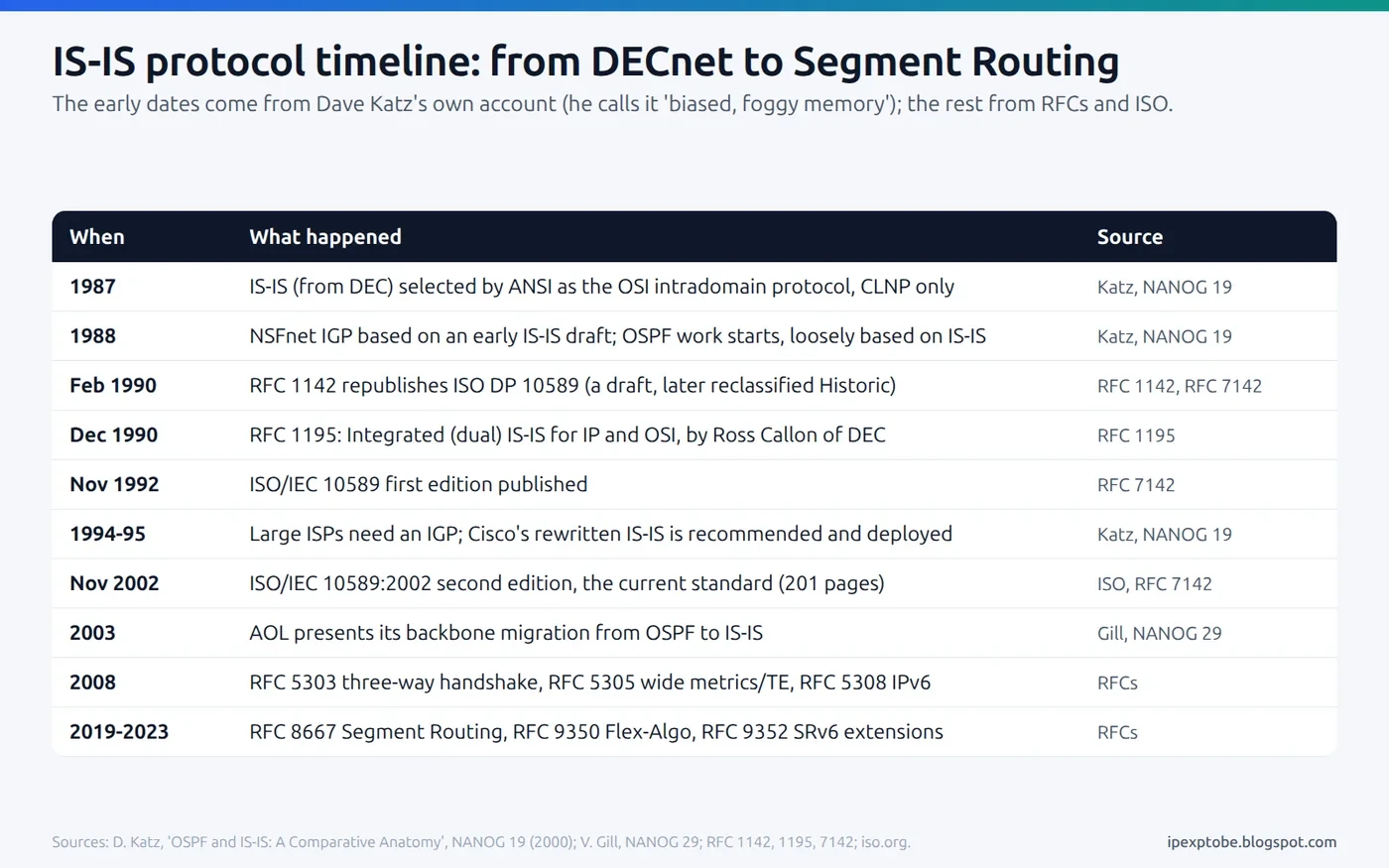
The most useful first-hand account of the early years is Dave Katz's talk OSPF and IS-IS: A Comparative Anatomy at NANOG 19 in June 2000. Katz worked on both protocols and calls his history slide "biased, foggy memory", so treat the exact years as approximate.[5] According to it:
- 1987: IS-IS, a protocol from Digital Equipment Corporation (DEC), is selected by ANSI as the OSI intradomain routing protocol, for CLNP only.
- 1988: the NSFnet is deployed with an IGP based on an early IS-IS draft. OSPF work begins, "loosely based on IS-IS mechanisms", and IP extensions to IS-IS are defined.
- 1989: OSPF version 1 is published and IS-IS becomes an ISO proposed standard. In Katz's words, after "public bickering" the IETF blessed both "as equals ..., with OSPF somewhat more equal".
- 1991-1992: Cisco ships OSPF and an OSI-only IS-IS, then dual IS-IS. "Lots of OSPF deployed, but very little IS-IS."
- 1994-1995: while shipping Novell's NLSP (an IPX copy of IS-IS) Cisco rewrites its IS-IS code. Large ISPs need an IGP, and IS-IS is recommended "due to recent rewrite and OSPF field experience". ISPs deploy it.
- 1996-1998: some ISPs switch from OSPF to IS-IS, and IS-IS becomes "a barrier to entry for router vendors targeting large ISPs". Juniper and others ship IS-IS.[5]
The documents tell the same story. RFC 1142 (February 1990) republished the ISO draft DP 10589 for the Internet community. RFC 7142 later moved it to Historic, because the draft "differed in a considerable number of significant respects" from the final ISO/IEC 10589 published in November 1992, and it kept being quoted by mistake. All references, RFC 7142 says, "should be to the latest edition", ISO/IEC 10589:2002, second edition.[3] ISO lists that edition as published in November 2002, 201 pages, and still confirmed.[1]
The IP side came from DEC as well: RFC 1195, Use of OSI IS-IS for Routing in TCP/IP and Dual Environments, was written by Ross Callon of DEC and published in December 1990.[2] Thirteen years later AOL presented at NANOG 29 how it moved its whole backbone from OSPF to IS-IS. The method is still a good template: load the IS-IS configuration next to OSPF, compare the IS-IS and OSPF routes and costs on every router, then raise OSPF's administrative distance to 254 and check that no OSPF route is left in the forwarding table.[6]
Integrated IS-IS: one protocol for IP and OSI (RFC 1195)
In 1990 routers had to carry IP and OSI traffic side by side. RFC 1195 describes the two options. The first, called "Ships in the Night", runs completely separate routing protocols for each protocol suite. The second, chosen by the IETF IS-IS working group, is a single integrated protocol: "the OSI IS-IS routing protocol, augmented with IP-specific information".[2]
The result is Integrated IS-IS (also called dual IS-IS). RFC 1195 defines three kinds of router: IP-only, OSI-only and dual. A single routing domain can mix them, with some topological limits.[2] The key point is in its own words: "This approach makes use of the existing IS-IS packets, with IP-specific fields added." In practice that means:
- each router lists the protocols it supports in a Protocols Supported field (TLV 129) using NLPIDs, where 0xCC means IPv4;
- its IP interface addresses are carried in Hellos and LSPs (TLV 132);
- internally reachable IP prefixes go into every LSP, and external prefixes into Level 2 LSPs (TLVs 128 and 130);
- authentication information "may be added to all IS-IS packets".[2][7]
Both IP and OSI packets keep being forwarded "as is", without encapsulating one inside the other.[2] When engineers say "IS-IS" today they mean Integrated IS-IS, and almost always in IP-only mode. Cisco's guide states it plainly: "this module ... use[s] the term IS-IS to refer to the Integrated IS-IS".[13]
The locomotive and its wagons
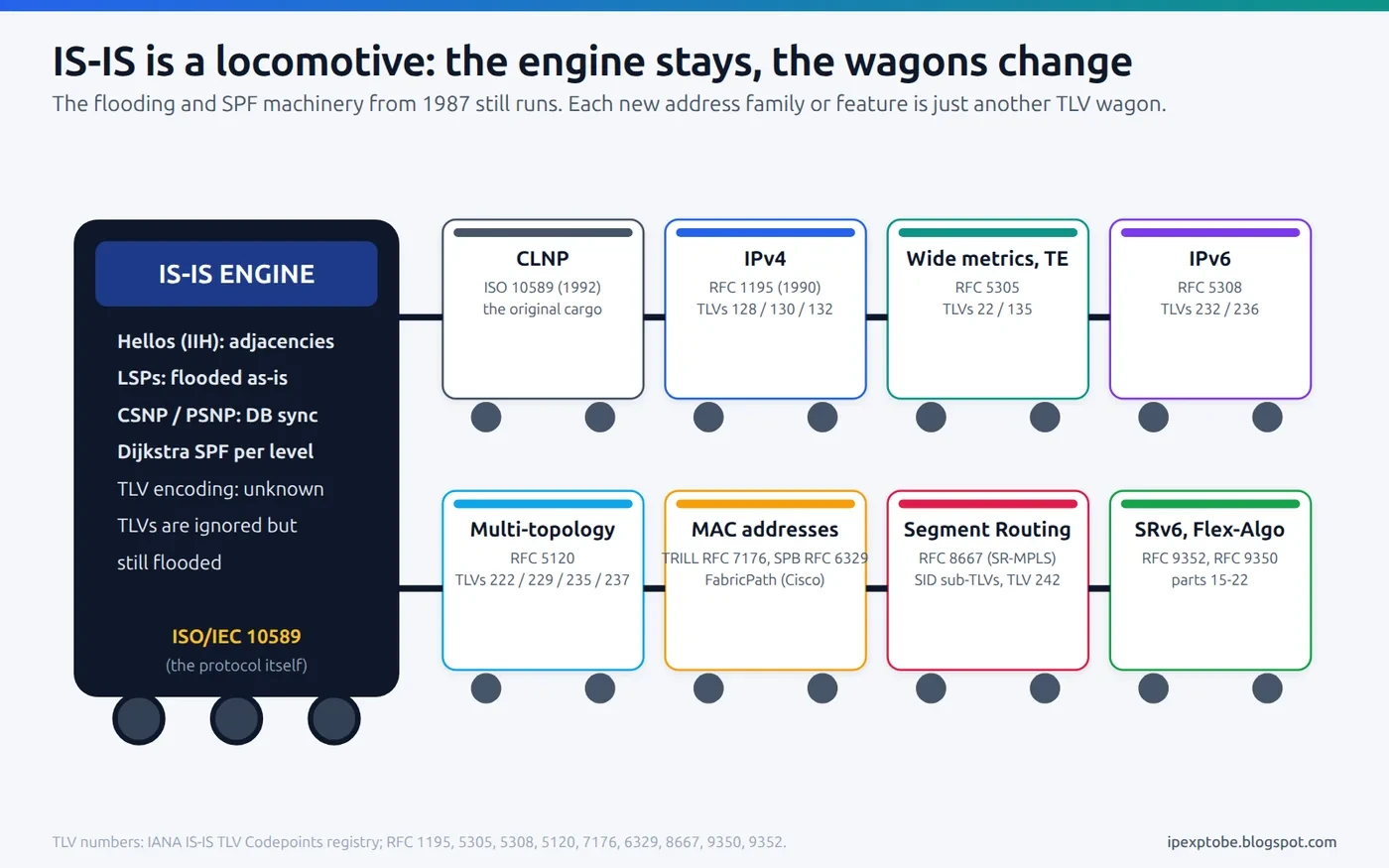
Pat, who runs this blog, likes to describe IS-IS as a locomotive. The engine is the protocol machinery: hellos, reliable flooding, sequence-number PDUs and SPF. The wagons are whatever the network needs to carry. The engine does not care what is inside a wagon.
That is not just a metaphor; it is how the packets are built. After a short fixed header, almost every IS-IS PDU is a list of Type-Length-Value fields: one byte of type, one byte of length, then the value. Katz lists the consequences: "Extensible from the start (unknown types ignored but still flooded)", and "All packet types are extensible".[5] A router that does not understand a TLV skips it using the length byte, and it still passes the whole LSP on untouched. New features therefore spread through a network even before every router understands them. Cisco's own troubleshooting note puts it the same way: "The real power of IS-IS lies in its use of Type-Length-Value (TLVs) which makes IS-IS highly extensible protocol."[14]
The IANA registry of IS-IS TLV codepoints is the list of wagons. Some examples:[7]
| Wagon (cargo) | Main TLVs | Defined in | Series part |
|---|---|---|---|
| OSI / CLNP basics: areas, neighbours, padding, LSP entries, authentication | 1, 2, 6, 8, 9, 10 | ISO 10589 | 1-2 |
| IPv4 (original "narrow" form) | 128, 129, 130, 132 | RFC 1195 | 1, 3 |
| Wide metrics and traffic engineering | 22, 135 | RFC 5305 | 3, 6 |
| IPv6 | 232, 236 | RFC 5308 | 5 |
| Multi-topology (separate IPv4/IPv6 topologies) | 222, 229, 235, 237 | RFC 5120 | 5 |
| Point-to-point three-way handshake | 240 | RFC 5303 | 2 |
| Router capabilities (where SR data lives) | 242 | RFC 7981 | 3, 11 |
| MAC addresses for TRILL and Shortest Path Bridging | TRILL and SPB sub-TLVs | RFC 7176, RFC 6329 | 9 |
| Segment Routing (Prefix-SID, Adjacency-SID ...) | sub-TLVs of 22/135/236, 242 | RFC 8667 | 11-18 |
| Multiple IS-IS instances on one link | 7 | RFC 8202 | - |
Compare that with OSPF. IPv6 needed a new protocol version, OSPFv3, and OSPFv2 extensions such as traffic engineering are carried in Opaque LSAs (RFC 5250).[11] In IS-IS, IPv6 was simply two more TLVs and a new NLPID, 0x8E.[10] Juniper's documentation notes the practical result: "Because IS-IS uses ISO addresses, the configuration of IP version 6 (IPv6) and IP version 4 (IPv4) implementations of IS-IS is identical."[12]
Why IS-IS runs on layer 2, and why that matters
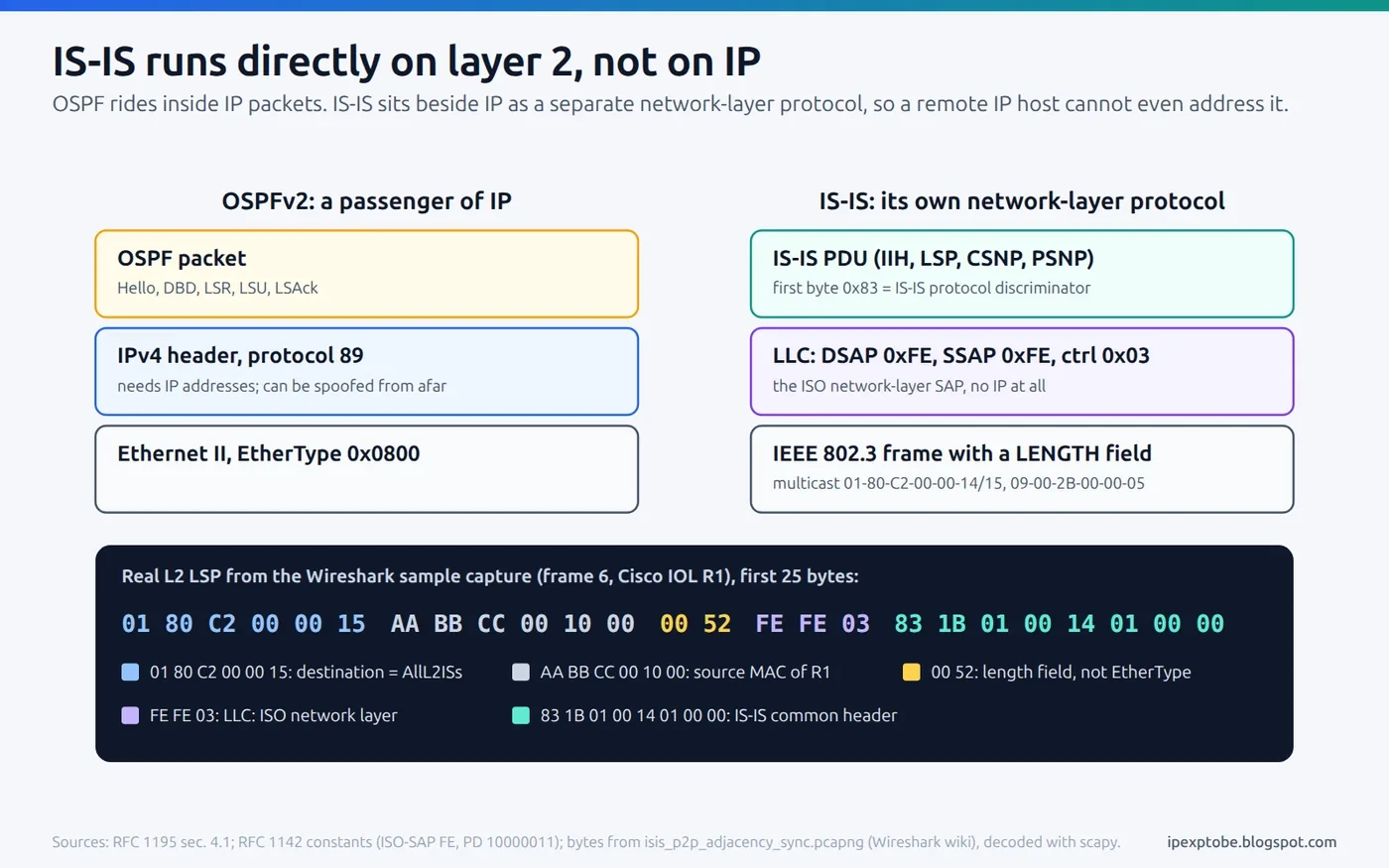
OSPF packets are IP packets with protocol number 89. IS-IS packets are not IP packets at all. RFC 1195 says that "IS-IS packets are encapsulated using the normal method for transmission of OSI packets over any particular link type", and that even IP-only routers must accept that encapsulation.[2] On Ethernet that means an IEEE 802.3 frame with a length field instead of an EtherType, followed by an LLC header with DSAP and SSAP 0xFE, the SAP of the ISO network layer.[4]
The architectural constants published with the draft standard (RFC 1142) list the addresses and values you see in every capture:[4]
01-80-C2-00-00-14= AllL1ISs (Level 1 LAN hellos, LSPs and SNPs)01-80-C2-00-00-15= AllL2ISs (Level 2)09-00-2B-00-00-05= AllIntermediateSystems (used by ISO 9542, and by point-to-point hellos)- Intradomain routing protocol discriminator
10000011= 0x83, the first byte of every IS-IS PDU - ReceiveLSPBufferSize 1492: every IS must accept LSPs of this size; MaxAge 1200 seconds; sequence numbers modulo 232
Our real capture (details below) matches all of them: hellos go to 09:00:2b:00:00:05, Level 2 LSPs and SNPs to 01:80:c2:00:00:15, the LLC header is FE FE 03, and the first IS-IS byte is 0x83.[16]
Three practical consequences follow:
- No IP needed to bring the protocol up. IS-IS adjacencies and flooding do not depend on IP reachability between the routers. That makes IS-IS a natural foundation for a network whose job is to build IP reachability in the first place.
- A smaller attack surface. An IS-IS PDU has no network-layer header that a router could forward, so it cannot be sent to a router from a remote network. Katz contrasts this with OSPF, which runs on IP and is "subject to spoofing and DoS attacks (use of authentication is strongly advised)".[5] You still want IS-IS authentication on every link (part 8), but the threat is local.
- LSPs are flooded intact. IS-IS never fragments or rebuilds an LSP in transit. Katz: LSPs are "always flooded intact, unchanged across all flooding hops (so LSP MTU is an architectural constant - it must fit across all links)".[5] That is why hellos may be padded to the full MTU (more on that in the capture section) and why every router must accept at least 1492-byte LSPs.
IS-IS levels and areas
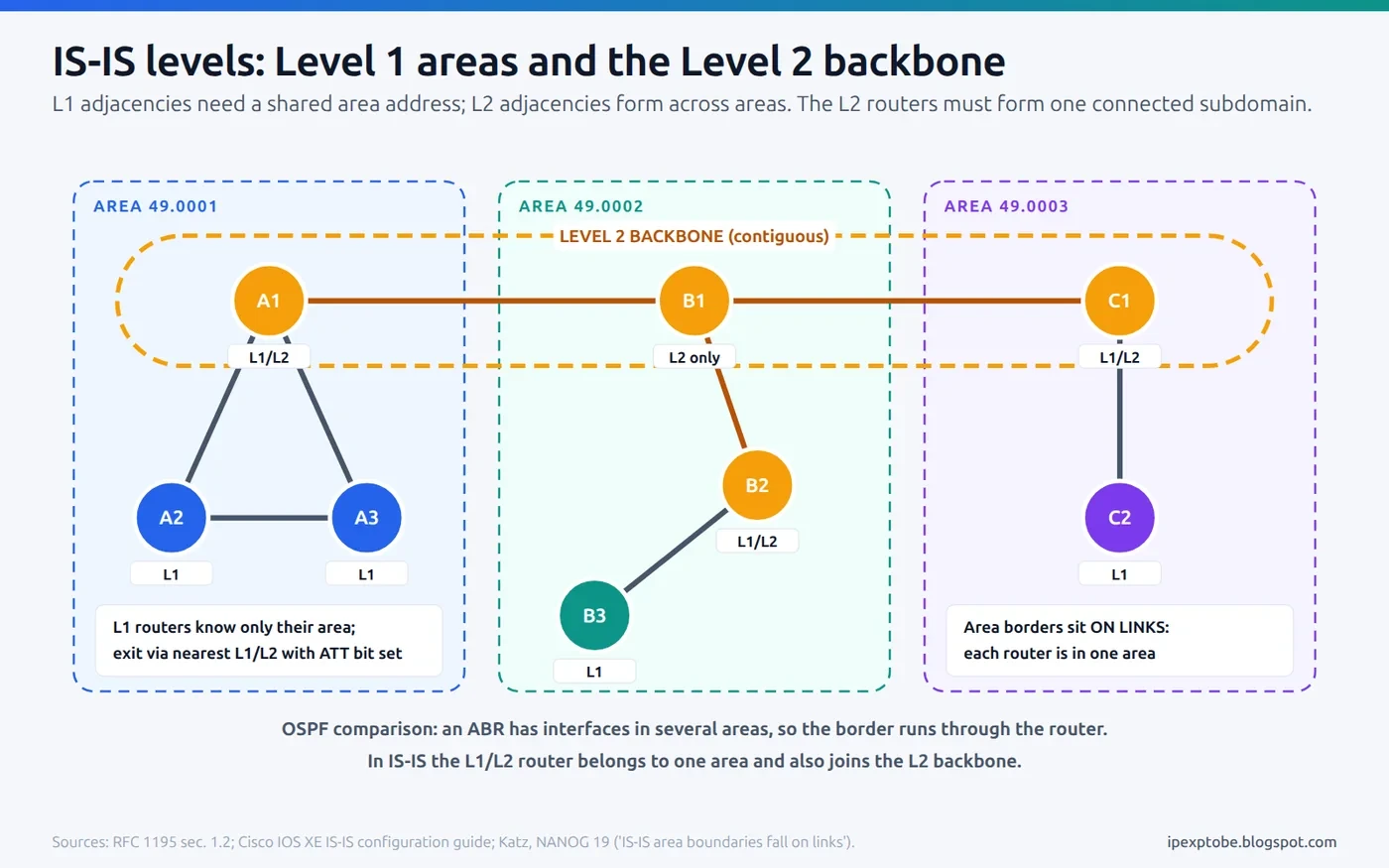
IS-IS uses a two-level hierarchy. RFC 1195 describes it like this: "Level 1 routers know the topology in their area, including all routers and end systems in their area. However, level 1 routers do not know the identity of routers or destinations outside of their area." They send traffic for other areas to a Level 2 router in their own area. "Level 2 routers know the level 2 topology, and know which addresses are reachable via each level 2 router."[2]
Three router types follow from this:
- Level 1 (L1): intra-area only, comparable to a router inside a totally stubby OSPF area.
- Level 2 (L2): backbone only.
- Level 1/Level 2 (L1/L2): takes part in its own area and in the backbone, a bit like an OSPF ABR. Junos enables both levels by default,[12] and Cisco's lab examples show routers running as level-1-2 until a level is configured.[14]
The adjacency rules are where IS-IS differs most from OSPF:[2]
- A Level 1 router "will refuse to become a neighbor with a node whose area addresses do not overlap its area addresses". One shared area address is enough.
- "A level 2 router will accept another level 2 router as a neighbor, regardless of area address." If the areas do not overlap, the link is level-2-only.
- The set of Level 2 routers must be connected. "Should the level 2 backbone become partitioned, there is no provision for use of level 1 links to repair a level 2 partition." Cisco's guide repeats it: the Level 2 subdomain "must not be partitioned in order for routing to work properly".[13] There are no virtual links as in OSPF.
- An L1/L2 router that has lost contact with the backbone says so in its Level 1 LSPs by clearing the attached (ATT) bit. Level 1 routers only send inter-area traffic to L2 routers that report themselves as attached, which in practice means they install a default route towards the nearest attached L1/L2 router (Cisco's example shows exactly such an
i*L1 0.0.0.0/0route on a Level 1 router).[14]
Katz points out the structural difference behind all this: in OSPF, "area boundaries fall within a router" (interfaces belong to areas, and a router may be in many areas), while in IS-IS "area boundaries fall on links" and a router "is in only one area, plus perhaps the L2 backbone".[5] His other remark from 2000 still describes most providers today: "Little or no multilevel deployment (large flat areas work so far)." Many ISPs run a single Level 2 domain and never configure Level 1 at all. Part 4 of this series covers multi-area design and route leaking.
One more design detail survives from OSI: a router may have several area addresses at once (up to three by default; the Maximum Area Addresses header field set to 0 means 3).[14] RFC 1195 lists the reasons: renumbering an area, merging two areas and splitting one, all without an outage, by letting routers know both the old and the new address for a while.[2]
NET addresses explained
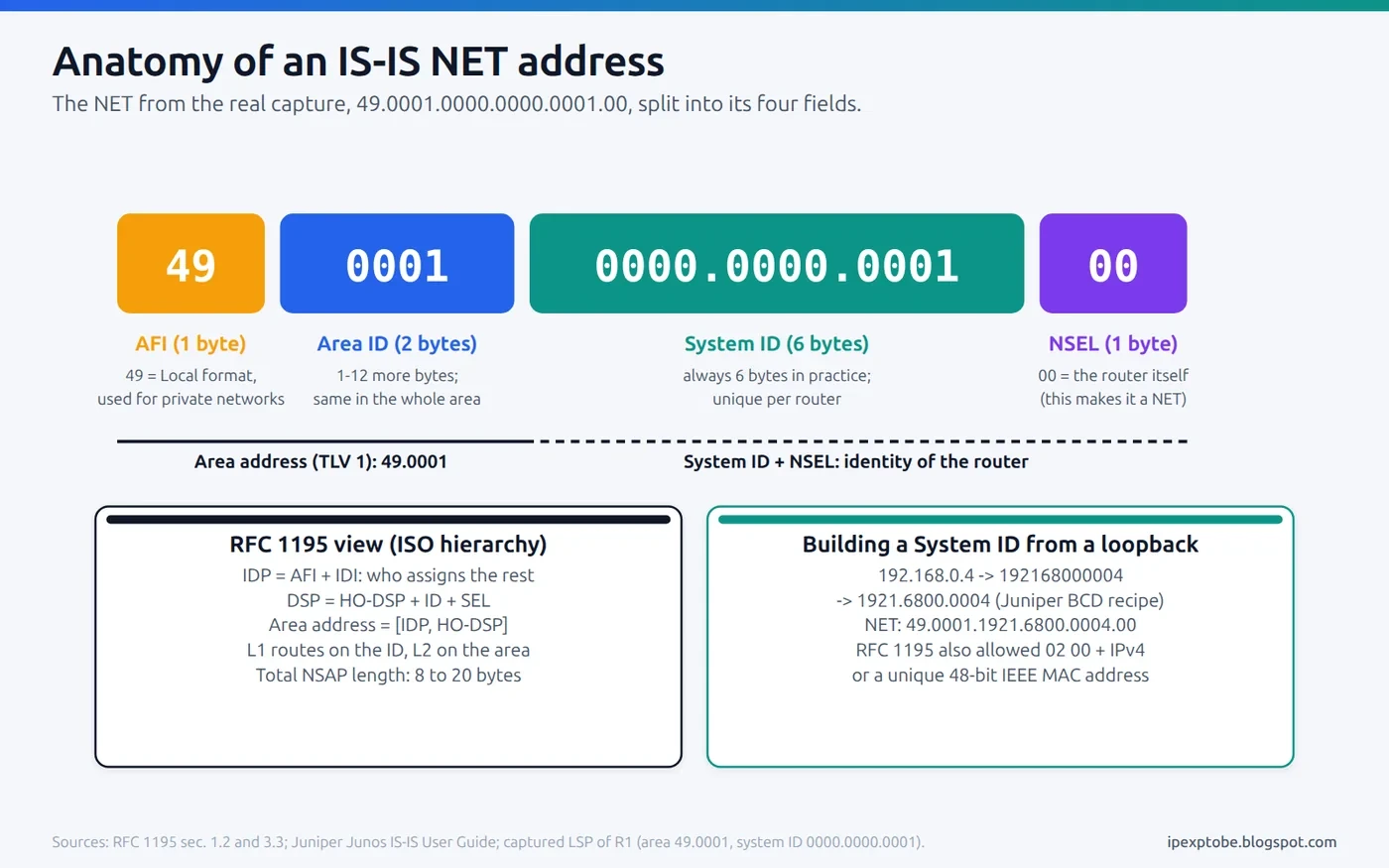
Even on an IP-only network every IS-IS router needs an OSI-style address. RFC 1195: "It is therefore necessary for all routers making use of the IS-IS protocol to have OSI style addresses assigned. For IP-only routers, these addresses will be used only in the operation of the IS-IS protocol."[2]
The address is an NSAP (Network Service Access Point). ISO splits it into an Initial Domain Part (IDP: AFI and IDI, which say who assigns the rest) and a Domain Specific Part (DSP: high-order DSP, system ID and selector).[2] For a router the selector is 00, and the address is then called a Network Entity Title (NET). Juniper's guide gives the practical rules:[12]
- A NET is 8 to 20 bytes long and written in hexadecimal.
- The area address is 1 to 13 bytes: the AFI plus 0 to 12 bytes of area ID.
- The system ID is the next 6 bytes and "must be unique within the network".
- The last byte, the NSEL, is 00.
In the header of every PDU the field "ID Length" is set to 0, which by definition means a 6-byte system ID.[4] Our capture shows exactly that.[16]
Why almost every NET starts with 49
AFI 49 is the "Local" address format. DEC's own DECnet-Plus planning guide explains: "An AFI value of 49 indicates a private network, one that is not interconnected with other OSI networks and, therefore, does not need a globally unique IDP."[17] Since IS-IS NETs never leave your own routing domain, 49 is the sensible choice, the OSI equivalent of RFC 1918 space. RFC 1195 also defined a longer format for IP-only routers based on the US GOSIP address plan (AFI 47, ICD 0005, with the AS number inside), but it is rarely seen today.[2]
Choosing a system ID
RFC 1195 recommended either a unique 48-bit IEEE MAC address or the value 02 00 followed by the router's IPv4 address.[2] Most operators now encode the loopback address in decimal: Juniper's recipe turns router ID 192.168.0.4 into the 12-digit string 192168000004, inserts dots every four digits and gets 1921.6800.0004, so the NET in area 47 becomes 47.1921.6800.0004.00. Juniper also notes that in production you may prefer a hardware-derived ID.[12] Whatever you choose, it must be unique: a duplicate system ID is one of the nastiest IS-IS faults, because the two routers keep overwriting each other's LSPs.
Configuration on three platforms
The same minimal setup (one Level 2 domain, wide metrics, a point-to-point core link, a passive loopback) on three platforms. These are configuration examples written from the vendors' documented syntax, not output from our lab.
Cisco IOS XR
router isis CORE
 is-type level-2-only
 net 49.0001.0000.0000.0001.00
 address-family ipv4 unicast
  metric-style wide
 !
 interface Loopback0
  passive
  address-family ipv4 unicast
  !
 !
 interface HundredGigE0/0/0/0
  point-to-point
  address-family ipv4 unicast
  !
 !
!
Juniper Junos (the NET goes on lo0, and every IS-IS interface needs family iso, otherwise "valid IS-IS packets are dropped"):[12]
set interfaces lo0 unit 0 family inet address 192.0.2.1/32
set interfaces lo0 unit 0 family iso address 49.0001.0000.0000.0001.00
set interfaces et-0/0/0 unit 0 family iso
set protocols isis level 1 disable
set protocols isis interface et-0/0/0.0 point-to-point
set protocols isis interface lo0.0 passive
FRRouting (wide metrics are already FRR's default, and the RFC 5303 three-way handshake is on by default):[15]
router isis CORE
 net 49.0001.0000.0000.0001.00
 is-type level-2-only
 metric-style wide
!
interface eth0
 ip router isis CORE
 isis network point-to-point
!
Inside a real IS-IS adjacency, decoded byte by byte
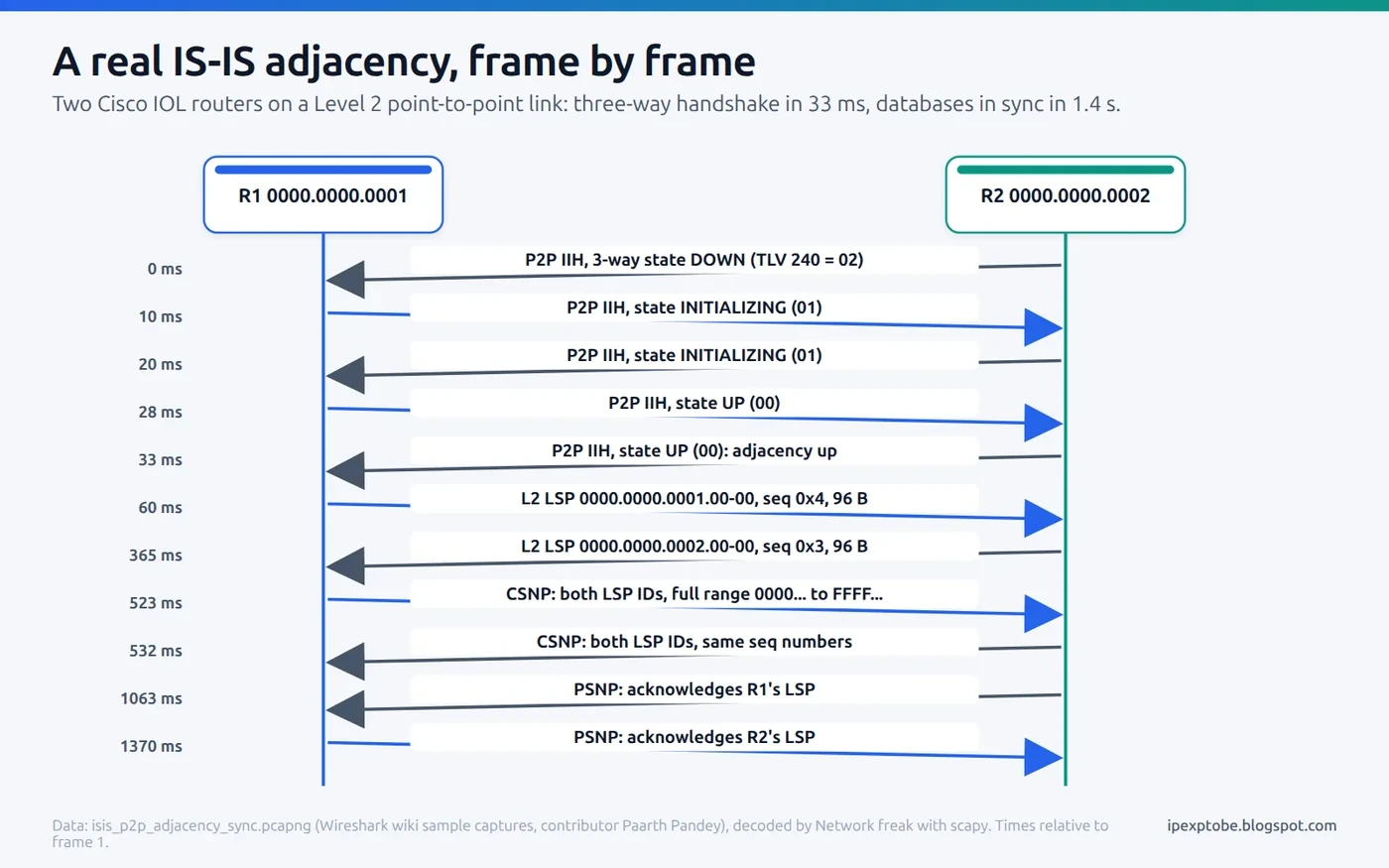
To see the architecture at work we took the sample capture isis_p2p_adjacency_sync.pcapng from the Wireshark wiki. Its description: "Pristine IS-IS Level-2 Point-to-Point adjacency synchronization between two Cisco IOL routers", triggered by a process reset.[16] We decoded all 15 frames with Python and scapy's IS-IS dissector (scapy.contrib.isis). The routers are R1 (system ID 0000.0000.0001, loopback 1.1.1.1) and R2 (0000.0000.0002, 2.2.2.2) in area 49.0001, connected by 10.0.0.0/30.
Step 1: the three-way handshake
The original ISO point-to-point hello had no proof that the neighbour could hear us. RFC 5303 fixed that with TLV 240, the Point-to-Point Three-Way Adjacency TLV, whose first byte is the state: 0 = Up, 1 = Initializing, 2 = Down.[8] Here is what the routers sent (raw TLV bytes in brackets):
frame  time    sender  TLV 240         meaning
  1    0 ms    R2      f0 01 02        Down: I hear nobody yet
  2   10 ms    R1      f0 01 01        Initializing: I hear you
  3   20 ms    R2      f0 01 01        Initializing
  4   28 ms    R1      f0 01 00        Up
  5   33 ms    R2      f0 01 00        Up: adjacency established
Five hellos and 33 milliseconds. Each hello also carries TLV 129 (protocols supported: IPv4), TLV 1 (area 49.0001), TLV 132 (the interface address, 10.0.0.1 or 10.0.0.2) and TLV 211, the Restart TLV used for graceful restart (RFC 8706).[16][7] The holding time is 30 seconds.
Step 2: hello padding, the MTU check
Each hello frame is 1,513 bytes on the wire, although the useful content fits in about 60. The PDU length field says 1,496 bytes, and 1,453 of them are six Padding TLVs (type 8), five of 255 bytes and one of 166.[16] The ISO standard asks for hellos padded to the maximum size so that an adjacency cannot come up over a link that would later drop full-size LSPs.[4] Katz was not a fan: padding "is effectively useless and causes needless support calls (deprecated in practice)".[5] The routers in this 2026 capture still pad by default, so check your platform before you assume otherwise.
Step 3: the LSP, a train of TLVs
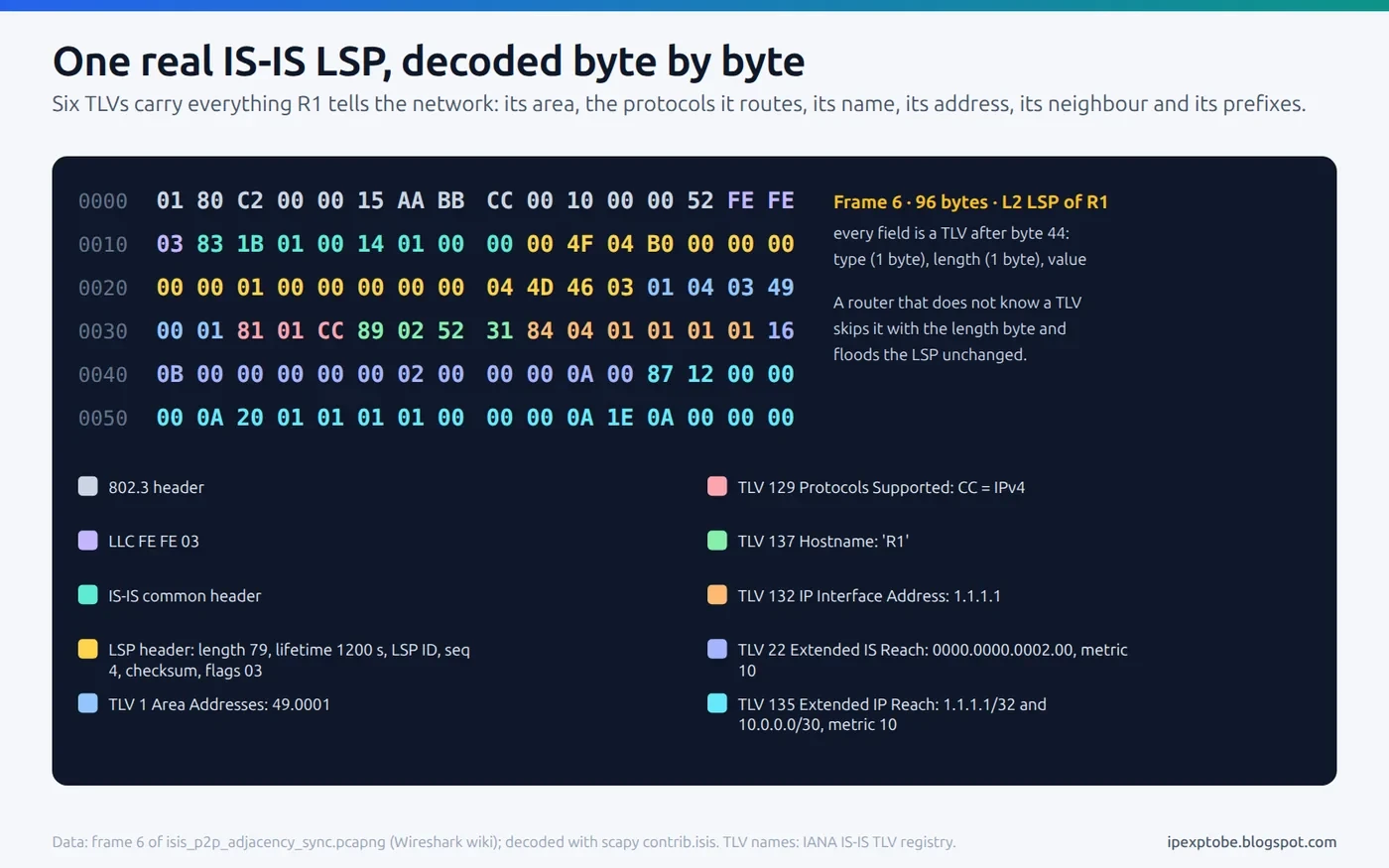
27 ms after the adjacency is up, each router floods its own LSP. R1's LSP has the ID 0000.0000.0001.00-00: system ID, pseudonode number 00 (a real router, not a LAN pseudonode) and fragment number 00. Its sequence number is 0x4 and its remaining lifetime 1200 seconds, the MaxAge constant.[4][16] The last header byte, 0x03, carries the IS Type bits: 3 means the originator is a Level 2 intermediate system. Then come six wagons:
| TLV | Bytes on the wire | Meaning |
|---|---|---|
| 1 Area Addresses | 01 04 03 49 00 01 | one area, 3 bytes long: 49.0001 |
| 129 Protocols Supported | 81 01 CC | NLPID 0xCC = IPv4 |
| 137 Dynamic Hostname | 89 02 52 31 | "R1" (RFC 5301) |
| 132 IP Interface Address | 84 04 01 01 01 01 | 1.1.1.1 |
| 22 Extended IS Reachability | 16 0B 00 00 00 00 00 02 00 00 00 0A 00 | neighbour 0000.0000.0002.00, 24-bit metric 10, no sub-TLVs |
| 135 Extended IP Reachability | 87 12 ... | 1.1.1.1/32 and 10.0.0.0/30, 32-bit metric 10 each |
TLVs 22 and 135 are the "wide metric" wagons from RFC 5305: three bytes of metric per link instead of the original six bits, whose maximum was 63 per link and 1023 per path.[9][4] This is a whole router description in 52 bytes of TLVs, which is why IS-IS databases stay small. Katz noted that an IS-IS router's LSP set is limited to 256 fragments of about 1470 bytes, and called that "ultimately a non-issue for even slightly sane topologies".[5]
Step 4: synchronising the databases
About half a second later each router sends a CSNP covering the whole LSP ID range from 0000.0000.0000.00-00 to FFFF.FFFF.FFFF.FF-FF. It lists every LSP it holds with sequence number, lifetime and checksum (here both LSPs, seq 0x4 and 0x3). Each router then acknowledges the LSP it received with a PSNP: R2 at 1,063 ms for R1's LSP, R1 at 1,370 ms for R2's. On point-to-point links a PSNP is the acknowledgement; on LANs the Designated IS sends periodic CSNPs instead, and routers use PSNPs to ask for what they are missing.[16][13] Part 2 of the series covers flooding and the DIS in detail.
Why service providers love the IS-IS protocol
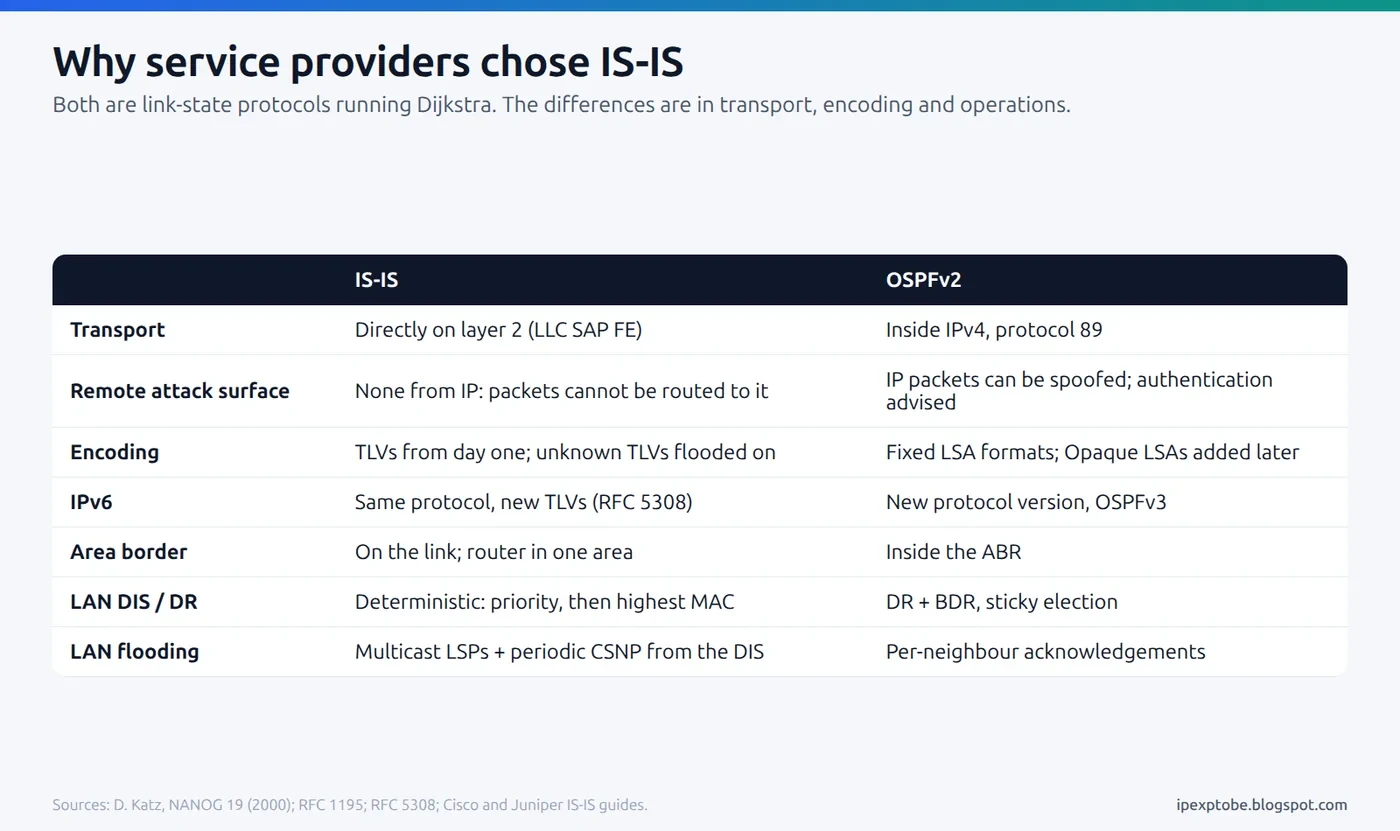
Both protocols run Dijkstra on a link-state database, and Katz's conclusion from 2000 is still the honest one: "For all but extreme cases ..., protocols are pretty much equivalent in scalability and functionality", and "stability and scalability are largely artifacts of implementation, not protocol design".[5] So why did providers end up on IS-IS?
- Timing. When large ISPs needed an IGP in 1994-95, Cisco had just rewritten its IS-IS, and IS-IS was recommended, in Katz's words, "due to recent rewrite and OSPF field experience". Once the biggest networks ran it, vendors that wanted to sell to them had to follow.[5]
- Extensibility, politically and technically. "Despite anti-OSI FUD, IS-IS has proven much easier politically to extend (primarily due to small constituency and IETF disinterest)." Vendors and large ISPs could add what they needed quickly.[5] The TLV format made it easy: traffic engineering, IPv6, multi-topology and Segment Routing are all new TLVs.[7]
- One protocol for IPv4 and IPv6. No second protocol version and no second database to operate.[10][12]
- Not reachable over IP. The control plane cannot be targeted from outside the link.[5]
- Simple area model. Large flat Level 2 domains work, so many providers never deal with multi-area design at all.[5]
- Deterministic DIS. On LANs the Designated IS is always the highest priority, then the highest MAC address, so the result never depends on boot order. IS-IS also needs no Backup DR, because every router on the LAN is adjacent to every other.[4][5]
The list has a flip side. Katz also wrote that "OSPF is much more widely understood", with more books and a far larger enterprise user base, while IS-IS is "well understood within a niche".[5] That niche happens to run the cores of very large networks, and it is where Segment Routing, Flex-Algo and SRv6 were born, as the second half of this series will show.
If you want the interview-level comparison first, our OSPF vs IS-IS explained post covers the basics, and IS-IS in service provider networks covers day-to-day design and operations. For OSPF background see OSPF neighbor states explained.
Common mistakes and how to check for them
| Symptom | Likely cause | What to check |
|---|---|---|
| Level 1 adjacency never comes up, Level 2 does | no shared area address (L1 needs one; L2 does not) | area addresses in the received hello (TLV 1) |
| No adjacency at all on a link | circuit-type mismatch (one side L1-only, the other L2-only), or interface type mismatch (point-to-point vs broadcast) | circuit type in the hello header, interface configuration on both ends |
| Adjacency does not form over one particular link | padded hellos are larger than that link's MTU (the padding check doing its job) | PDU length in the received hello vs the MTU on both ends |
| Routes flapping, LSP sequence numbers racing upwards | duplicate system ID: two routers overwrite each other's LSP | uniqueness of the NETs, the hostname behind each LSP ID |
| Some routers ignore prefixes from others | narrow vs wide metrics mismatch (TLV 128/2 vs 135/22) | metric style on all routers; use a transition mode during migration |
| Junos router silently drops IS-IS | family iso missing on the interface[12] | interface families |
| Inter-area traffic blackholed | partitioned Level 2 backbone; IS-IS has no virtual links[2] | L2 adjacency map, ATT bit of the L1/L2 routers |
Useful commands: on IOS XR show isis adjacency, show isis database verbose and show isis hostname; on Junos show isis adjacency, show isis database extensive and show isis hostname;[12] on FRR show isis neighbor and show isis database detail. And when in doubt, capture: as you saw above, a single LSP tells you the area, protocols, hostname, neighbours and prefixes of a router in under 100 bytes. If you derive system IDs from MAC addresses, our MAC address converter prints the dotted format IS-IS uses.
FAQ
Is IS-IS a layer 2 or a layer 3 protocol?
IS-IS is a network-layer (layer 3) routing protocol, but it does not run on top of IP. Its packets are carried directly in layer-2 frames (on Ethernet: 802.3 with LLC SAP 0xFE), next to IP rather than inside it. That is why people often say it 'runs on layer 2'.
Do I need CLNP or OSI to run IS-IS today?
No. Since RFC 1195 an IP-only router can run Integrated IS-IS. You still need a NET (an OSI-style address) on every router, because the protocol uses it to identify the router and its area, but no CLNP traffic is forwarded.
What does 49.0001.0000.0000.0001.00 mean?
49 is the AFI of the Local (private) format, 0001 is the area, 0000.0000.0001 is the 6-byte system ID that must be unique in the domain, and 00 is the NSEL, which marks the address as the router itself (a NET).
What is the difference between Level 1 and Level 2 in IS-IS?
Level 1 routers know the full topology of their own area only and send everything else to the nearest attached Level 1/Level 2 router. Level 2 routers form the backbone between areas and must be contiguous. A router can do both (L1/L2).
Why do service providers prefer IS-IS over OSPF?
History and operations more than raw capability: large ISPs adopted Cisco's rewritten IS-IS in the mid-1990s, it runs outside IP so it cannot be attacked with routed IP packets, its TLV format made extensions such as IPv6, traffic engineering and Segment Routing easy to add, and one protocol carries both IPv4 and IPv6.
Is IS-IS still relevant in 2026?
Yes. Segment Routing (RFC 8667), Flex-Algo (RFC 9350) and SRv6 (RFC 9352) were all defined for IS-IS, and the protocol also forms the control plane of TRILL and IEEE 802.1aq Shortest Path Bridging.
Series hub: IS-IS, Segment Routing, SRv6 and SD-WAN Deep Dive: The Complete Guide (2026)
Previous: —
Next: IS-IS Adjacencies, LSP Flooding, DIS and SPF: How the Protocol Actually Works (coming soon)
References (all read on 25 November 2026)
[1] ISO, "ISO/IEC 10589:2002 Intermediate System to Intermediate System intra-domain routeing information exchange protocol ...," 2nd edition, November 2002.
[2] R. Callon (DEC), "RFC 1195: Use of OSI IS-IS for Routing in TCP/IP and Dual Environments," December 1990.
[3] M. Shand, L. Ginsberg, "RFC 7142: Reclassification of RFC 1142 to Historic," February 2014.
[4] D. Oran (ed.), "RFC 1142: OSI IS-IS Intra-domain Routing Protocol," February 1990 (republication of ISO DP 10589, now Historic; used here for the architectural constants).
[5] D. Katz (Juniper), "OSPF and IS-IS: A Comparative Anatomy," NANOG 19, June 2000.
[6] V. Gill (AOL), "OSPF to ISIS," NANOG 29, 2003.
[7] IANA, "IS-IS TLV Codepoints" registry.
[8] D. Katz, R. Saluja, D. Eastlake, "RFC 5303: Three-Way Handshake for IS-IS Point-to-Point Adjacencies," October 2008.
[9] T. Li, H. Smit, "RFC 5305: IS-IS Extensions for Traffic Engineering," October 2008.
[10] C. Hopps, "RFC 5308: Routing IPv6 with IS-IS," October 2008.
[11] RFC 5120 (Multi-Topology Routing in IS-IS), RFC 7981 (Router CAPABILITY TLV), RFC 8202 (Multi-Instance), RFC 5301 (Dynamic Hostname), RFC 7176 (TRILL use of IS-IS), RFC 6329 (IS-IS for 802.1aq SPB), RFC 8667 (IS-IS Extensions for Segment Routing), RFC 9350 (Flex-Algo), RFC 9352 (SRv6), RFC 8706 (Restart TLV), RFC 5250 (OSPF Opaque LSA), all at rfc-editor.org.
[12] Juniper Networks, "Junos OS IS-IS User Guide."
[13] Cisco, "IP Routing: ISIS Configuration Guide - IS-IS Overview and Basic Configuration," IOS XE.
[14] Cisco, "Configure IS-IS Adjacency and Area Types," document 200293.
[15] FRRouting, "ISIS (isisd) documentation."
[16] Wireshark wiki, "Sample Captures": isis_p2p_adjacency_sync.pcapng (contributor Paarth Pandey), decoded by Network freak with scapy on 25 November 2026.
[17] HP/DEC, "DECnet-Plus Planning Guide: addressing."
Figures 1-8: Network freak, drawn from the sources above and from our own decode of the capture.
Try it: MAC Address Converter and EUI-64 Calculator - free, runs in your browser.
Related reading
- IS-IS in Service Provider Networks: Design and Operations Guide
- OSPF vs IS-IS Explained: Areas, Levels and Interview Answers
- FabricPath Explained: IS-IS, Conversational MAC Learning and Multidestination Trees
- Segment Routing: Why It Matters and Why It's Worth the Migration
- OSPF Neighbor States Explained: Down to Full, Stuck-State Troubleshooting and Verification


Comments
Post a Comment