ChatGPT vs Claude in November 2026: GPT-6 vs Claude Fable 5.2 Compared
Checked against vendor documentation on 12 November 2026. This is a comparison of published prices, limits and vendor claims. No benchmark was run for this article. Disclosure: the text was drafted with AI assistance (Claude Fable 5.2, one of the models compared) and every figure was checked against the linked pages.
“ChatGPT or Claude?” sounds like one question. In November 2026 it is at least five: which model, in which app or API, with which tools, on which plan, under which data policy. OpenAI sells four general-purpose GPT-6 models and Anthropic sells four current Claude models, and the price gap inside each family is 80x to 100x. Comparing brands hides all of that.
This article compares the eight models on what is documented: list prices, long-prompt rules, limits, discounts and the benchmark table Anthropic published with Claude Fable 5.2. It ends with a shortlist per workload and a test plan you can run yourself.
- Claude Fable 5.2 lists at $8 / $40 per million tokens and GPT-6 Astra at $10 / $50. The mid-tier models GPT-6.1 Sol and Claude Sonnet 5.5 are both $2 / $10.
- GPT-6 models double the input price above 272,000 input tokens. Claude models stay flat to 1 million tokens, except Haiku 5.5 above 100,000.
- Context window and output limits are effectively the same on all eight models.
- Anthropic's launch benchmarks favour Fable 5.2 on most tests, but they are vendor-reported and Gemini 4 Carbon leads one of them.
- Pick two candidates per workload and measure cost per accepted result, not price per token.
The two line-ups: eight models, not two brands · API pricing in November 2026 · Long prompts change the ranking · The modifiers: caching, batch and fast modes · Context, output and other limits · What the vendor benchmarks say, and what they do not · Apps, subscriptions and API credit · Integration differences that affect a comparison · Which models to test first · How to run a fair test
1. The two line-ups: eight models, not two brands
OpenAI's API catalogue describes GPT-6 Astra as “our most capable model for the most demanding work”, GPT-6.1 Sol as “near-Astra performance for complex work at a lower cost”, GPT-6.1 Terra as a fast model for visual reasoning, computer use and writing, and GPT-6 Luna as its most efficient model for focused, high-volume tasks.[1][2][3][4]
Anthropic's line-up is Claude Fable 5.2 for demanding reasoning and long-horizon agentic work, Claude Opus 5.5 for long-running agentic coding and knowledge work, Claude Sonnet 5.5 as “the best combination of speed and intelligence”, and Claude Haiku 5.5 for high-volume, latency-sensitive tasks.[5] Fable 5.2 was released on 9 November 2026.[6]

Two details matter before any comparison:
- Anthropic does not tell you to start with its most expensive model. Its documentation says to start with Opus 5.5 for most workloads and to move to Fable 5.2 only when evaluations on Opus at higher effort still fall short.[5][7]
- Both vendors have a restricted security model. GPT-6-Cyber requires organisation approval, and Claude Mythos 5.2 is available only to organisations verified through Anthropic's programmes.[8][6] Neither is an upgrade path for everyday work. We covered the OpenAI side in GPT-6 Cyber red teaming: safe scopes, monitoring and human approval.
2. API pricing in November 2026
The table lists standard, synchronous API prices in US dollars per million tokens, before caching, batch discounts, faster modes, regional processing or tool charges.[1][2][3][4][5][9]
| Model | API model ID | Input / 1M | Output / 1M | Context |
|---|---|---|---|---|
| GPT-6 Astra | gpt-6-astra | $10 | $50 | 1,050,000 |
| GPT-6.1 Sol | gpt-6.1-sol | $2 | $10 | 1,050,000 |
| GPT-6.1 Terra | gpt-6.1-terra | $1 | $5 | 1,050,000 |
| GPT-6 Luna | gpt-6-luna | $0.10 | $0.50 | 1,050,000 |
| Claude Fable 5.2 | claude-fable-5-2 | $8 | $40 | 1,000,000 |
| Claude Opus 5.5 | claude-opus-5-5 | $4 | $20 | 1,000,000 |
| Claude Sonnet 5.5 | claude-sonnet-5-5 | $2 | $10 | 1,000,000 |
| Claude Haiku 5.5 | claude-haiku-5-5 | from $0.10 | from $0.50 | 1,000,000 |
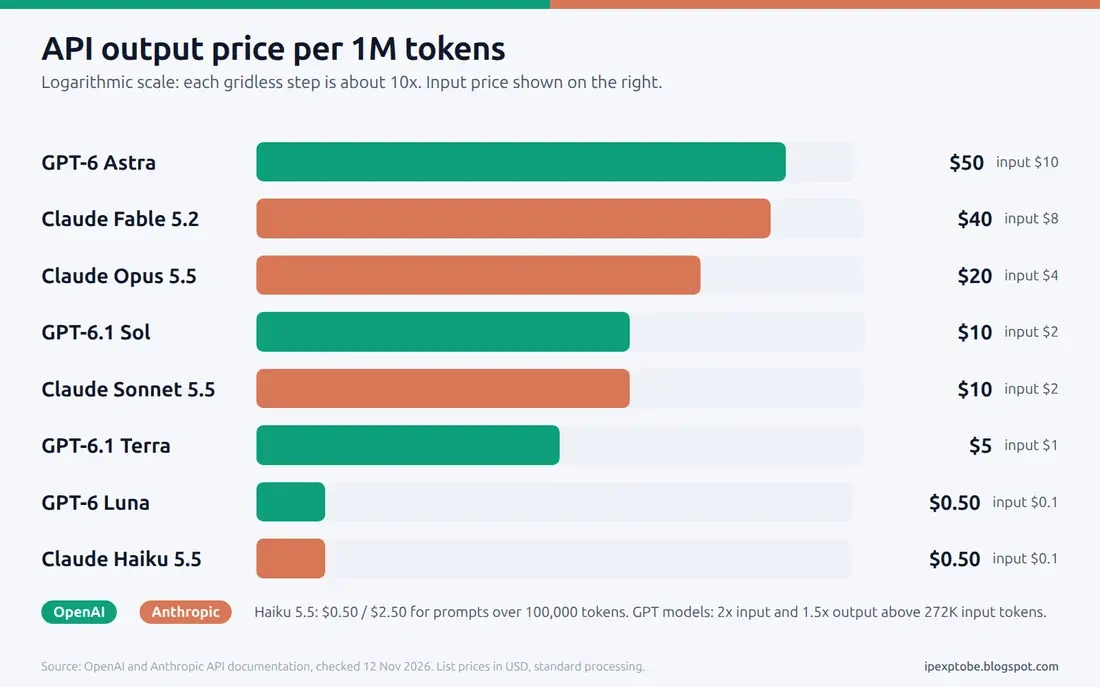
Three things stand out. The flagship gap is small: Fable 5.2 is 20% cheaper than Astra on both input and output, and Anthropic cut it from the $10 / $50 of Fable 5.1.[10] The mid-tier is a tie: Sol and Sonnet 5.5 cost the same. And the cheapest tier is a tie with a catch, which is the next section.
3. Long prompts change the ranking
The headline price is not the price of every request. OpenAI bills prompts above 272,000 input tokens at twice the input and cache rates and 1.5 times the output rate, for the full request.[1][2] Anthropic includes the full 1M-token window at standard pricing on its current models, with one exception: Claude Haiku 5.5 moves to $0.50 input and $2.50 output per million tokens when the prompt is over 100,000 tokens.[11][9]
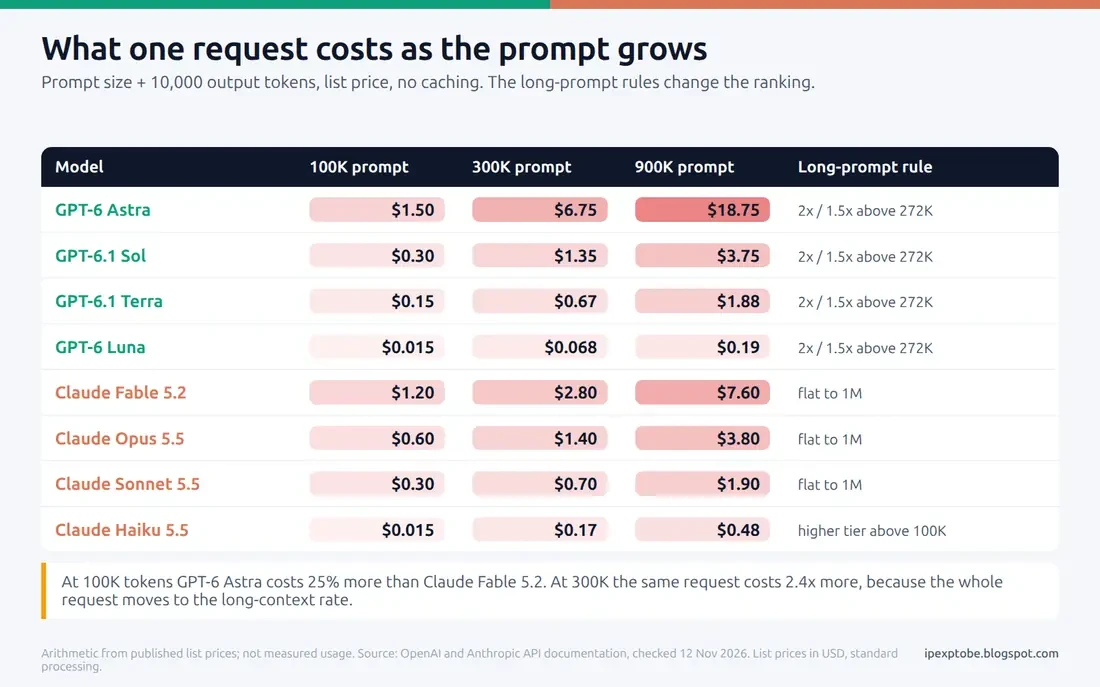
Work through one row. At a 100,000-token prompt, GPT-6 Astra costs $1.50 and Claude Fable 5.2 costs $1.20. At 300,000 tokens the Astra request costs $6.75 and the Fable request $2.80, because Astra's entire request is now on the long-context rate. For repository-scale or document-heavy agents that regularly cross 272K, this rule matters more than the base price.
The opposite happens at the bottom. GPT-6 Luna and Claude Haiku 5.5 cost the same below 100,000 tokens. Between 100,000 and 272,000 tokens Haiku is five times more expensive than Luna. If you plan to feed large prompts to the small model, check which side of each threshold your traffic falls on.
4. The modifiers: caching, batch and fast modes
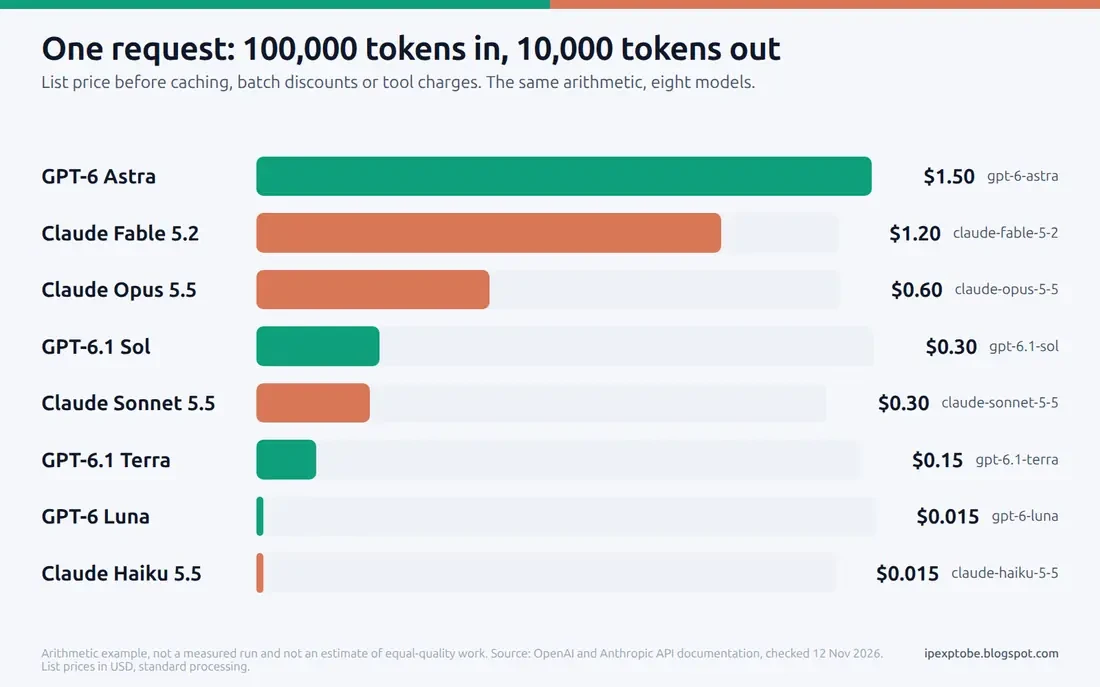
Agents re-read the same context many times, so cache pricing often decides the bill. The published multipliers differ:
- Cached input. OpenAI prices cached input at 5% of the input rate on Sol and Terra and 10% on Astra and Luna.[2][3][1] Anthropic's cache reads cost 2.5% of input on Fable 5.2, 5% on Opus 5.5 and Sonnet 5.5, and 10% on Haiku 5.5.[6][9]
- Batch. Both vendors discount asynchronous batch work by 50%.[1][6]
- Speed. OpenAI's fast mode costs 2x, and Sol also has an “ultrafast” mode at 6x.[2] Anthropic's fast mode for Fable 5.2 costs $16 / $80 per million tokens for up to 2.5 times the output speed.[10]
- Region. OpenAI adds 10% for regional processing where available; Anthropic applies a 1.1x multiplier for US-only inference.[2][11]
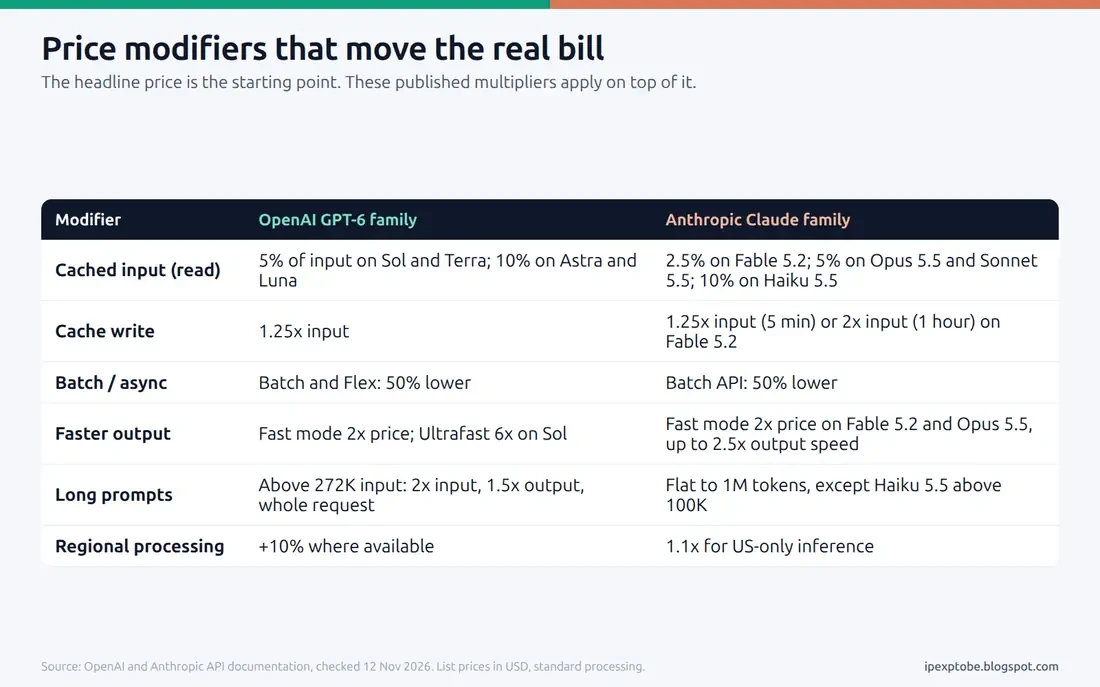
The practical point: a long agent session with a 90% cache hit rate pays close to the cache price for most of its input, not the list price. Our review of public Fable 5.2 projects includes one repository where caching cut the reported cost of a run from $60.57 to $15.96.
5. Context, output and other limits
On paper the eight models are almost interchangeable. Each GPT-6 model lists a 1,050,000-token context window, 922,000 maximum input tokens and 128,000 maximum output tokens.[1][4] Each current Claude model lists a 1M-token context window and 128K output tokens.[5] All accept text and images and return text.
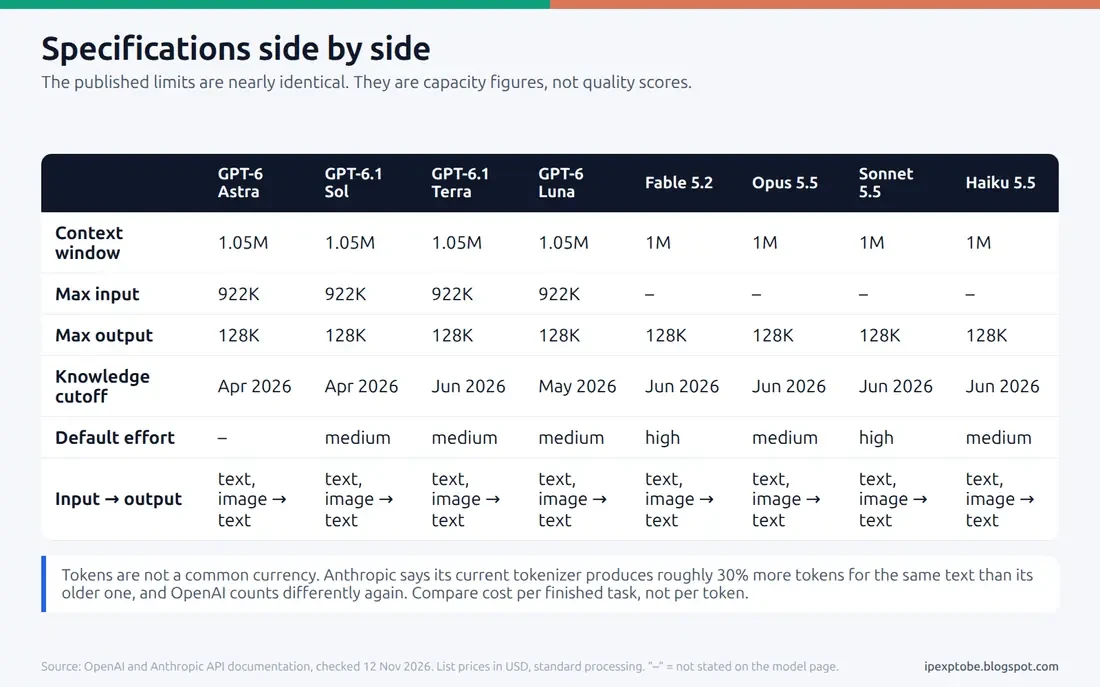
Do not read the 50,000-token difference as an advantage. Tokens are not a common unit across vendors: Anthropic notes that its current tokenizer produces roughly 30% more tokens for the same text than its previous one, and each vendor counts differently.[11] A price per million tokens is only comparable after you measure how many tokens each model uses for your task.
The knowledge cutoffs are close as well: April 2026 for Astra and Sol, May 2026 for Luna, June 2026 for Terra and for all four Claude models.[1][4][5]
6. What the vendor benchmarks say, and what they do not
Anthropic published a benchmark table with the Fable 5.2 launch that includes GPT-6 Astra and Gemini 4 Carbon.[12] Six of the rows have a score for every model:
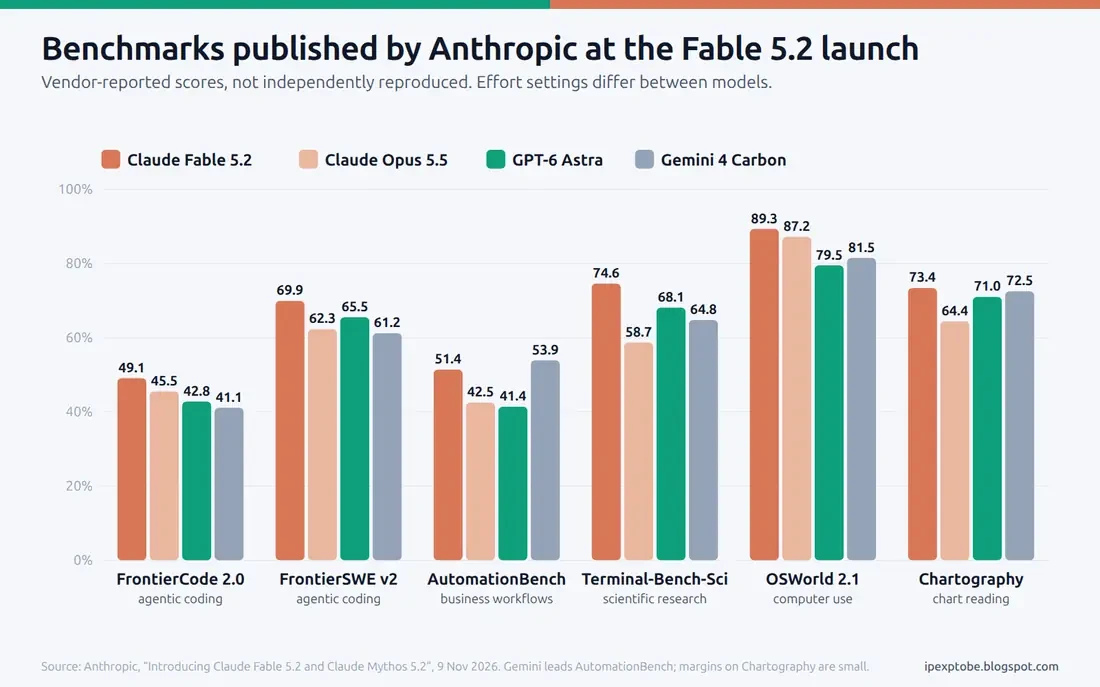
On these six tests Fable 5.2 leads on five. Gemini 4 Carbon leads AutomationBench (53.9% against 51.4%), and the margins on chart reading are a few points. GPT-6 Astra is ahead of Claude Opus 5.5 on FrontierSWE v2, Terminal-Bench-Science and Chartography, which is a reminder that “Claude vs GPT” has no single answer even inside one vendor's own table.[12]
Read the table with three limits in mind:
- It is a vendor's table. Anthropic chose the benchmarks, ran or collected the scores and published them at its own launch. We found no equivalent OpenAI table covering Fable 5.2 on the pages we checked.
- Effort settings differ per cell. The footnotes say scores show each model's highest available effort unless noted, and some cells are marked with a different setting.[12]
- Cost is part of the claim. Anthropic says Fable 5.2 at high effort scores about the same as Opus 5.5's best on FrontierCode 2.0 (45.3% against 45.5%) for roughly half the cost per task.[12] That is an efficiency claim you can test on your own workload.
7. Apps, subscriptions and API credit
An API model page does not describe what the ChatGPT or Claude app gives you. OpenAI's own Sol page says the model uses a default 500K-token context in Codex and ChatGPT Work, separate from the API window.[2] Check the plan you actually use.
Both vendors now attach API credit to some subscriptions. Eligible ChatGPT Pro and Business plans can claim up to $500 of API credit per month.[13] Claude Max includes $100, Ultra $200, and Team plans $20 or $100 per seat, pooled and capped at $500; Free, Pro and Enterprise plans are not eligible.[14]

8. Integration differences that affect a comparison
A test harness written for one model does not automatically run on another. On Claude Fable 5.2, adaptive thinking is always on, forced tool use (tool_choice of type any or tool) returns a 400 error, and a request that edits earlier turns after a thinking block fails a prefix check.[10] On the OpenAI side, the Sol and Terra pages state that tool calling requires the Responses API.[2][3]
Data handling also differs per model, not per brand. Fable 5.2 requires 30-day data retention and is not available under zero data retention unless Anthropic expressly authorises it.[6] If you plan to send real configurations or customer data, read the retention terms for the exact model and contract first. The integration details are covered step by step in how to build a read-only network change reviewer.
9. Which models to test first
This is a starting shortlist, not a ranking. In each row the idea is the same: begin with the cheaper pair and escalate only if it fails your acceptance criteria.
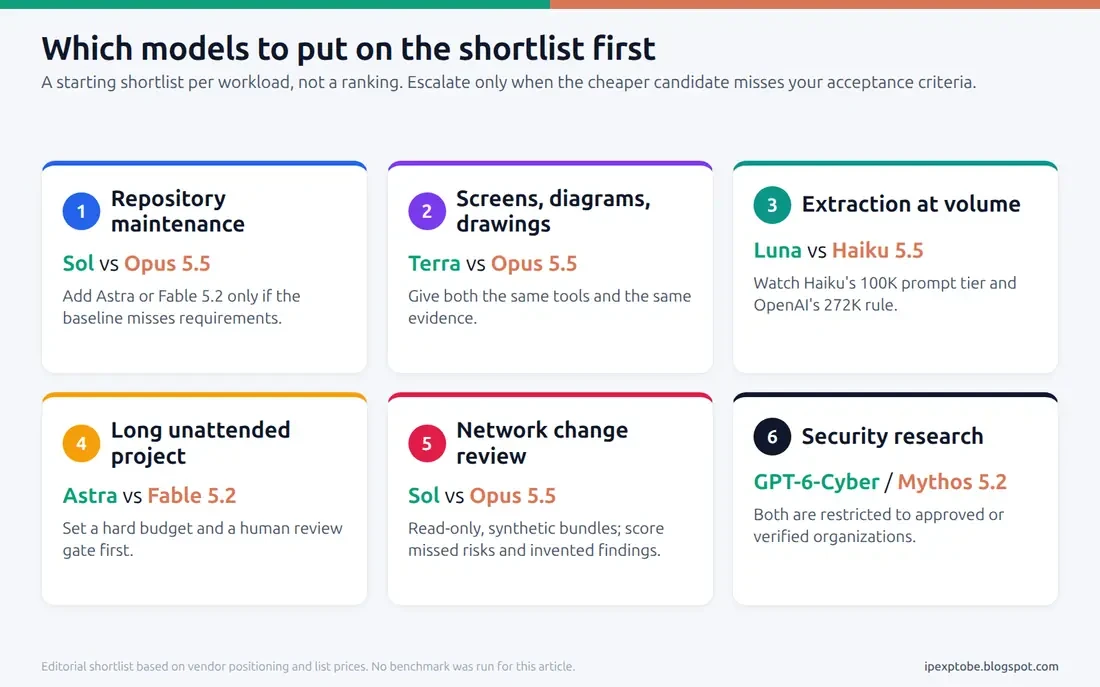
- Repository maintenance: GPT-6.1 Sol against Claude Opus 5.5. Add Astra or Fable 5.2 only if the baseline misses requirements.
- Screens, diagrams and drawings: GPT-6.1 Terra, which OpenAI positions for visual reasoning and computer use, against Opus 5.5 with the same tools.
- Extraction at volume: GPT-6 Luna against Claude Haiku 5.5, with the prompt-size thresholds in mind.
- A long unattended project: Astra against Fable 5.2, with a hard budget and a human review gate.
- Network change review: Sol against Opus 5.5 on synthetic, read-only bundles.
10. How to run a fair test
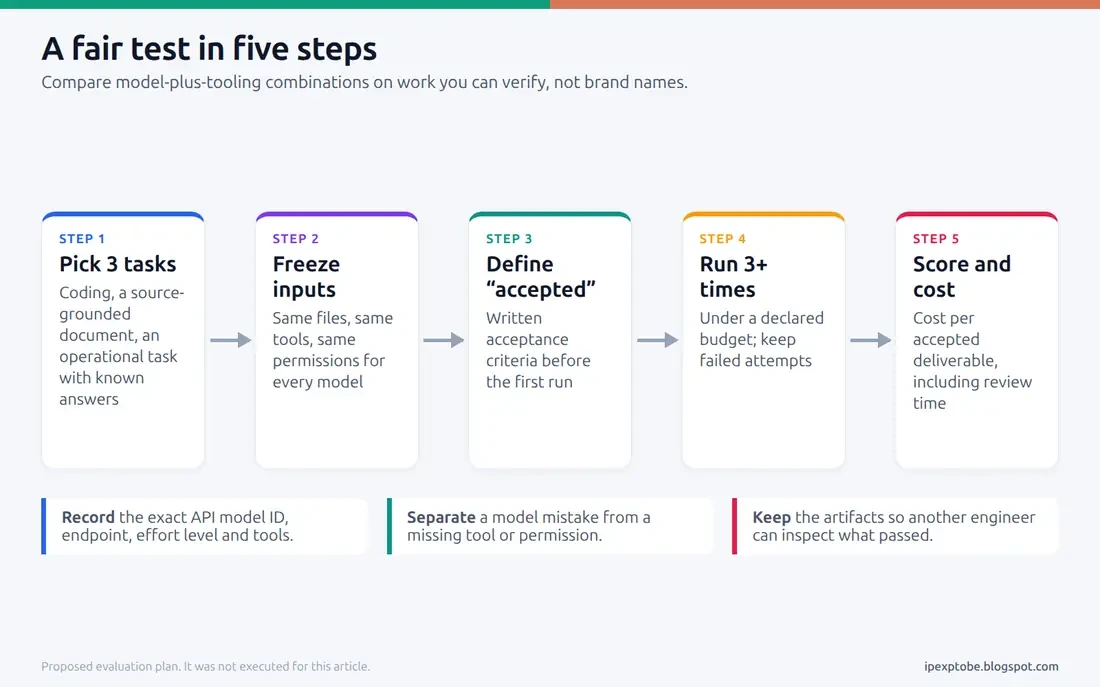
Choose three tasks you can check: one coding task, one source-grounded document task and one operational task with known answers. Freeze the inputs, tools and permissions. Write down what “accepted” means before the first run. Run each model at least three times under a declared budget and keep the failed attempts. Then compare cost per accepted result, including the time a person spent reviewing it.
The conclusion is not that one brand wins. It is that the price lists are close enough, and the limits similar enough, that the decision comes down to how each model performs on your work with your tools. That is measurable in a few days, and it is worth more than any table, including the ones in this article.
Frequently asked questions
Is ChatGPT or Claude better in November 2026?
Neither brand wins outright. Each vendor sells four general-purpose models at different prices, and the right comparison is between specific models with the same tools on your own tasks. Anthropic's launch benchmarks put Claude Fable 5.2 ahead of GPT-6 Astra on most of the tests it published, but those are vendor-reported numbers.
How much does Claude Fable 5.2 cost compared with GPT-6 Astra?
Claude Fable 5.2 costs $8 per million input tokens and $40 per million output tokens. GPT-6 Astra costs $10 and $50. Above 272,000 input tokens GPT-6 Astra is billed at twice the input rate and 1.5 times the output rate for the whole request, while Fable 5.2 stays flat up to 1 million tokens.
What is the cheapest current model from OpenAI and Anthropic?
GPT-6 Luna and Claude Haiku 5.5 both start at $0.10 per million input tokens and $0.50 per million output tokens. Haiku 5.5 rises to $0.50 and $2.50 for prompts over 100,000 tokens.
Does a ChatGPT or Claude subscription include API access?
Some paid plans include monthly API credit. ChatGPT Pro and Business plans can claim up to $500 per month, and Claude Max, Ultra and Team plans include $100, $200 or per-seat credit. The credit has eligibility rules and does not mean unlimited API use.
Which model has the largest context window?
They are nearly identical. The four GPT-6 models list a 1,050,000-token context window with 922,000 maximum input tokens, and the four current Claude models list 1 million tokens. All eight allow up to 128,000 output tokens.
Sources
Primary sources, checked 12 November 2026.
- GPT-6 Astra model page (OpenAI API docs)
- GPT-6.1 Sol model page (OpenAI API docs)
- GPT-6.1 Terra model page (OpenAI API docs)
- GPT-6 Luna model page (OpenAI API docs)
- Claude models overview (Anthropic docs)
- Claude Fable 5.2 model overview (Anthropic docs)
- Choosing the right Claude model (Anthropic docs)
- GPT-6-Cyber model page (OpenAI API docs)
- Claude Haiku 5.5 model overview (Anthropic docs)
- What's new in Claude Fable 5.2 (Anthropic docs)
- Claude API pricing (Anthropic docs)
- Introducing Claude Fable 5.2 and Claude Mythos 5.2 (Anthropic, 9 Nov 2026)
- API credits for ChatGPT subscribers (OpenAI docs)
- Monthly API credits for Max, Ultra, and Team plans (Claude Help Center)
Related reading
- Claude Fable 5.2 in the Wild: What the Public Project Evidence Shows
- Top 10 Claude Opus 5.5 Projects and Demos: What It Does Better Than GPT-6 Astra
- Claude Opus 5.5 Capability Deep Dive: Coding Agents, Computer Use and Real-World Limits
- Claude Opus 5.5 Current News Update: Availability, Copilot Rollout, Pricing and Builder Reaction
- Claude Fable 5.2: Six Useful Projects Beyond the Viral Demos
- Build a Read-Only Network Change Reviewer with Claude Fable 5.2


Comments
Post a Comment