Claude Fable 5.2: Six Useful Projects Beyond the Viral Demos
Design patterns and documented model behaviour, checked against Anthropic's documentation on 12 November 2026. The projects are proposals with verification plans, not finished case studies. Disclosure: drafted with AI assistance.
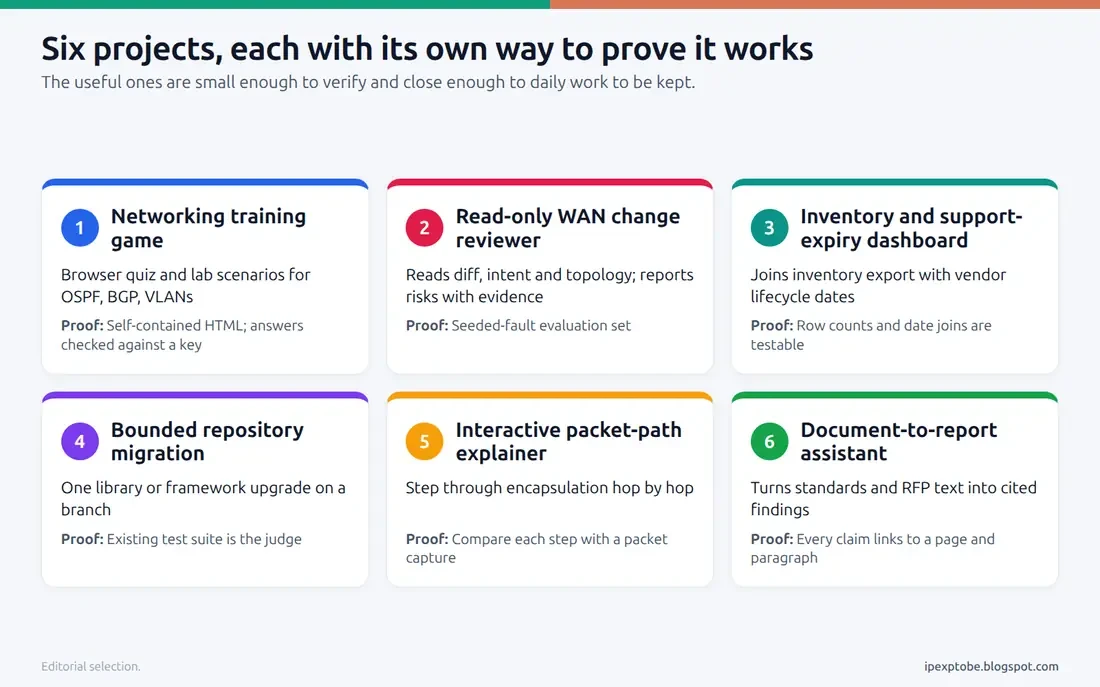
The launch-week demos - games from one prompt, endless 3D worlds - are real, and we examined their evidence separately. But a demo's job is to impress once. A useful project is one you still run next quarter, which means it needs three things no demo has: a frozen scope, a mechanical way to verify the result, and a budget. Here are six that fit on a network team, each with all three.
- Every project pairs the model with a mechanical judge: an answer key, a test suite, a capture, a citation checker. No judge, no project.
- Start on Opus 5.5 or Sonnet 5.5; move to Fable 5.2 only when your own evaluations fall short - this is Anthropic's own guidance.
- Scope is the cost lever: published single-run data shows complete experiments for $5-16 with caching.
- Say in the prompt who owns the code - Fable 5.2 behaves differently when told the code base is its own to restructure.
- A result you cannot verify is a demo, whatever it cost.
First, separate the model from the environment · Project 1: a browser-based networking training game · Project 2: a read-only WAN change reviewer · Project 3: an inventory and support-expiry dashboard · Project 4: a bounded repository migration · Project 5: an interactive packet-path explainer · Project 6: a document-to-report assistant with checkable citations · The starting prompt, anatomised · Scoping and model choice · Cost control: the documented levers
First, separate the model from the environment
Every impressive agent result is a stack: model, effort level, harness, tools, permissions. Change any layer and the outcome changes. Decide them separately, and when something fails, debug the right layer - a missing tool is not a model weakness.
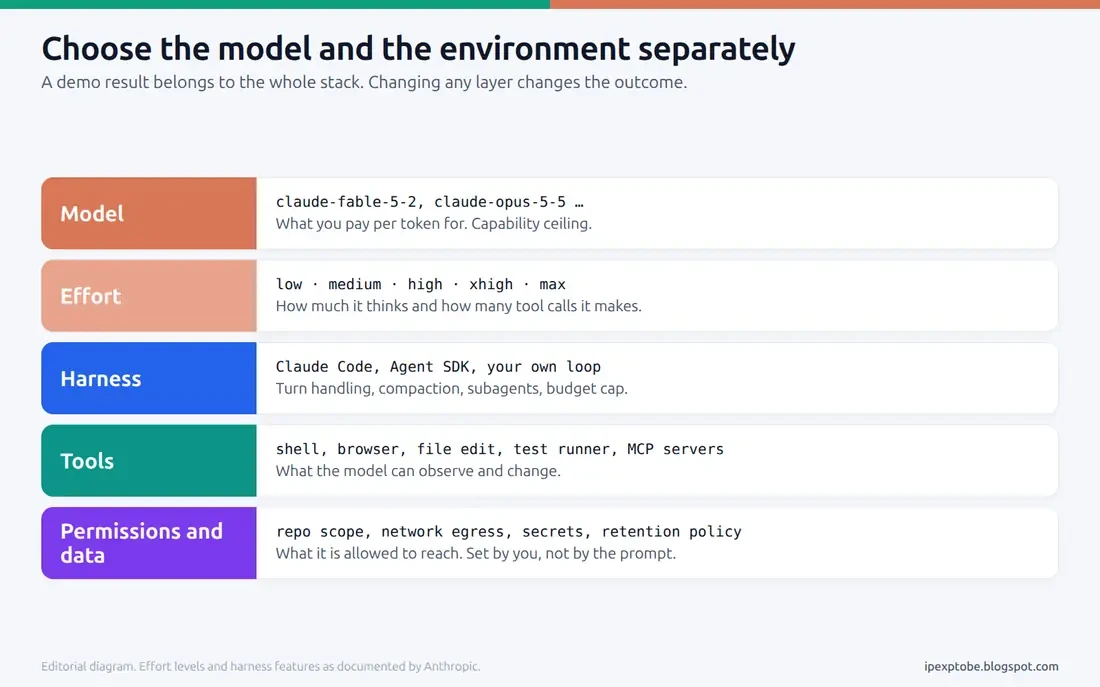
On the model layer, note that "Fable 5.2 in your IDE" is also an environment statement: in GitHub Copilot it is a policy-gated option, off by default for business plans, with its own data-retention terms.[1]
Project 1: a browser-based networking training game
A single-file HTML quiz and scenario trainer for your own team: OSPF, BGP, VLANs, your network's conventions. No server, no accounts, runs offline in a lab.
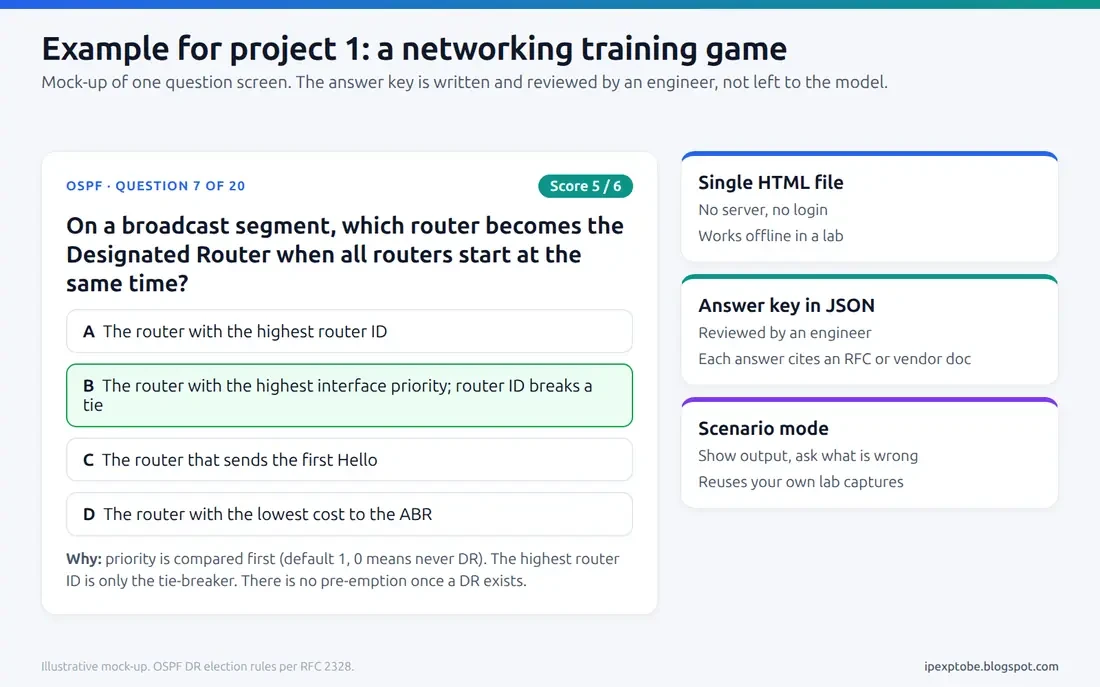
The one rule that makes this work: the model builds the game, not the truth. The answer key is a JSON file an engineer writes and reviews, with each answer citing an RFC or vendor document. The agent's job is the interface, the scoring, the scenario player for your own lab captures. Verification is direct - play it and diff the displayed answers against the key.
Project 2: a read-only WAN change reviewer
The highest-value item on the list and the one with the most rules, so we gave it a full article. The short version: the reviewer reads a frozen change bundle, deterministic checks run first, the model correlates diff with intent and topology, the output is a JSON report where every finding cites evidence, and the worker holds no device credentials at all. Trust comes from a seeded-fault evaluation set, never from how confident the reports sound.
Project 3: an inventory and support-expiry dashboard
Join your inventory export against vendor end-of-support dates and show what expires when. Unglamorous, and exactly the kind of task where an agent saves real days: parsing messy CSVs, normalising model names, building the static dashboard page.
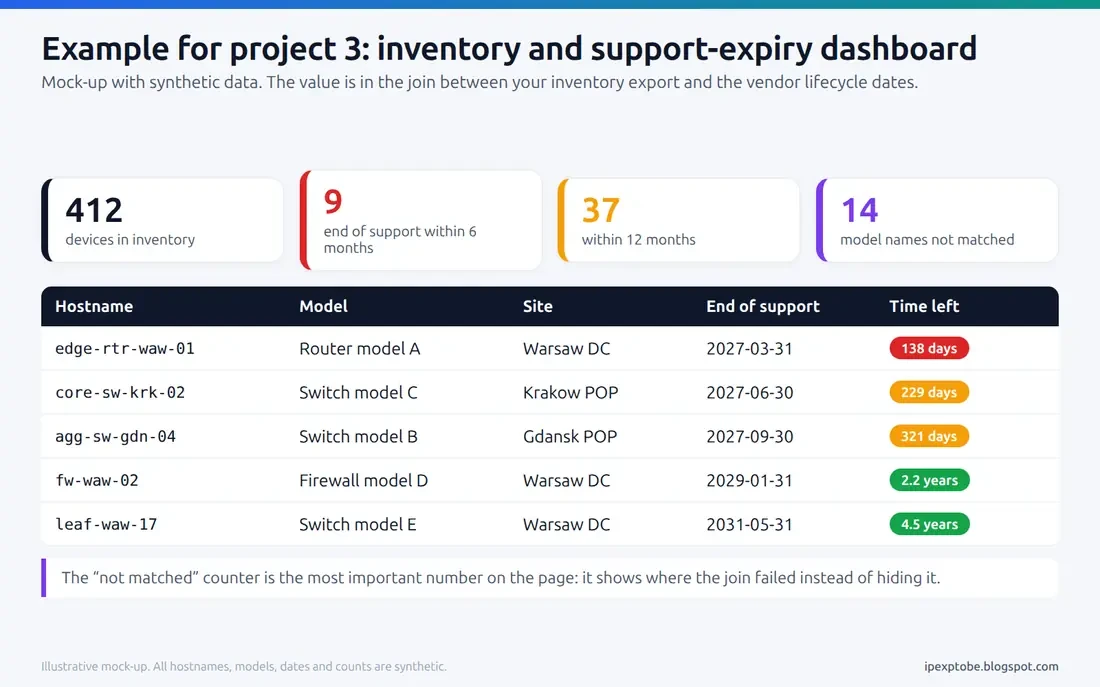
The design detail that matters is the "not matched" counter. Model-name joins fail; a dashboard that hides failed joins produces false confidence about exactly the devices nobody is watching. Verification: row counts in versus out, plus a spot-check of 20 devices against the vendor portal.
Project 4: a bounded repository migration
Not "modernise our codebase" - one library upgrade or one framework jump, on a branch, with the existing test suite as judge.
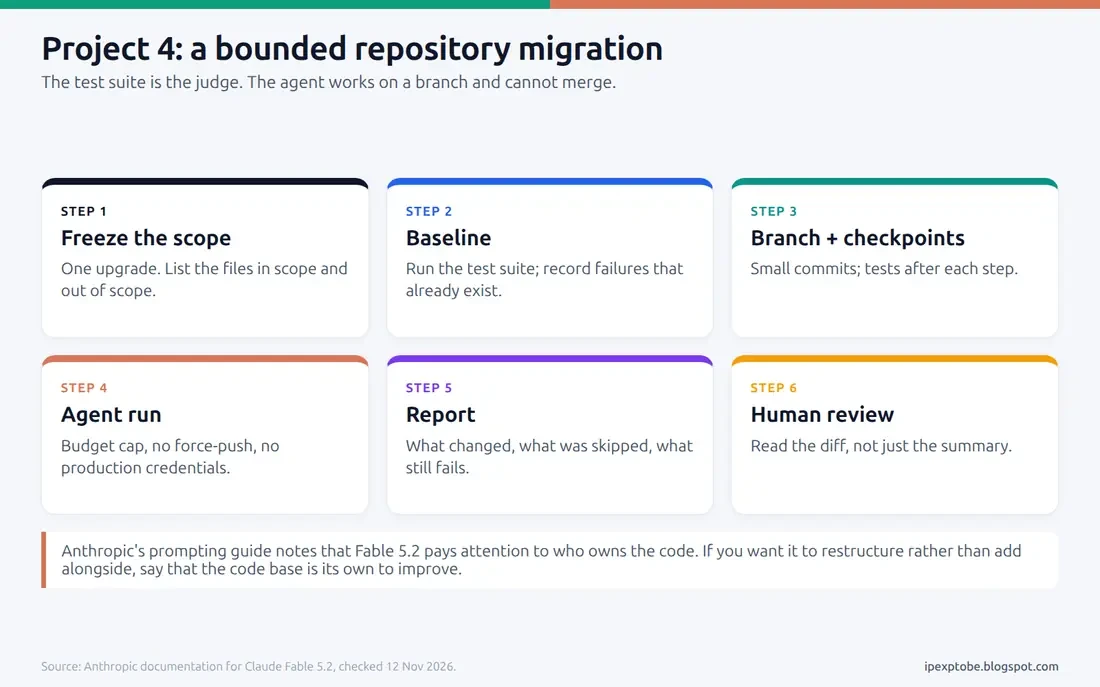
Two Fable-5.2-specific notes from Anthropic's own prompting guide.[2] First, code ownership changes behaviour: told nothing, the model tends to add alongside existing structure and report problems rather than fix them; told the code is its own, it consolidates and refactors. Say which you want. Second, on long tasks the model sometimes ends a turn early with a list of what remains - the guide's recommended fix is explicit "work through ordinary obstacles" instructions in the system prompt. Keep the agent on a branch with no force-push and no production credentials, and read the diff, not just the summary.
Project 5: an interactive packet-path explainer
A teaching page that walks a packet hop by hop through your actual topology, showing the headers at every step - the thing every onboarding deck promises and never quite delivers.
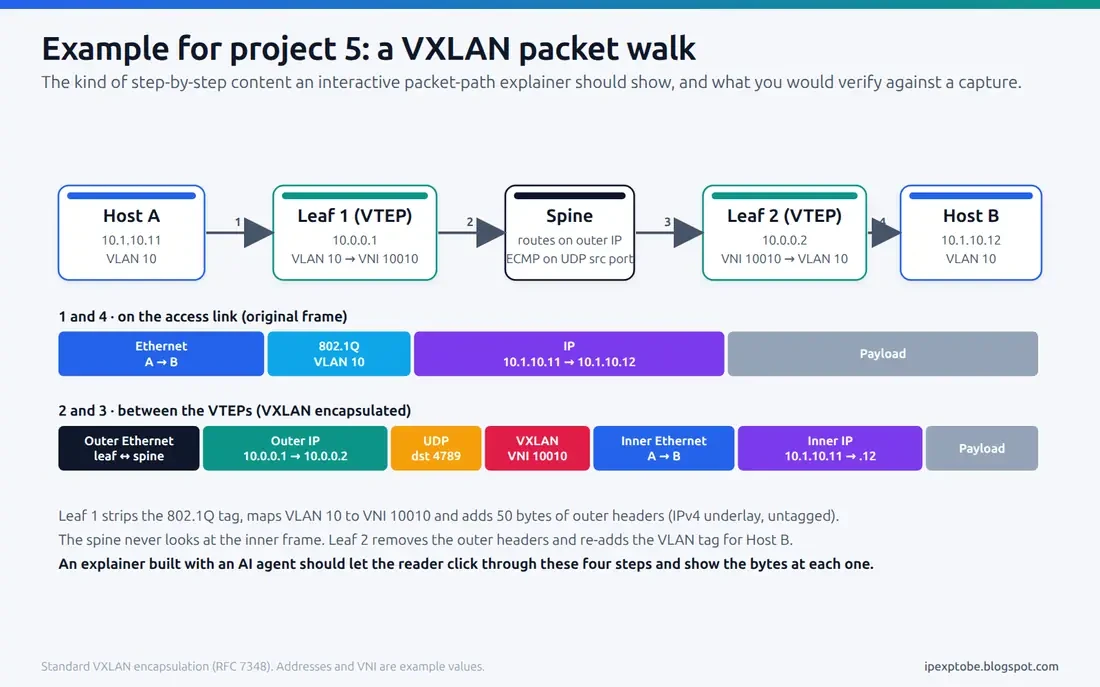
Verification is the whole point here: every step must match a real packet capture from the lab. An explainer that is plausible but wrong about one header field is worse than no explainer - it teaches the error at scale. This is also a natural place to reuse the training-game engine from project 1: "here is the capture, which header did the explainer get wrong?"
Project 6: a document-to-report assistant with checkable citations
Feed it standards PDFs, RFP text or design documents plus a fixed question list; get back a findings table where every answer quotes its source with a page number.
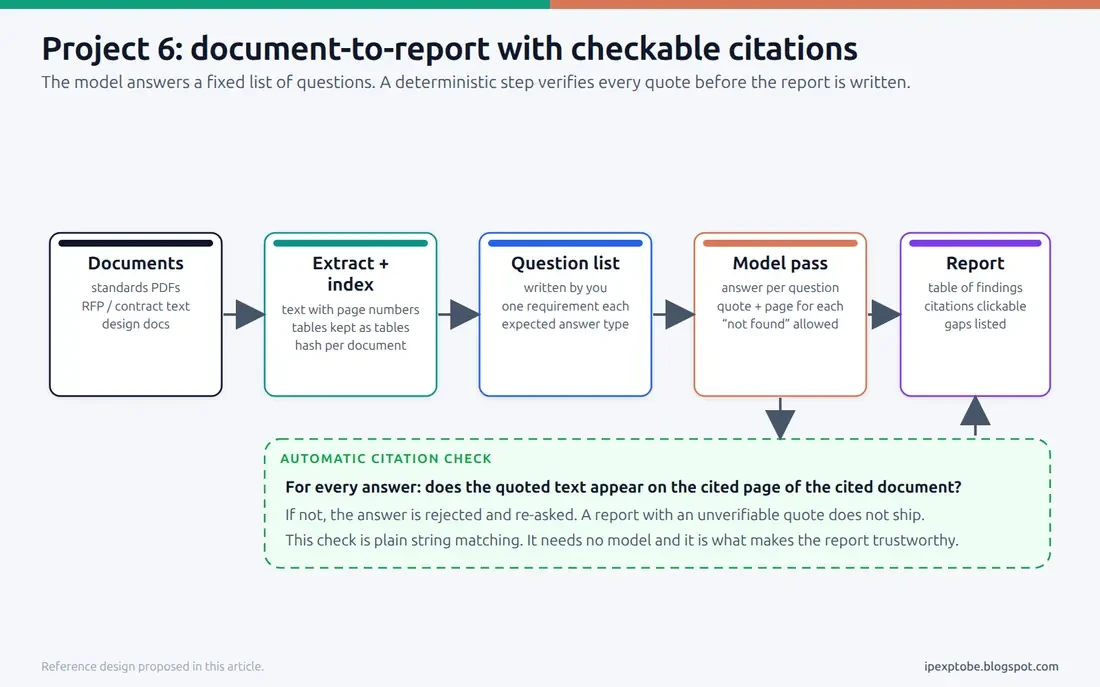
The load-bearing component is deterministic: a checker that verifies every quoted passage actually appears on the cited page of the cited document, and bounces the answer back if not. "Not found" must be an allowed answer - an assistant that cannot say "the document does not address this" will invent compliance.
The starting prompt, anatomised
All six projects start from the same prompt skeleton. Seven parts, each removing a documented reason for a long run to drift, stall or go quiet:[2]
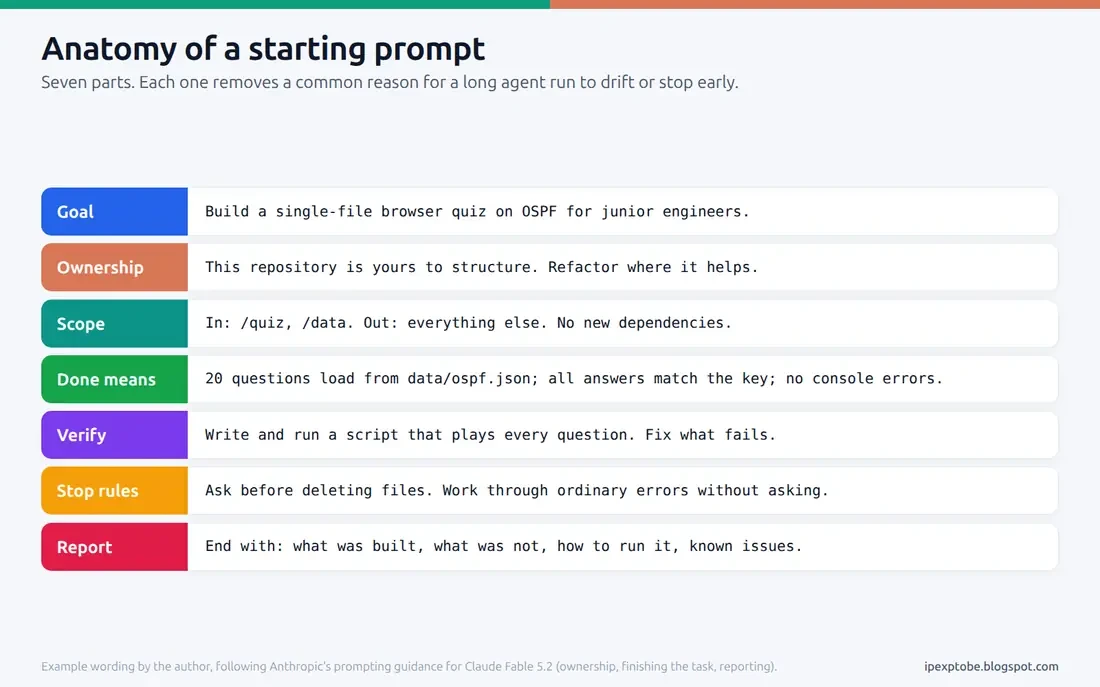
Two parts earn their place directly from Anthropic's guidance: ownership (see project 4) and the final report - after long agentic work, the reader has not seen the tool calls, so the guide recommends explicitly asking for a self-contained report of what was built, what was skipped and what still fails.[2] The verify line borrows the best trick from the public demos: the SUBLEVEL 07 agent wrote a script to play its own game through all three waves before calling it done.[3]
Scoping and model choice
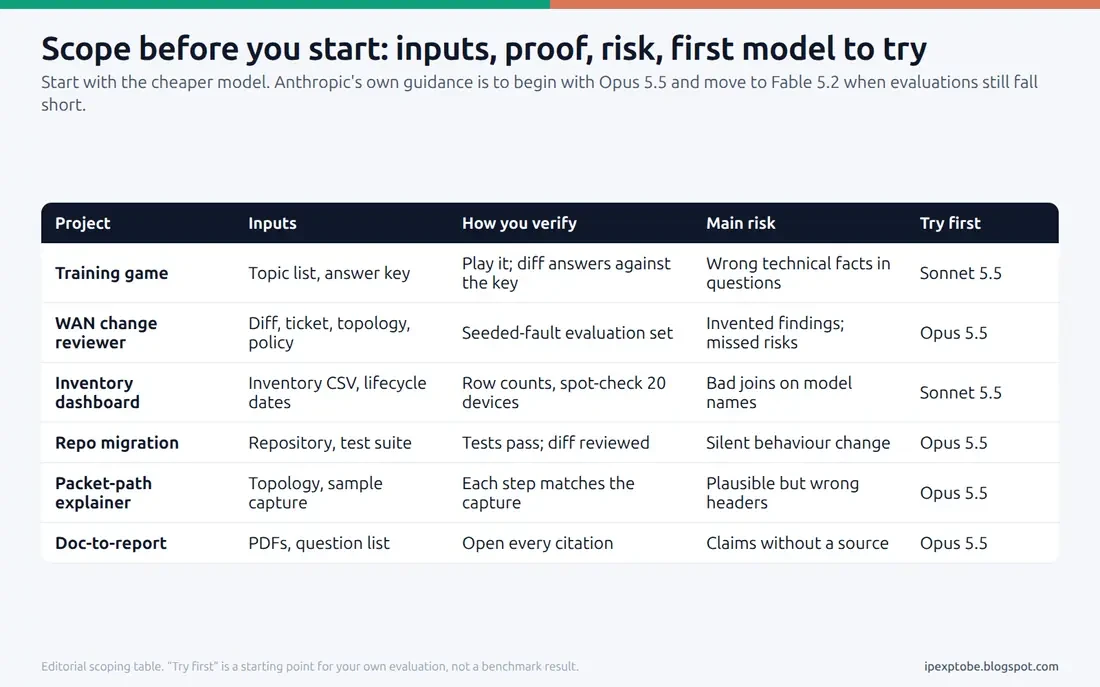
The "try first" column follows Anthropic's own escalation rule: start with Opus 5.5 for most workloads (Sonnet 5.5 for the lighter builds), and move to Fable 5.2 when evaluations at higher effort still fall short.[4] For the model-against-model picture, including GPT-6 candidates for the same slots, see our November 2026 comparison.
Cost control: the documented levers
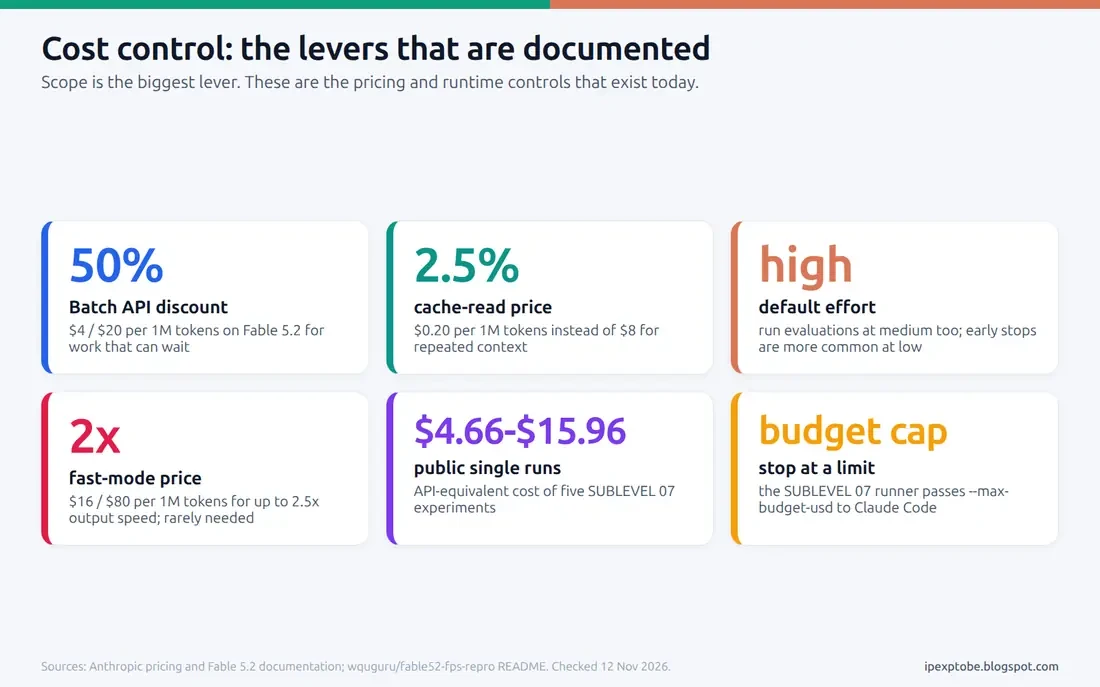
Scope is the biggest lever, but the published ones stack well:[5][6]
- Batch API: 50% off ($4 / $20 per million tokens on Fable 5.2) for anything that can wait - nightly dashboard rebuilds, document batches.
- Prompt caching: cache reads at 2.5% of input price on Fable 5.2. For agents that re-read the same standards and topology every run, this is the difference between $60 and $16 - exactly the ratio in the published SUBLEVEL 07 accounting.[3]
- Effort: the API default is high; Anthropic says most of the capability gain is already there. Reserve xhigh for measured wins, not as a default.[6]
- Budget caps: cap the run, not the month - the SUBLEVEL 07 runner passes a max-budget flag so the agent stops at a limit.[3]
- Fast mode (2x price for up to 2.5x output speed) is for humans waiting at keyboards; none of these six projects needs it.[6]
One non-cost lever belongs in every plan: data policy. Fable 5.2 requires 30-day retention unless Anthropic authorises zero-retention use - decide whether that fits before the first real config or contract goes into a prompt, and prototype on synthetic data regardless.[7]
The finish line for all six is the same: a tool your team still uses when the launch-week screenshots are forgotten - because you can prove, mechanically, that it is right.
Frequently asked questions
What are practical uses of Claude Fable 5.2 for network engineers?
Six good starters: a browser-based networking training game, a read-only WAN change reviewer, an inventory and support-expiry dashboard, a bounded repository migration, an interactive packet-path explainer, and a document-to-report assistant with checkable citations.
Should I use Claude Fable 5.2 or Opus 5.5 for my project?
Anthropic's own guidance is to start with Claude Opus 5.5 for most workloads and move to Fable 5.2 when evaluations at higher effort still fall short. Four of the six projects here are fine starting on Opus 5.5 or even Sonnet 5.5.
How do I keep an AI agent project from running up costs?
Freeze the scope, cap the run with a budget limit, use batch pricing for non-urgent work (50% off), keep stable context in the prompt cache (cache reads cost 2.5% of input price on Fable 5.2), and run at the default high effort rather than max.
How do I verify what an AI agent built?
Give every project a mechanical judge before you start: an answer key for a quiz, a test suite for a migration, a packet capture for an explainer, a citation checker for a report. If no such judge exists, the project is not ready for an agent.
Sources
Primary sources, checked 12 November 2026.
- Claude Fable 5.2 in GitHub Copilot (GitHub changelog)
- Prompting Claude Fable 5.2 (Anthropic docs)
- wquguru/fable52-fps-repro README (cost and runner data)
- Claude models overview (Anthropic docs)
- Claude API pricing (Anthropic docs)
- What's new in Claude Fable 5.2 (Anthropic docs)
- Claude Fable 5.2 model overview (Anthropic docs)
Related reading
- Build a Read-Only Network Change Reviewer with Claude Fable 5.2
- Claude Fable 5.2 in the Wild: What the Public Project Evidence Shows
- AI Evaluation Projects That Can Make Money: LangSmith, Phoenix and Braintrust
- AI Knowledge Assistant Projects That Can Make Money: Glean, Onyx and Dust
- AI Meeting Automation Projects That Can Make Money: Fireflies, Granola and Fathom
- AI Software Testing Projects That Can Make Money: Playwright, QA Wolf and mabl


Comments
Post a Comment