Inside the FAA's Nov. 13 Ground Stop: A Network Engineer's Post-Mortem
This is a news-analysis post, not an official incident report. Every factual claim below is sourced to the FAA's own statement or named press reporting, linked at the bottom and checked 16 November 2026. Where the FAA's investigation is still open, this article says so explicitly.
On 13 November 2026, the FAA issued a nationwide ground stop - the longest one since the September 2001 attacks.[3] Mainstream coverage mostly asked "was it a cyberattack?" or "was it AI?" and the FAA answered both: no.[2] The more interesting question for this blog's readers is the one almost nobody asked out loud: what kind of network failure was this, in terms an engineer would actually use? The FAA's own language - a flood of connection attempts, a router deployment, facilities "going dark" one after another - maps cleanly onto concepts every network and infrastructure engineer already works with: control-plane floods, blast radius, and the gap between a data plane that keeps running and a control plane that doesn't.
- The ground stop was triggered by a connection flood - about 1,000 connection attempts every 4-5 seconds - on the FAA's shared FTI telecom backbone, traced to two sites: a radio comms site in El Dorado, Arkansas (where a new router was being deployed) and a radar site in Amarillo, Texas.
- The flood destabilized facilities that had nothing to do with either site, because they all share the same backbone - a textbook control-plane flood on under-segmented infrastructure.
- The actual fix was containment, not a deep repair: block the two sites, disable the broadcast function on the new routers. That is the same "stop the bleeding first" sequence network engineers use for route leaks and BUM storms.
- FAA and DHS officials stated explicitly there is "zero evidence" of a cyberattack and "zero evidence of anything AI-related."
- The event reopened debate on a long-flagged problem: much of the FAA's telecom plant is still analog/legacy equipment that Transportation Secretary Sean Duffy says needs a roughly $50 billion overhaul.
What happened, in order · Where the flood happened, and why it spread · The networking diagnosis · Why legacy infrastructure made this worse · The fix: containment, not a deep repair · Not a cyberattack, not AI · How this compares to the 2023 NOTAM outage · Lessons for network engineers outside aviation · FAQ
1. What happened, in order
Around 3:30 p.m. ET on Friday, 13 November 2026, the FAA issued a nationwide ground stop "out of an abundance of caution."[1] It lasted roughly four hours and forty-five minutes, lifting at about 8:15 p.m. ET - the longest nationwide stoppage since the 9/11 attacks grounded U.S. airspace in 2001.[3]
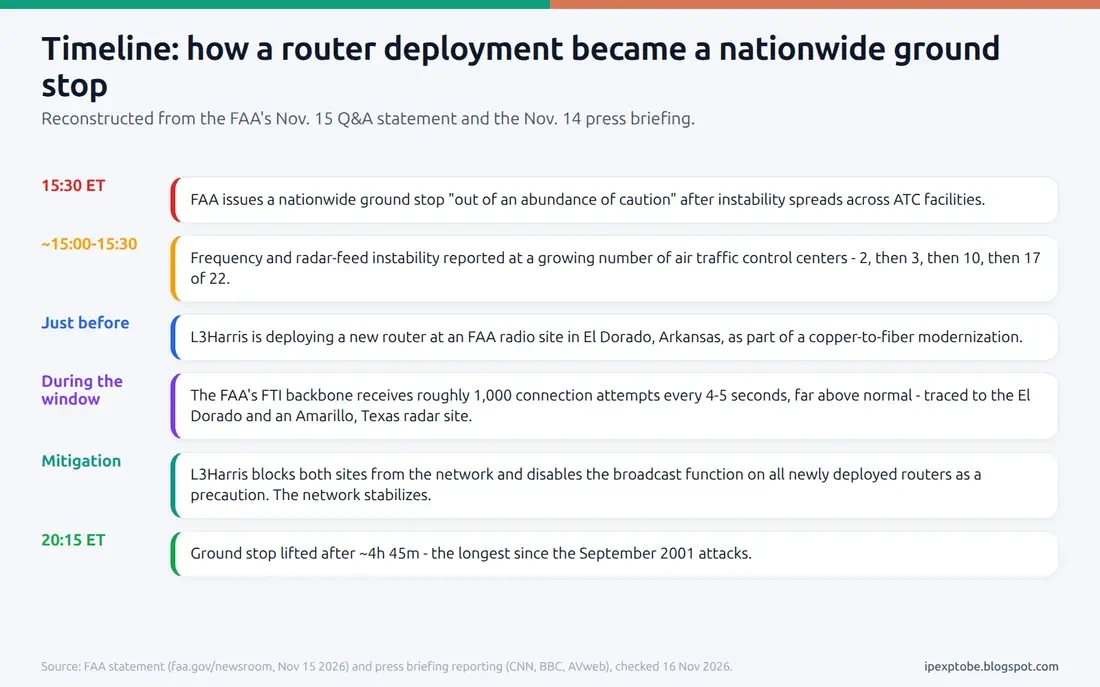
According to the FAA's own account, published as a Q&A on 15 November, the trigger was that its "legacy equipment became unstable when data began flooding the FAA FTI network, at a rate of 1,000 connection attempts every 4 to 5 seconds."[1] FTI is the FAA Telecommunications Infrastructure - the shared backbone that carries radar feeds and radio communications between facilities. The FAA's investigation points to two possible origin points: a radar site in Amarillo, Texas, and a radio communications site in El Dorado, Arkansas, where contractor L3Harris had been doing modernization work, including deploying a new router.[1]
FAA Administrator Bryan Bedford described how the response escalated at a Saturday press conference: facilities reported frequencies "going in and out," forcing a switch to backup systems. "If that had been a single facility, we would have just worked through it," he said. "But when we saw it go to two, three, 10, 17 facilities, that's when we started to realize there was something much larger going on here."[2] Seventeen of the FAA's 22 air route traffic control centers were affected, though Bedford said none of them actually "went dark."[2]
2. Where the flood happened, and why it spread
The detail that matters most for a networking reader is that the anomaly was traced to two specific sites, but its effect was not local. Because El Dorado and Amarillo both feed into the same shared FTI backbone that also carries traffic for dozens of other facilities, a problem confined to two endpoints was able to degrade service at facilities with no direct connection to either one.
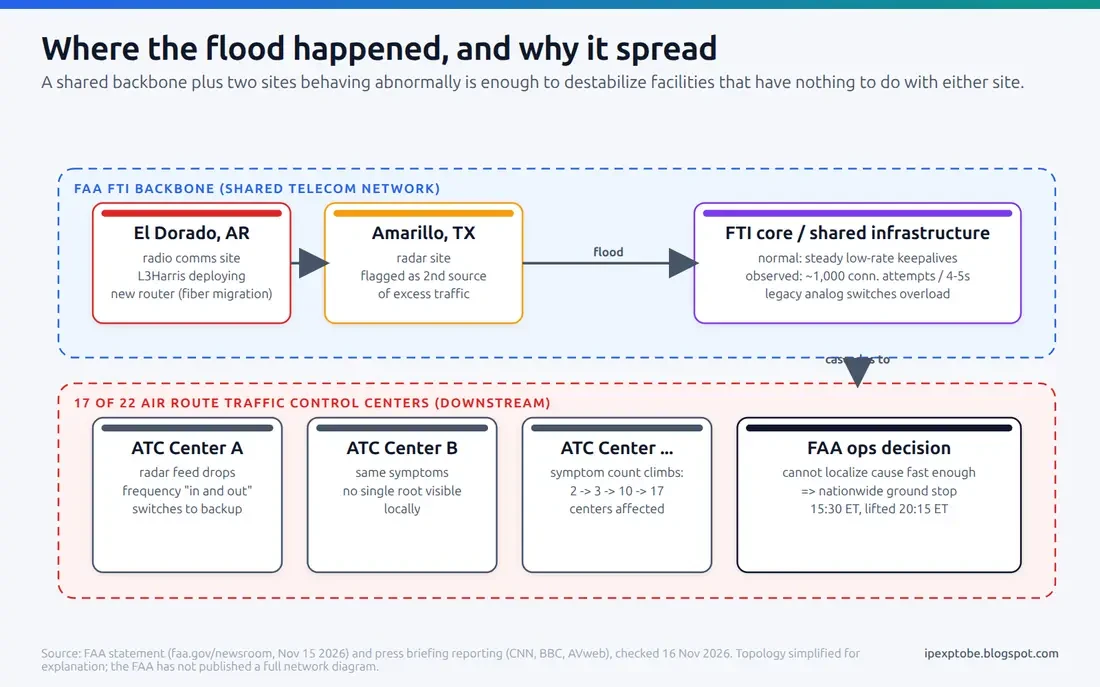
General-audience coverage tends to skip this part: the FAA's statement says L3Harris "blocked those two locations and the network stabilized"[1] - which only makes sense if the backbone had no earlier mechanism to isolate an abnormal site before it affected everyone sharing the link. That missing isolation, not the router deployment itself, is the structural reason a localized event went nationwide.
3. The networking diagnosis: what kind of failure was this?
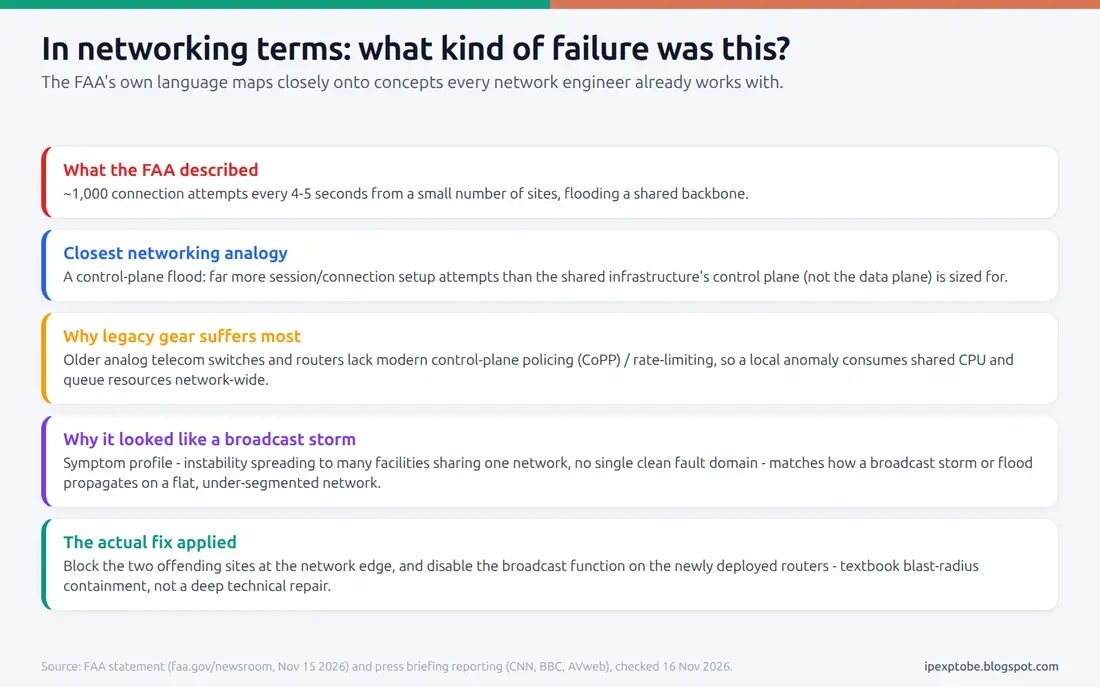
None of the public statements use the word "flood control" or "control-plane policing," but the behavior they describe is unmistakable to anyone who has debugged a similar incident on an enterprise or carrier network.
Three things stand out:
- This reads as a control-plane event, not a data-plane one. Bedford's description - frequencies "going in and out," switching between primary and backup - is the signature of session/connection churn overwhelming shared signaling and session-management resources, not a simple loss of a physical link.
- The symptom pattern (spreading, no clean single fault domain) matches a flood on flat, under-segmented infrastructure. That's the same pattern engineers see with Ethernet broadcast storms or an EVPN/VXLAN BUM-traffic storm: the failure mode isn't "this link is down," it's "everything sharing this domain degrades together."
- The remedy applied - block the sources, disable a risky feature - is containment, not root-cause repair. Modern routers carry control-plane policing (CoPP) and per-neighbor rate limiting specifically to stop this class of event locally, before it reaches a shared backbone. Whether El Dorado's new router had that protection configured, misconfigured, or simply didn't have the chance to apply it before the flood started is exactly the open question the FAA and L3Harris are still investigating.[4]
4. Why legacy infrastructure made this worse
Transportation Secretary Sean Duffy was unusually blunt about the state of the underlying plant. Describing the affected systems as "analogue telecom," he said: "Our switches, our routers actually got overloaded with data and they went down." He put a price tag on a full overhaul at roughly $50 billion and added, "It's going to continue to fail."[3] AVweb's reporting adds a specific, telling detail: newer digital equipment at the affected sites kept operating through the incident, while it was the older analog systems that failed.[4]
That rules out the simplest "just unplug the legacy stuff" narrative: the trigger was change-adjacent work, a router deployment and copper-to-fiber migration Duffy called "straightforward work that has been happening across the country for decades."[3] It's the transition state - old and new equipment sharing a backbone with no isolation between them - that produced the failure.
5. The fix: containment, not a deep repair
Whatever ends up in the final incident report, the response the FAA and L3Harris actually executed on 13 November follows a sequence familiar to anyone who has run an incident bridge for a network outage: stop the bleeding, stabilize, then diagnose.
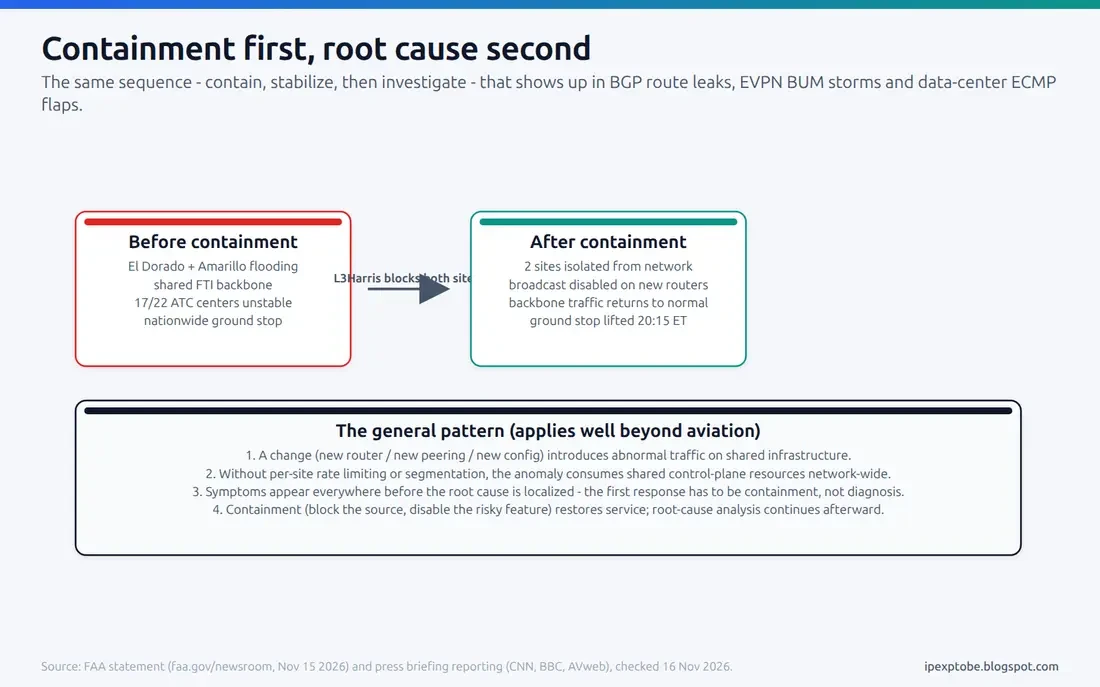
Two containment actions were taken, per the FAA's statement: L3Harris blocked the El Dorado and Amarillo locations from the network, and the broadcast function was disabled on all newly deployed routers as a precaution.[1] Disabling a feature across an entire fleet of new routers, rather than isolating the one site with the problem, is the kind of blunt, fleet-wide mitigation teams reach for when they can't yet be certain which specific unit or configuration is responsible - the networking equivalent of "turn off the thing we just turned on, everywhere, until we know more."
6. Not a cyberattack, not AI
Given the scale of the disruption, speculation about a cyberattack or an AI system malfunction was immediate. Officials addressed both directly and consistently across multiple briefings. Homeland Security Secretary Markwayne Mullin: "we don't believe so" on the cyberattack question.[2] FAA Administrator Bryan Bedford went further: "We see zero evidence of anything nefarious, and zero evidence of anything AI-related."[2] AVweb's independent reporting on the same briefing corroborates this, noting that a prior concern - the FAA's SMART AI system - was explicitly ruled out as a cause.[4]
That's a useful data point for anyone tracking how often "AI" gets blamed for infrastructure failures by default these days: in this case, officials checked specifically and said no, and the facts as described - a router deployment plus an un-isolated flood on legacy telecom gear - are a complete and mundane explanation that needs no AI involvement at all.
7. How this compares to the 2023 NOTAM outage
The FAA's last nationwide grounding, in January 2023, is a useful contrast because it was a different kind of failure entirely: a corrupted database file inside the NOTAM (Notice to Air Missions) application, not a network-layer event.[5]
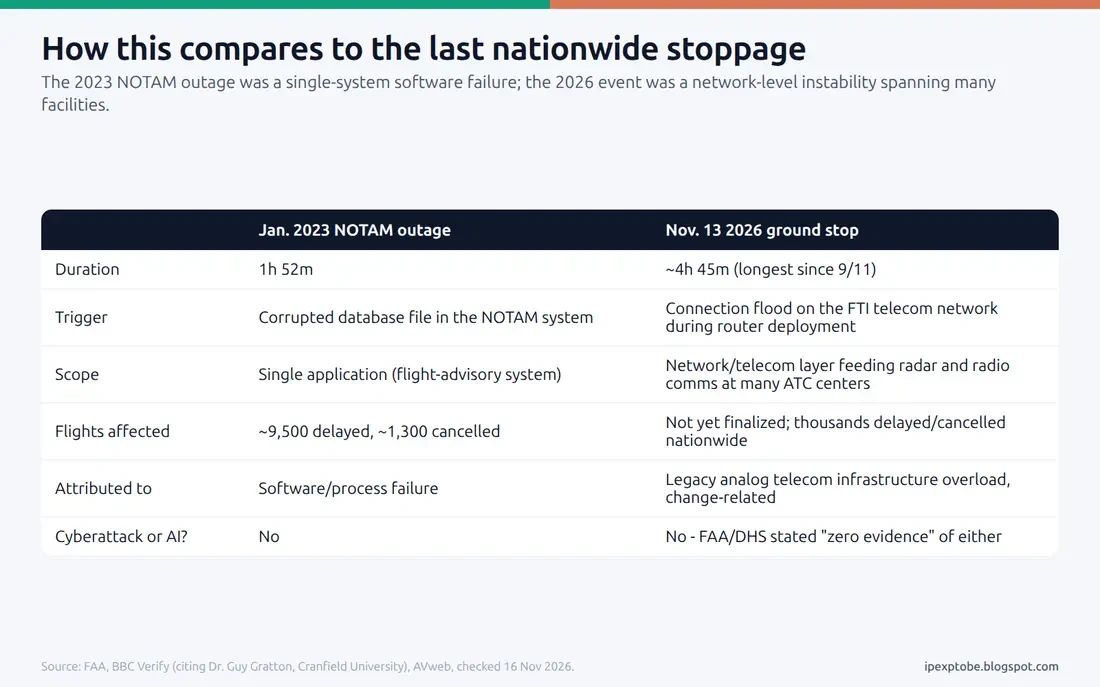
Aviation analyst Dr. Guy Gratton of Cranfield University told BBC Verify that the 2026 event "looks like the worst since 9/11, but clearly not on that scale," pointing out that the 2023 outage - though shorter - still delayed about 9,500 flights and cancelled roughly 1,300.[5] The 2026 event ran more than twice as long and touched the network layer feeding radar and voice comms directly, rather than a single advisory application - which is consistent with why so many facilities were affected simultaneously.
8. Lessons for network engineers outside aviation
You don't run an air traffic control network, but the pattern here shows up anywhere a shared backbone serves many independent sites:
- Segment the blast radius before you need it, not during the incident. If a single misbehaving site can flood a backbone that serves facilities with no relation to it, the segmentation boundary was in the wrong place. Per-neighbor rate limiting and CoPP on a router aren't optional hardening for "someday" - they're what stopped this from being worse.
- Changes to legacy-adjacent infrastructure need a canary, not a big-bang rollout. A new router deployment and a copper-to-fiber migration are exactly the kind of change that benefits from being proven on an isolated segment first, with explicit traffic caps, before it can talk to the shared core.
- Have a fast, blunt containment lever ready, separate from root-cause diagnosis. "Block the suspect sites" and "disable the new feature fleet-wide" bought time without requiring anyone to first understand exactly what went wrong. Most organizations don't rehearse this distinction until an incident forces it on them.
- Rule out the attention-grabbing causes explicitly and publicly. Naming "no cyberattack, no AI involvement" directly, with the officials' own words, closed off a speculation spiral that otherwise would have dominated coverage over the real, more useful explanation.
FAQ
What caused the ground stop?
A flood of roughly 1,000 connection attempts every 4-5 seconds on the FAA's shared FTI telecom backbone, traced to El Dorado, Arkansas (new router deployment) and Amarillo, Texas. The FAA's legacy equipment became unstable under that load.[1]
Was it a cyberattack or AI-related?
No to both, per the FAA, DHS and the Transportation Secretary. Administrator Bryan Bedford: "zero evidence of anything nefarious, and zero evidence of anything AI-related." The FAA's SMART AI system was specifically ruled out.[2][4]
How does it compare to the 2023 NOTAM outage?
Longer (~4h 45m vs. 1h 52m) and network-layer rather than single-application, though 2023 still delayed ~9,500 flights.[3][5]
What is the FAA FTI network?
The FAA Telecommunications Infrastructure - the shared backbone carrying radar feeds and radio comms between facilities nationwide, run by contractor L3Harris.[1]
Is it fixed now?
Contained, not repaired: the two sites were blocked and broadcast was disabled on new routers. Root-cause work continues; officials floated a roughly $50 billion legacy-telecom overhaul as the longer-term fix.[1][3]
Sources
[1] FAA, "Nationwide Ground Stop: Questions and Answers," faa.gov/newsroom, published 15 Nov 2026.
[2] CNN, "What we know about the cause of the nationwide FAA ground stop," 14 Nov 2026.
[3] BBC, "What we know about the longest US nationwide flight ground stoppage since 9/11," 14-15 Nov 2026.
[4] AVweb, "FAA Rules Out SMART AI System as Cause of Nationwide Ground Stop," 14 Nov 2026.
[5] BBC Verify via the BBC article above, citing Dr. Guy Gratton, Cranfield University, on the January 2023 NOTAM outage comparison.
Try it: Network Latency Calculator - free, runs in your browser.
Related reading
- GPT-6 Cyber Red Teaming: Safe Scopes, Monitoring, and Human Approval
- Hugging Face AI-Agent Intrusion: What the Public Logs Show—and Why It Wasn’t GPT-6 Cyber
- Can an LLM Pick the Right EIGRP Feasible Successor? DUAL's Strict-Inequality Trap
- Weekly BGP Table Watch: IPv4, IPv6 and ASN Changes — 2026-11-16
- OSPF Router ID Explained: Duplicate IDs, Selection and Safe Changes
- OSPF ECMP Explained: Equal-Cost Routes, Load Sharing and Troubleshooting


Comments
Post a Comment