Juniper Session Smart Conductor CVE-2026-103406 Explained: Exploited Root RCE, Fixed Versions and How to Check

Security analysis, written 27 November 2026. Every claim links to a source I read during this run. No exploit details are given because none have been published. Things I infer or suggest myself are marked as such.
On 24 November 2026 Juniper added one sentence to a security bulletin that had been public for four weeks: at least one instance of malicious exploitation of CVE-2026-103406 had been reported to its security incident response team.[3][4] The next day CISA put the flaw in its Known Exploited Vulnerabilities (KEV) catalog with a federal due date of 28 November.[5][8] The bug is an operating-system command injection in Session Smart Conductor, the controller of Juniper's Session Smart Router SD-WAN, rated CVSS 9.8: an unauthenticated attacker with network access can run commands as root by supplying a crafted Salt minion ID.[1][2][5]
For anyone running HPE Juniper SD-WAN, the point is that the fix has existed since 28 October and the thing being attacked is the management plane, not a single branch router. This article covers what is known about the flaw, which releases are fixed, what Juniper and CISA have not said yet, what to do if the upgrade has to wait, and how to check a Conductor that may already have been reached.
- What it is: OS command injection (CWE-78) in the AutomatedProvisioner component of Session Smart Conductor. A crafted Salt minion ID leads to commands running as root during key management.[1][4]
- Fixed in: Session Smart Router and Conductor 7.0.5, 7.1.7 and 7.2.3, and later releases on those branches. Juniper says there is no workaround for the flaw.[1][4]
- Exploited: yes, at least one case reported to Juniper; CISA KEV 25 Nov, due 28 Nov, forensic triage required, ransomware use listed as 'Unknown'.[3][5][8]
- Not known: who, when, how many, and any indicators of compromise. Juniper and CISA have published none.[1][2]
- Not just one CVE: the same bulletin fixes 17 other flaws, including a second 9.8 on the router side that only applies before a router is onboarded. Only 103406 is confirmed exploited.[1][2]
What Juniper and CISA said · Why the Conductor is the target · The root cause as far as it is public · The other 17 flaws · Are you exposed? · Fix, restrict, check, rebuild · Same KEV batch · FAQ
What Juniper and CISA have said
Juniper published bulletin JSA112183[10], titled as an on-demand security bulletin for Session Smart Router and Session Smart Conductor, on 28 October 2026. It resolves 18 vulnerabilities that Juniper's own product security testing found. At that point the bulletin said Juniper SIRT was not aware of any malicious exploitation.[1][7] On 24 November the bulletin was updated to say that at least one instance of malicious exploitation of CVE-2026-103406 has been reported, and that customers should upgrade to a fixed release as soon as possible and in the meantime take steps to mitigate.[3][4]
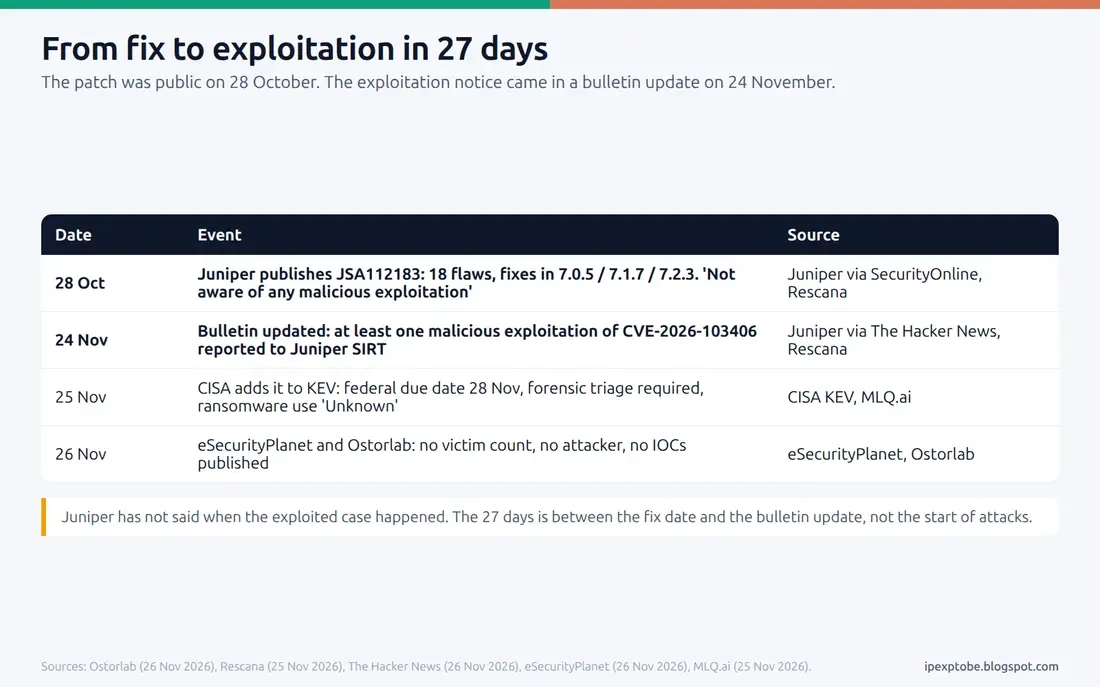
CISA's catalog entry, added 25 November, describes it as an OS command injection that could allow a remote attacker to execute arbitrary commands as root via a specially crafted salt minion ID. It sets a due date of 28 November, marks forensic triage as required under Binding Operational Directive 26-04, and lists use in ransomware campaigns as unknown.[5][8] The Hacker News and eSecurityPlanet both report the same facts, and eSecurityPlanet adds that neither Juniper nor CISA has identified the attackers, affected customers or the number of compromised systems.[2][3]
Two naming details can cost time when you search your inventory. CISA lists the vendor as Hewlett Packard Enterprise (HPE), so a search for 'Juniper' in a KEV feed filtered by vendor name will miss it; Rescana suggests filtering by CVE ID instead.[4] And CISA's entry names both Conductor and Router, whereas Juniper's own CVE record places 103406 in the Conductor. Rescana and eSecurityPlanet both say to treat both products as in scope, because the fixed releases are the same.[2][4]
Why the Conductor is the target
Session Smart Router is the software router behind Juniper's SD-WAN product, and the Conductor is the controller that manages a group of those routers.[1][7] A service provider or a large enterprise can run both, and eSecurityPlanet's summary is that root on the management system could let an attacker interfere with configurations or reach sensitive information about the managed infrastructure.[2]
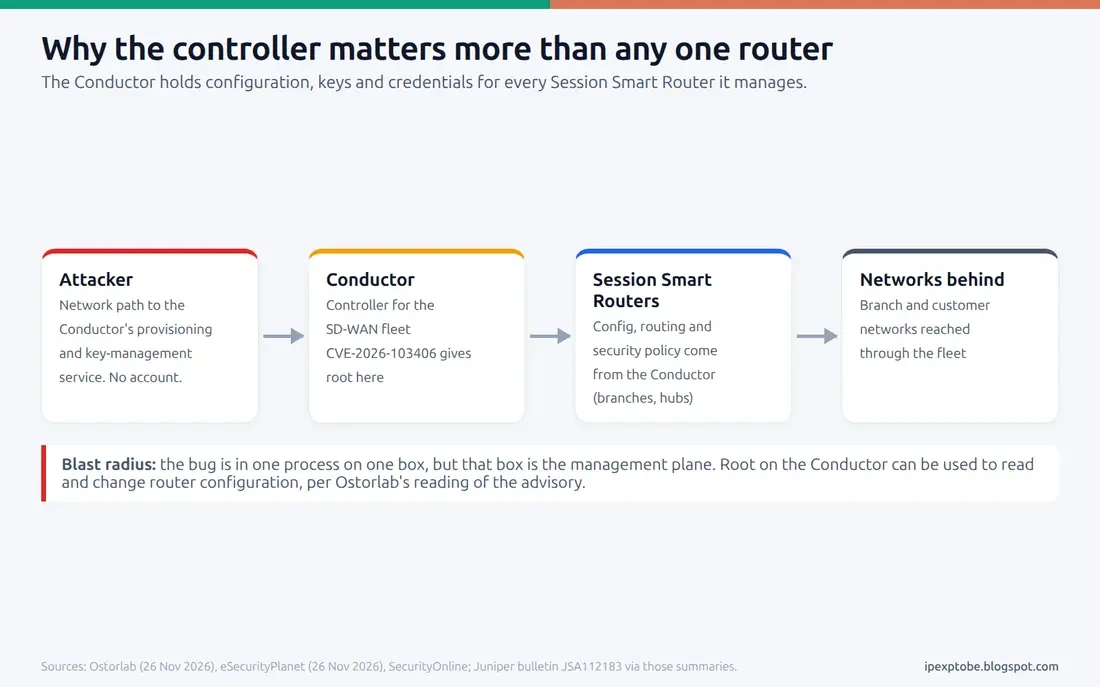
Ostorlab lists what root on the Conductor would give: reading and changing every managed router's configuration, including routing and security policy; reaching routing credentials and PKI material that the Conductor stores; using the Conductor's position to reach networks behind the routers; and pivoting to the routers themselves.[1] That is Ostorlab's reasoning from the product's role, not a description of what the attacker in the reported case did, which nobody has published. I would read it as the worst case you plan for, in the same way the vCenter zero-day and the Cisco Expressway root RCE were about what an attacker does after reaching a management node, not about the first bug.
The root cause, as far as it is public
Salt is an automation system in which each managed node, called a minion, registers with an ID. Per Salt's documentation as cited by Ostorlab, the ID defaults to the hostname and can be set explicitly in the minion configuration.[1] Juniper's CVE record puts the flaw in the AutomatedProvisioner, a Conductor component that handles key management, and says a remote attacker can execute arbitrary commands as root 'via a specially crafted salt minion ID'.[1][4]
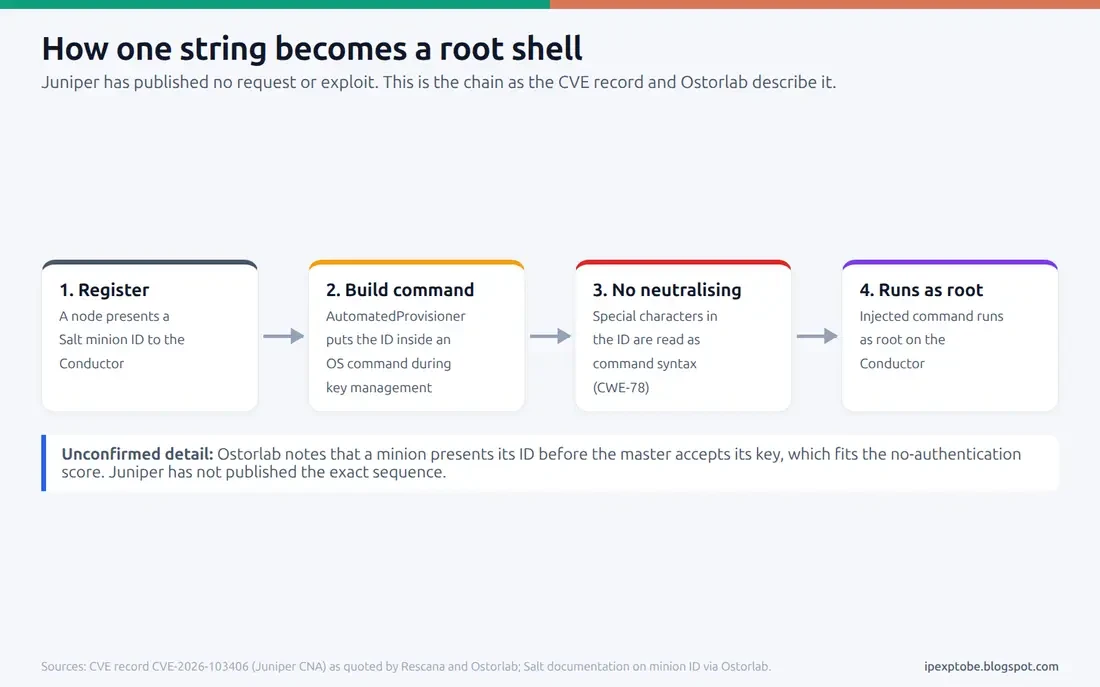
The weakness class, CWE-78, is the classic one: a string supplied by a remote party is placed inside an operating-system command without neutralising characters that the command interpreter treats as syntax. Because the process runs as root, so does the injected command.[1][4] Juniper tracks it internally as I95-65205.[1]
Ostorlab makes one observation worth keeping, flagged by them as consistent rather than confirmed: a Salt minion presents its ID when it connects, before the master accepts its key. That ordering fits the unauthenticated network vector in the CVSS score, although Juniper has not published the sequence.[1] Ostorlab also states that neither Juniper nor the CVE records include a request, payload or exploit script, and that no public proof of concept is mentioned in the material it read.[1] Rescana says no source it opened mentions a public proof of concept either, and that it did not search for one.[4] So 'no public PoC' means 'none reported by these two', not 'none exists'.
The score vector is CVSS 3.1 AV:N/AC:L/PR:N/UI:N, which is 9.8. NVD had not provided its own assessment as of Rescana's check on 25 November and displayed Juniper's CNA score. CISA's SSVC entry records exploitation as active, automatable as no and technical impact as total.[1][4] 'Automatable: no' is a useful nuance: CISA does not see this as a worm-style bug.
The other 17 flaws in the same bulletin
Treating this as a one-CVE problem would be a mistake, because the upgrade fixes 18 in one go and Juniper says there is no known workaround for all of them.[1][7] By Juniper's scores, as tabulated by Ostorlab, there are two Critical, eight High, seven Medium and one Low.[1] I counted that split from Ostorlab's table myself.
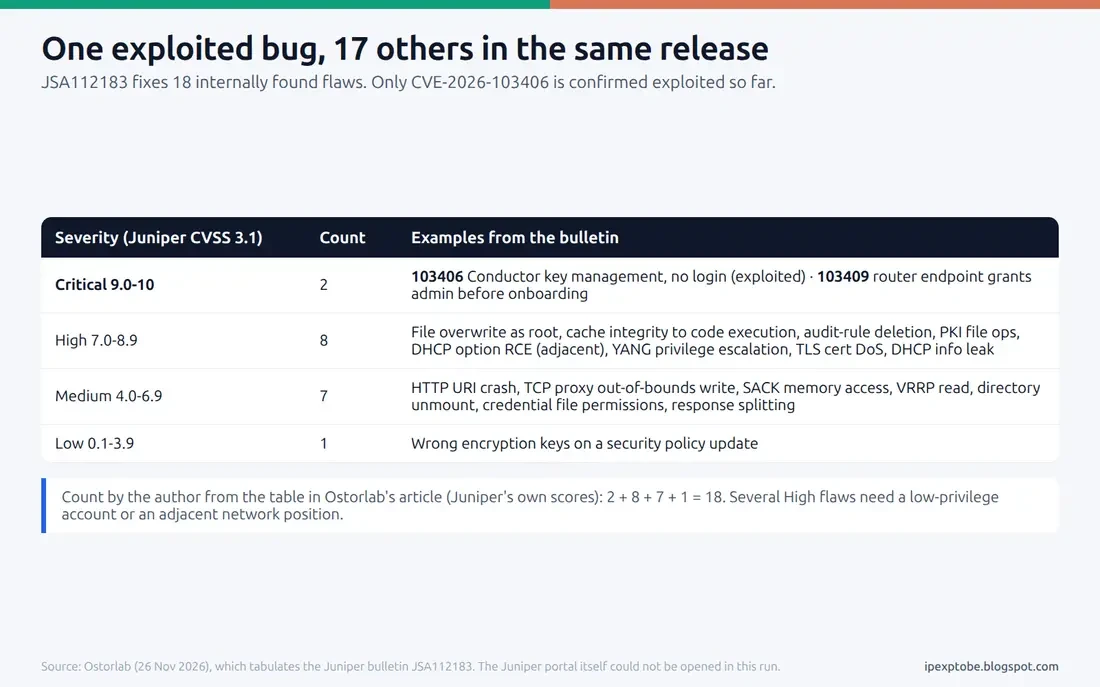
- CVE-2026-103409 (9.8, router). A missing-authentication flaw (CWE-306): an internal endpoint that runs as root accepts crafted URL parameters and grants administrative privileges. Juniper says it can only be exploited before the device is onboarded to Mist or a Conductor, so onboarding closes the window, though it does not fix 103406.[1]
- Six flaws rated 8.8. Most need a low-privilege account and lead to root file overwrite, code execution through missing cache integrity, file deletion and command execution through audit-rule deletion, PKI file operations, and privilege escalation through YANG configuration updates. One, CVE-2026-103408, is remote code execution through DHCP option parsing from an adjacent network.[1][7]
- Data-plane bugs in the Medium range. An out-of-bounds write with the TCP proxy feature, a SACK-option memory issue with TCP sequence stitching, a VRRP out-of-bounds read, and a crash on a malformed HTTP URI during application identification. Juniper rates them 4.3 to 5.5.[1]
The data-plane items are the ones a network engineer may find more familiar: they are about what a router does with packets from a peer, not about the controller. They are not reported as exploited. I mention them because they are fixed by the same upgrade, so the maintenance window is also the moment to close them.
Are you exposed?
- Release. Anything earlier than 7.0.5, or 7.1.0 to 7.1.6, or 7.2.0 to 7.2.2.[1][2] Juniper does not evaluate releases beyond end of engineering or end of life, so an older branch should be treated as affected and moved to a supported one.[1][9] Read the Conductor's version in its management interface, then each router's.[1]
- Reachability. The attack needs a network path to the Conductor's provisioning and key-management service and no account.[1] A Conductor reachable from the internet or from networks you do not control is the urgent case.[4] Neither source gives a port or exposure count, and I do not know of a public Censys-style figure for Conductors, so I will not quote one.
- Who runs it. If a managed service provider operates your SD-WAN, Rescana's advice is to ask for the release in writing, and to ask whether the Conductor was internet-reachable before the upgrade.[4]
| Branch | Affected | Fixed |
|---|---|---|
| 7.0 and earlier | every release before 7.0.5 | 7.0.5 |
| 7.1 | 7.1.0 to 7.1.6 | 7.1.7 |
| 7.2 | 7.2.0 to 7.2.2 | 7.2.3 |
Table per Ostorlab and eSecurityPlanet.[1][2]
Fix, restrict, check, rebuild
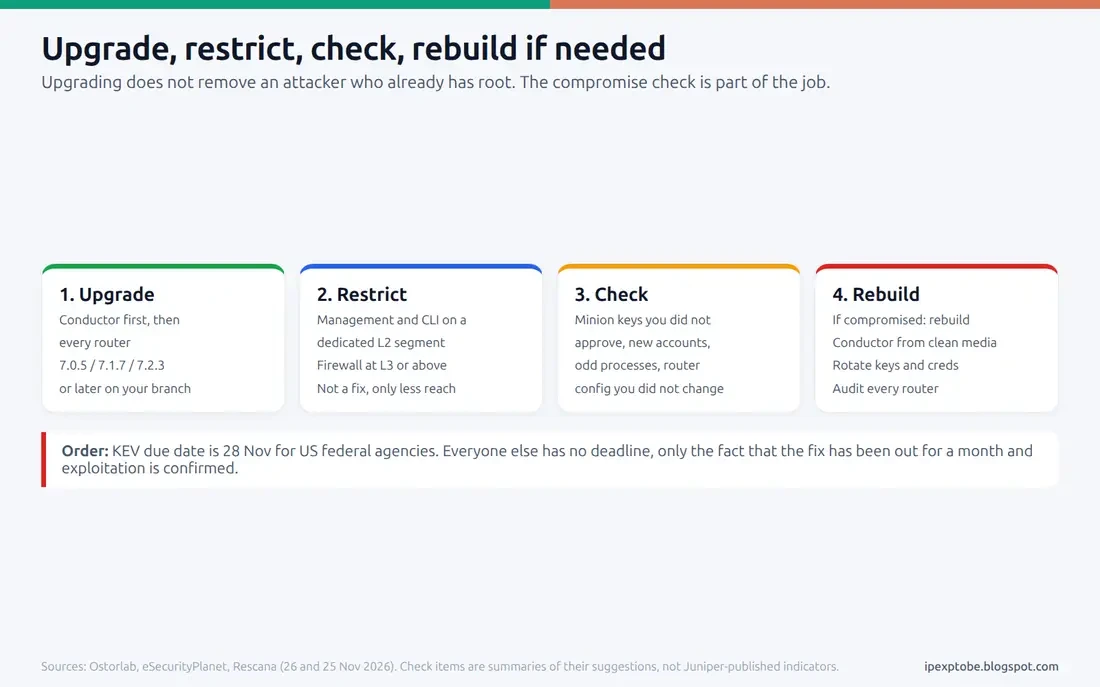
1. Upgrade the Conductor first, then every router
Ostorlab's order is: back up the Conductor configuration and record each router's current release; install 7.0.5, 7.1.7 or 7.2.3 on the Conductor from the Juniper support portal; upgrade managed routers to the same fixed release with the Conductor's router upgrade function; confirm every router reports the fixed release, standby and high-availability peers included.[1] Rescana points out that the same releases fix 17 other CVEs, 16 of which Juniper lists for the router, so upgrading routers is not optional even though 103406 is a Conductor flaw.[4]
2. If the upgrade has to wait, shrink who can reach it
Juniper's recommended mitigation, as Ostorlab quotes it, is to restrict the CLI and web-based management interfaces to a dedicated Layer 2 segment or VLAN and to enforce firewall policy at Layer 3 or above on the paths to them. Ostorlab is explicit that this reduces exposure but does not fix the flaw: an attacker with a network path to the provisioning service can still reach the vulnerable code.[1] CISA's KEV wording is stricter: apply vendor mitigations, and discontinue use of the product if mitigations are unavailable.[5]
My own addition, not vendor text: also check how routers reach the Conductor. If branch routers register over the internet, the provisioning path is by design reachable from outside, and a source allow-list for the branch addresses is worth considering. That is an inference from how the product is described, not a Juniper statement.
3. Check the Conductor for signs of compromise
Juniper and CISA have published no indicators, and Ostorlab warns that an attempt that failed, or one that ran a single command, may leave no trace.[1] eSecurityPlanet labels its own checks as investigative, based on the reported behaviour, not vendor-confirmed indicators.[2] The consistent list across Ostorlab, eSecurityPlanet and Rescana is:
- Minion registrations and key approvals you did not perform, including IDs that do not match your routers.[1][2]
- New local accounts, changed passwords and changes to the Conductor's own configuration.[1]
- Unexpected processes, files or scheduled jobs on the Conductor host.[1][4]
- Router configurations that changed outside your change process.[1][4]
- Connections to the Conductor's provisioning and management interfaces from outside the management VLAN, and connections from the Conductor to router management interfaces at times you did not schedule.[1]
Rescana adds that the window to review starts on 28 October, when the flaw became public, and that logs should be sent to a system an attacker on the Conductor cannot edit.[4] The second half of that is a good habit whatever the outcome.
4. If you find something, rebuild
Both Ostorlab and Rescana say an upgrade does not remove an attacker who already has root. The advice is to treat the Conductor as fully compromised: rebuild it from known good media, rotate the credentials and keys it holds, audit every router it manages, and contact Juniper SIRT and your incident response team.[1][4] The reason is the one that applies to every management-plane bug: with root, an attacker can have created persistence that the fixed code does not touch. The question 'who could reach this before I patched' also ran through the earlier posts on the F5 BIG-IP overflows and the Drupal installer flaw, and the patch-wave piece covers how to stage an urgent change so the fix itself does not cause an outage.
Same KEV batch: what else landed on 25 November
The Hacker News reports that CISA added ten flaws that day: five in Mitel MiCollab (disclosed the week before; Mitel's patch is for 10.3.0.18, and the advice for those who cannot update is to restrict external access to the AWV component), one in Vates Xen Orchestra (CVE-2026-133469, a 9.8 authentication bypass that Vates says was exploited), three in Danfoss AK-SM 800A refrigeration controllers, and the Juniper flaw.[3] Due dates are 28 November for most of them and 9 December for two. I only read the CISA listing and The Hacker News for these, so check each vendor's advisory before acting.[3][6]
FAQ
What is CVE-2026-103406?
An OS command injection (CWE-78) in the AutomatedProvisioner of Juniper Session Smart Conductor. A remote attacker can run commands as root through a crafted Salt minion ID. Juniper scores it CVSS 3.1 9.8 with no privileges and no user interaction.[1][4]
Is it being exploited?
Yes. Juniper reports at least one instance of malicious exploitation, and CISA added the CVE to KEV on 25 Nov 2026. No victim count, attacker or date has been published.[2][3][5]
Which versions are fixed?
7.0.5, 7.1.7 and 7.2.3, and later releases on the same branches, for both Session Smart Router and Session Smart Conductor.[1][4]
Is there a workaround?
No. Juniper's CVE record says no workaround exists. Restricting the management interfaces to a dedicated VLAN with firewall policy reduces exposure but does not fix the flaw.[1][4]
Do I need credentials to exploit it?
No, per the CVSS vector for CVE-2026-103406. Some of the other 17 flaws need a low-privilege account or an adjacent network position.[1]
Does it affect routers or only the Conductor?
Juniper's CVE record places 103406 in the Conductor. CISA's entry names both products, and the other flaws in the bulletin, including the second 9.8, affect the router. Upgrade both.[1][2][4]
Why does the federal due date matter to me?
It does not bind anyone outside US federal civilian agencies. It does tell you CISA considered the exploitation evidence strong enough for a three-day deadline, and it requires forensic triage, which is the step many teams skip after a patch.[2][5]
Is there a public exploit?
Juniper published no request, payload or script, and Ostorlab and Rescana report none public in the material they read. That is not proof that none exists.[1][4]
Sources
[1] Ostorlab, "Juniper Session Smart Router RCE, Exploited (CVE-2026-103406)," 26 Nov 2026 (read in full; it summarises Juniper's bulletin and CVE records).
[2] eSecurityPlanet, "Juniper Session Smart Conductor RCE Exploited: CISA Sets Nov. 28 Deadline," 26 Nov 2026 (read in full).
[3] The Hacker News, "Hackers Exploit 10 Vulnerabilities Across Mitel, Juniper, Vates, and Danfoss Products," 26 Nov 2026 (read in full).
[4] Rescana, "Juniper Session Smart Conductor CVE-2026-103406 Exploited and in CISA KEV: Upgrade Now," 25 Nov 2026 (read in full; quotes Juniper's bulletin and CVE record, read by Rescana).
[5] CISA, Known Exploited Vulnerabilities Catalog, entry for CVE-2026-103406 (search-result excerpt, which includes the full entry text: date added 2026-11-25, due 2026-11-28, forensic triage required).
[6] CISA, "CISA Adds 10 Known Exploited Vulnerabilities to Catalog," 25 Nov 2026 (search-result excerpt).
[7] SecurityOnline, "Session Smart Router Vulnerabilities Actively Exploited," (partial text; includes the 24 Nov update).
[8] MLQ.ai, "CISA gives agencies until Nov. 28 to patch an exploited Juniper router flaw," 25 Nov 2026 (search-result excerpt).
[9] ThreatTicker, "Juniper Session Smart Conductor flaw CVE-2026-103406 exploited in the wild, CISA adds it to KEV," 25 Nov 2026 (search-result excerpt; source for the end-of-engineering / end-of-life remark).
[10] Juniper Networks, JSA112183 (2026-10 On-Demand Security Bulletin): not opened directly (the portal failed to load in this run); its content is taken from the secondary sources above.
Try it: Network Latency Calculator - free, runs in your browser.
Related reading
- Drupal Fail2Install (CVE-2026-132165) Explained: Exploited Installer Flaw, Fixed Versions and How to Block It
- F5 BIG-IP Six Critical Flaws (CVE-2026-123637 and More) Explained: Hotfix Only, Who Is Exposed and How to Check
- Cisco Expressway CVE-2026-76466 Explained: Root RCE Exploited After a Public PoC, Fixed Versions and How to Check
- VMware vCenter CVE-2026-123890 Explained: The Zero-Day Used Since September, Fixed Versions and How to Check for Compromise
- NGINX2Root (CVE-2026-123007) Explained: The nginx HTTP/2 Bug, Who Is Exposed and How to Fix It
- Java4Shell (CVE-2026-114938) Explained: The OpenJDK Base64 Bug, Who Is Exposed and How to Fix It


Comments
Post a Comment