Did Rushed Security Patches Cause the November 2026 Outages? Evidence Check and a Safe Patching Playbook
News analysis, written 19 November 2026. Every factual claim links to a source we read today. Several root causes are still preliminary, so treat the incident table as a snapshot, not a verdict.
In six days, Microsoft 365 went down for almost 24 hours, the FAA stopped every departure in the US, a bug at JPMorgan Chase slowed payments at other banks, Apple's iCloud and App Store failed, and the NSA's classified internal network was degraded.[1] No one has blamed an attacker. Instead, a new explanation has taken hold in Washington: defenders patching too much, too fast. Secretary of State Marco Rubio says patches are "creating short-term disruption in the way the system works."[2] Director of National Intelligence Jay Clayton says systems being upgraded are "not coming back as expected in all cases."[8]
Is that true? Partly. Below: what the evidence shows, how security changes actually take infrastructure down, and a playbook for patching quickly without causing your own outage.
- The specific claim is unverified. The idea that patches for AI-found bugs caused the outages comes from anonymous sources, and several causes on the record do not fit it.[1]
- The general claim is partly supported. The NSA disruption has been tied on record to PHP2Shell patching, and Apple blamed an "internal update."[7][1]
- The pressure is real. More than 100,000 CVEs were published in 2026 by 13 November, more than double all of 2025.[4] Patch deadlines are shrinking too.[9][10]
- What to do: triage by exposure and exploitability, shield first, then roll out in rings with capacity checks between them.
The outage cluster · Evidence check · Why the patch queue exploded · How patches break networks · Playbook · What to watch · FAQ
The outage cluster: what each organisation actually said
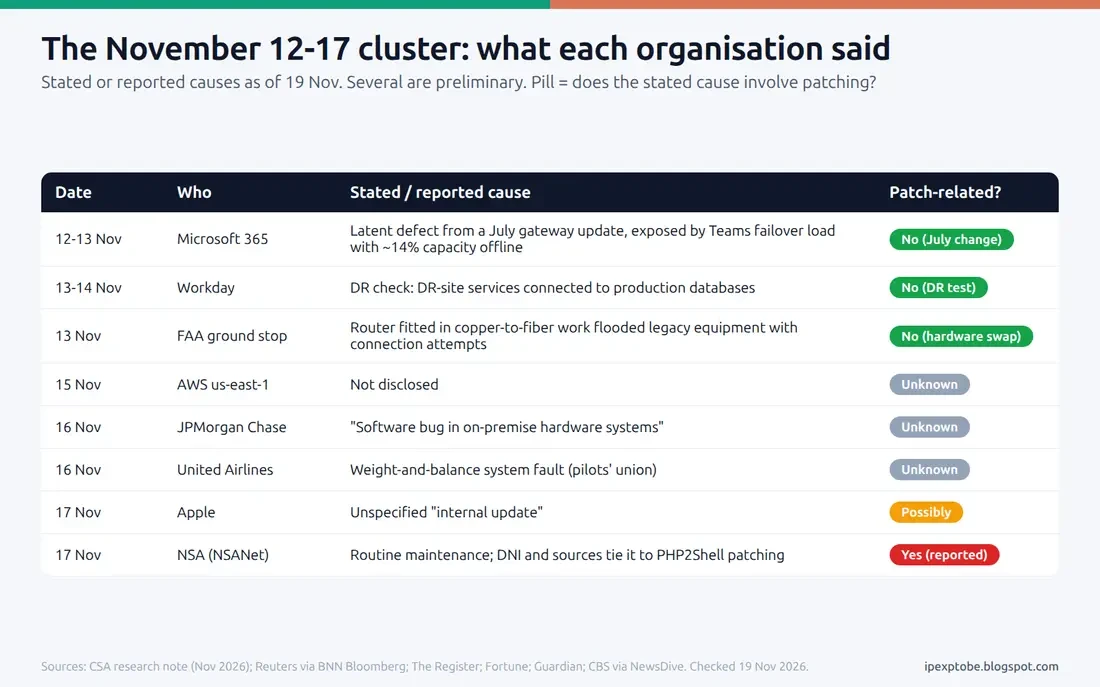
The Cloud Security Alliance (CSA) has put together the most careful list so far. Every organisation that has published a cause "pointed to something internal: a latent software defect, a failover, a disaster-recovery test, a router replacement, an internal update, or routine maintenance."[1] In detail:
- Microsoft 365 (12-13 Nov): a defect shipped in a July gateway update, triggered when Teams failover traffic arrived while about 14% of gateway capacity was offline.[1] We covered the PIR in our Microsoft 365 outage analysis.
- Workday and the FAA (13 Nov): a DR check in which DR-site services "unexpectedly connected to Production databases," and a router fitted during copper-to-fiber work that flooded legacy equipment with about 1,000 connection attempts every four to five seconds.[1] See our FAA ground stop post-mortem.
- AWS, Chase, Apple, NSA (15-17 Nov): AWS has not disclosed a cause; Chase cited a "software bug in on-premise hardware systems"; Apple an unspecified "internal update"; the NSA "temporary degradation during scheduled routine maintenance," which sources tied to routine patching.[1]
As Fortune put it: "Most of it happened while someone was changing or fixing something."[5] That is not the same as saying they were all security patches.
The "rushed patches" theory: evidence check

Claim A: patches for AI-discovered bugs caused the outages. According to secondary coverage of a Washington Sun report, Wall Street executives and NSA officials privately told Congress that rushed fixes for AI-found vulnerabilities caused the outages. A congressional official was quoted: "They're trying to push through a lot of patches all at once — more than the system was designed for."[3] CSA could not find the original report and calls this specific causal claim "unsupported."[1] It also conflicts with causes on the record: Microsoft's bug dates from July, Workday's came from a DR test, and the FAA's from a router swap.[1] Christiaan Beek of Rapid7 says he sees no public evidence that rushed updates caused the outages: "Complex systems fail in boring ways far more often than because of an adversary."[3]
Claim B: patching and upgrades caused some of them. This one has support on the record. Clayton linked the NSA outage to patching for PHP2Shell, two AI-assisted PHP findings that the FBI, NSA and CISA urged everyone to patch on 21 October. He said updates to a PHP-based web interface left some systems unable to restart as expected.[7] Even after NSANet came back, the agency kept staggering staff arrivals ("Code Gray") because of concern the system might not handle everyone logging in at once.[7] Clayton also said "handoffs are not coming back as expected."[8] None of these sources says the patched bugs were found by AI.[1]
Claim C: patch pressure itself has become a risk. This is well documented, as the next section shows. CSA's conclusion is the one we would sign: there is no public evidence that patching for AI-found bugs caused any particular outage, but "organizations should treat change velocity as a security-relevant risk in its own right."[1]
Why the patch queue exploded in 2026
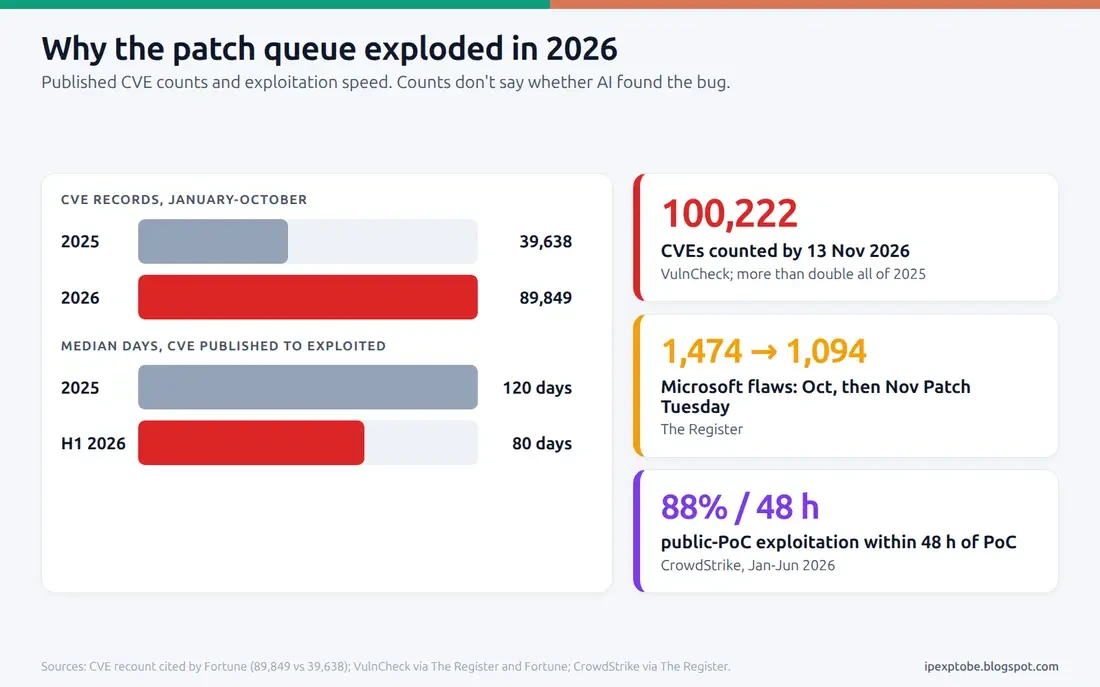
- Volume. VulnCheck counted 100,222 CVEs on 13 November, more than double 2025's total. Microsoft added 1,094 flaws on November Patch Tuesday after 1,474 the month before.[4] A recount of CVE records cited by Fortune found 89,849 through October, against 39,638 in the same months of 2025.[5]
- Exploitation speed. VulnCheck found that the median time from CVE publication to exploitation fell from 120 days in 2025 to 80 days in the first half of 2026. CrowdStrike saw 88% of exploitation using public proof-of-concept code happen within 48 hours of the code's release.[4]
- Shorter disclosure windows. On 13 November, Google Project Zero dropped its "90 + 30" policy. It argues that "patch soak time is no longer meaningful" when attackers can work out a bug from its patch almost immediately. The window falls to 60 days on 2 February 2027 and to 30 days on 3 January 2028.[9]
There are caveats. CVE records do not say whether AI found the bug, and the recount found that the set of flaws flagged for urgent patching "hasn't grown much": "Twice as many CVEs does not mean twice the danger."[5] Only about 1.4% of this year's CVEs (1,363) are in VulnCheck's known-exploited catalog.[4] That number is the key to the playbook below. You do not have to patch 100,000 things urgently. You have to find the few dozen that matter to you.
How a security patch turns into an outage
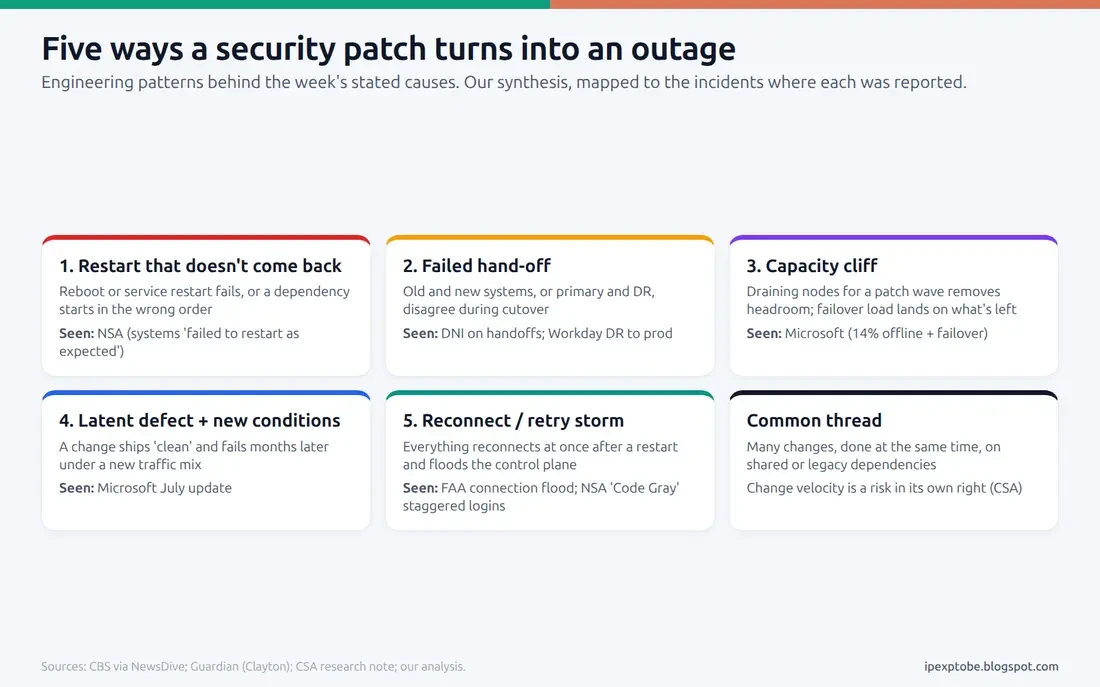
Chris Krebs, the former CISA director, described the basic mechanism to CNN: "Sometimes you do a patch, you push an upgrade in a system, it behaves abnormally, and it tips over, so to speak."[6] From a network and operations point of view, the week's causes fall into five patterns. The classification is ours; the examples come from the sources.
- The restart that doesn't come back. A patch means a reboot or a service restart, and something fails to start, or starts in the wrong order. That is the NSA case.[7]
- The failed hand-off. The old and new system, or primary and DR, disagree about who owns traffic or state during the cutover. This matches Clayton's "handoffs" and Workday's DR environment connecting to production.[8][1]
- The capacity cliff. To patch, you drain nodes. If the drain happens while part of the fleet is already degraded and a failover moves load onto the remainder, you go over the edge. Microsoft's outage came from that combination, although its trigger was not a security patch.[1]
- Latent defect plus new conditions. A change looks clean for months and then fails under a traffic mix the lab never reproduced. Microsoft's load testing missed its defect because of the lab traffic mix and hardware SKUs; faster cadence leaves less time to watch each change.[1]
- The reconnect storm. After a restart, every client reconnects at once. The FAA's connection flood and the NSA's staggered logins are two forms of the same control-plane problem.[1][7]
As one security CTO quoted by Reuters put it, emergency patches "change runtimes, kernels and network components that everything else depends on. That speed and scale of change is itself a source of failure."[2] Kernel fixes like NoisyTCP (CVE-2026-99288), disclosed the same week, need a reboot of every affected host: a fleet-wide event that invites patterns 1, 3 and 5.
Playbook: patch fast without taking yourself down
Step 1. Triage by exposure and exploitability, not CVSS
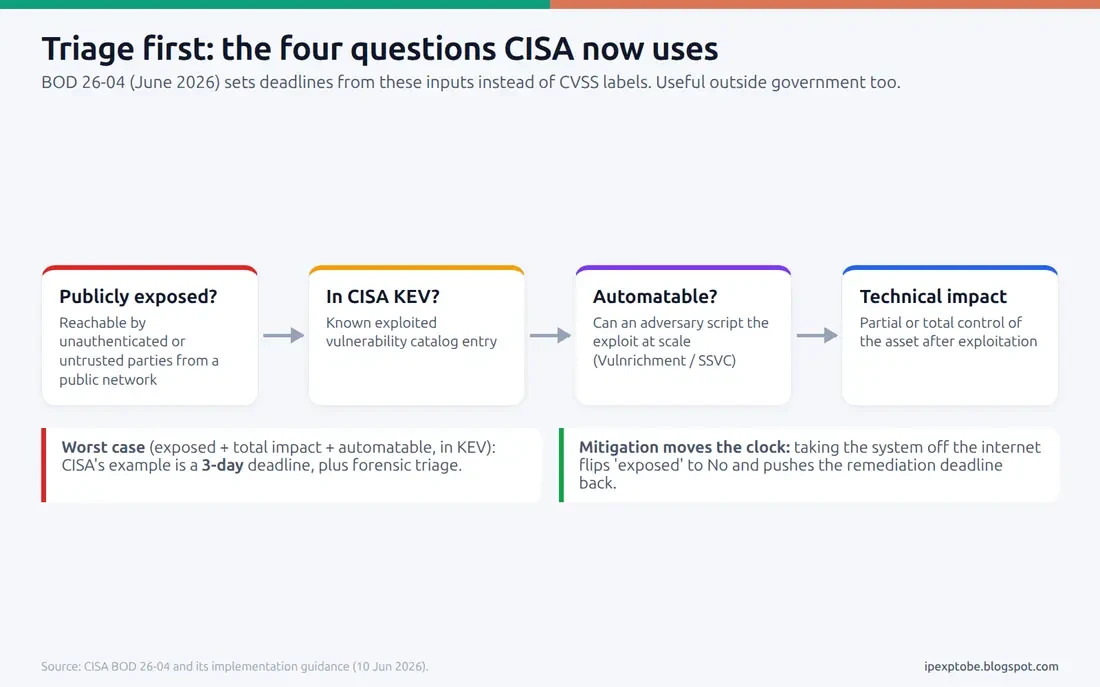
CISA's BOD 26-04 (June 2026) replaced BOD 19-02 and BOD 22-01. It sets remediation urgency from four inputs: is the asset publicly exposed, is the CVE in the KEV catalog, is the exploit automatable, and what technical impact does an attacker gain.[10] For example, if a vulnerability is on a publicly exposed asset, gives total control and is automatable, the KEV due date is a 3-day patching deadline.[11] The directive binds only US federal agencies, but the model works anywhere. Mitigation counts: "one valid mitigation is to remove the system from the internet," which changes the exposure input and pushes the deadline back.[10] And CISA says it would remove a KEV entry "if the vendor's security update causes an unforeseen issue with greater impact than the vulnerability itself."[11] In other words, a broken patch is a recognised failure mode, not a reason for shame.
Step 2. Shield first, then patch
Project Zero tells vendors to plan "non-patch strategies" for when a serious bug goes public before a fix.[9] Operators can do the same. Use an ACL or firewall rule in front of the service, remove the management interface from reachable address space, add a WAF rule, or turn off the vulnerable feature. These are fast, reversible and rarely need a reboot, so they buy time for a safe rollout. CSA also recommends compensating controls such as segmentation and restricted management interfaces.[1]
Step 3. Roll out in rings with real gates
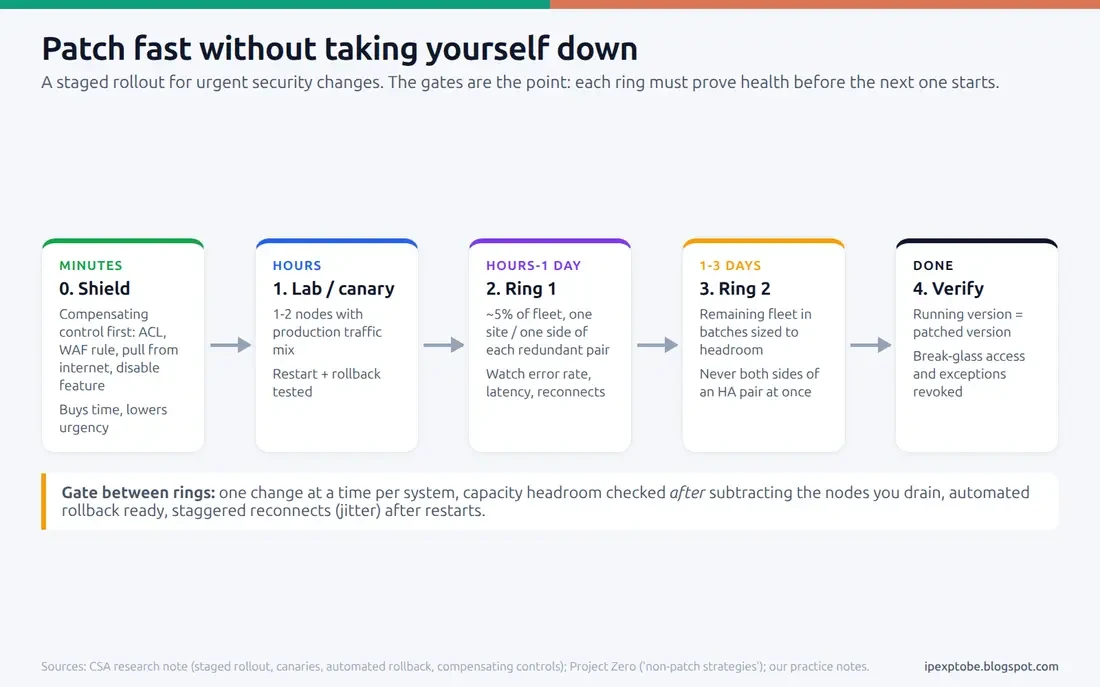
CSA's advice is to apply staged rollout with canary populations and automated rollback to security changes as well as feature changes.[1] The following network-specific rules are our own practice, not taken from the sources:
- Calculate headroom after the drain. Subtract the nodes you are about to take down and anything already degraded, then check the rest can carry peak load plus a failover (the Microsoft lesson).
- Never patch both sides of a redundant pair in the same window. That applies to HA firewalls, dual route reflectors, MLAG peers and both members of an anycast pair. Confirm the patched side carries traffic before you touch the other.
- One change per system per window, so you know what to roll back.
- Spread out reconnects: jitter client retries and stagger VPN, controller and session re-establishment after restarts.
- Verify what is actually running. Check the running version, not the package on disk. Afterwards, revoke break-glass accounts and temporary policy exceptions, which CSA also recommends.[1]
Step 4. Communicate with stated confidence
CSA warns against "premature exoneration" and suggests wording like "no indicators of compromise identified to date; investigation ongoing." It also notes that outage windows, with emergency access grants and account-recovery prompts, are prime time for phishing.[1]
What to watch next
Microsoft's final post-incident report is still pending.[1] Microsoft's next Patch Tuesday on 8 December is, in Fortune's words, "the next test of the patch pipeline."[5] In Congress, the bipartisan ROOT CAUSE Act would create a CISA board to investigate major incidents, including faulty updates, even without signs of an attack.[3] Project Zero moves to "Full 60" on 2 February 2027.[9]
Former CISA director Chris Krebs expects "the next 12 to 18 months are going to be a bumpy ride."[3] The answer is not to patch slower. It is to treat the rollout process as a key part of security and give it the same engineering effort.
FAQ
Were the November 2026 outages a cyberattack?
No organisation has blamed an attacker, and the DNI said there was no sign of a coordinated or state-sponsored attack.[1] CSA cautions that "no evidence" is an early statement, not a finding.[1]
Did AI-found vulnerabilities cause the outages?
That has not been shown. The claim rests on anonymous sourcing, and CSA found no public evidence linking patches for AI-found bugs to any specific outage.[1]
What is PHP2Shell?
Two serious PHP flaws found with AI help. The FBI, NSA and CISA urged immediate patching on 21 October. Reports tie the NSA network disruption to that patching effort.[7]
Should we slow down patching to avoid outages?
Not across the board. Exploitation is getting faster.[4] Triage instead: patch what is exposed, exploited or automatable first, shield everything else with compensating controls, and roll out in staged rings.[10][1]
Sources
[1] Cloud Security Alliance AI Safety Initiative, "The November Outage Cluster: Correlated Fragility and Attribution," Nov 2026.
[2] Reuters via BNN Bloomberg, "Surge in software patches likely behind recent tech outages, experts say," 19 Nov 2026.
[3] Technology.org, "Rushed Patches for AI-Found Bugs Linked to US Bank and NSA Outages," 19 Nov 2026.
[4] The Register, "This year's bug count just passed 100K," 13 Nov 2026.
[5] Fortune, "Top cyber expert warns of a 'vulnpocalypse' after 4 major U.S. systems broke in 6 days," 18 Nov 2026.
[6] CNN, "What's causing all these outages?," 18 Nov 2026.
[7] CBS News via NewsDive, "Software Flaw Tied to Disruption of NSA Network," 19 Nov 2026.
[8] The Guardian, "'Zero' evidence that recent cascade of tech outages are linked, says Rubio," 18 Nov 2026.
[9] Google Project Zero, "Policy and Disclosure: 2026 Edition," 13 Nov 2026.
[10] CISA, "BOD 26-04: Prioritizing Security Updates Based on Risk," 10 Jun 2026.
[11] CISA, "BOD 26-04: Implementation Guidance," 10 Jun 2026.
Try it: Network Latency Calculator - free, runs in your browser.
Related reading
- NoisyTCP (CVE-2026-99288) Explained: The 11-Year-Old Linux TCP Bug That Crashes Servers Remotely
- GPT-6 Cyber Explained: What OpenAI’s New Model Can—and Cannot—Do
- Build a Read-Only Network Change Reviewer with Claude Fable 5.2
- GPT-6 Cyber Red Teaming: Safe Scopes, Monitoring, and Human Approval
- GPT-6 Cyber and the AI Supply Chain: Securing Models, Datasets, and Packages
- GPT-6 Cyber, Secrets, and Lateral Movement: Protecting Agent Credentials


Comments
Post a Comment