NoisyTCP (CVE-2026-99288) Explained: The 11-Year-Old Linux TCP Bug That Crashes Servers Remotely
This is a news-analysis and how-to post, not a vendor advisory. Every factual claim links to the researcher's disclosure, the kernel fix text or a distribution tracker, all read on 18 November 2026. Patch status changes daily, so check your own vendor's page before you act.
On 15 November 2026, once the embargo with the linux-distros list ran out, researcher Hyunwoo Kim (@v4bel) published NoisyTCP, tracked as CVE-2026-99288.[1] It is a race condition in the Linux kernel's TCP receive path. A remote attacker who needs no account and no login can make the kernel dereference a NULL pointer and panic. Kim says the target needs nothing special: a "plain" TCP listener is enough, such as Nginx, Apache or SSH running with their "default" configuration.[1] The bug was introduced on 3 October 2015 and fixed upstream on 3 November 2026, so it sat in the kernel for about 11 years and "affects almost all Linux distributions."[2]
For network engineers the interesting part is why it works: the race depends on how the NIC spreads packets across CPUs (RSS/RPS) and on SYN cookies, a defence we normally rely on.
- What: a race in the kernel's lockless TCP "established" socket lookup. A stale lookup can return a newly built SYN-cookie request socket that has no listener, and the kernel then panics.[3]
- Who: unpatched Linux hosts with two or more RX queues, or with RPS enabled, that expose a TCP listener the attacker can reach directly.[1]
- How bad: a remote denial of service of the whole host, including every container on it. Red Hat rates it Important and says it does not allow data alteration or code execution.[4] The researcher also describes a second use-after-free path, which he calls hard to trigger.[1]
- How fast: 5 seconds to 2 minutes against default services on QEMU/KVM VMs, and about 14 hours on a quiet bare-metal Nginx box, according to the researcher's tests.[1]
- Fix: upstream commit 4e2b3ef19e0e, "inet: reject unhashed sockets during established lookups", followed by a reboot. The stopgaps are
tcp_syncookies=0or a single RX queue with RPS/RFS turned off.[2][6]
How the race works · Why it is a networking bug · Who is exposed · Patch status · How to check your hosts · Mitigations and trade-offs · Timing: a week of outages · FAQ
How the race works
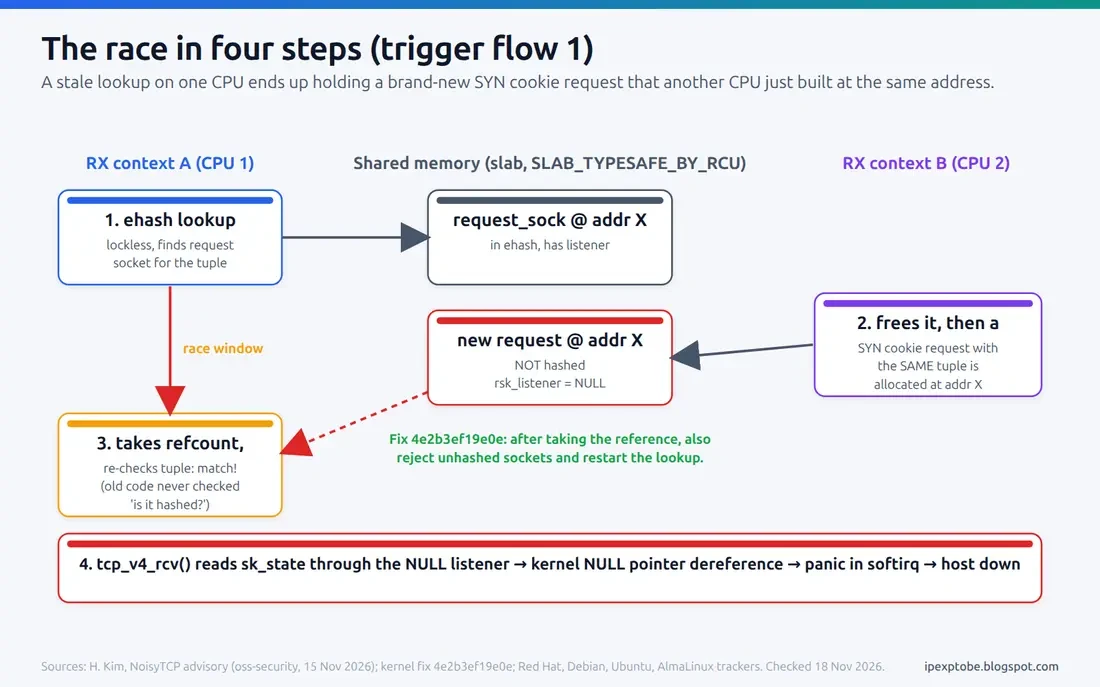
When a TCP segment arrives, the kernel has to find the socket it belongs to. It does that with a lookup in the established hash table (ehash). The fix description explains that "TCP established ehash lookups are lockless," and that the socket caches use SLAB_TYPESAFE_BY_RCU, "so memory can be reused before an RCU reader that retained its old address has finished."[3] To guard against that reuse, the lookup functions take a reference after a tuple match and then check the tuple again. Before the fix, "they do not check whether the new object is hashed."[3]
The exploit sits in exactly that gap. On one CPU, a lookup finds a request socket (the small socket created for a half-open handshake). At the same moment, another RX context frees that socket and "reallocates a SYN cookie request with the same tuple at the same slab address."[1] The first CPU takes a reference on the new object, and the tuple check still passes because the addresses and ports match. A request rebuilt from a SYN cookie, however, is never inserted into the hash table and has a NULL rsk_listener. tcp_v4_rcv() then reads sk_state through that NULL pointer, and the kernel logs "Kernel panic - not syncing: Fatal exception in interrupt."[3] AlmaLinux sums it up this way: the second check "only compared addresses and ports. It did not check whether the object was actually in the hash table."[6]
The fix does what that sentence implies. After taking the reference, both the IPv4 and IPv6 lookups now check whether the node is unhashed, and if it is, they drop the reference and restart.[3]
Why this is a networking bug, not just a kernel bug
The race needs two features that network engineers tune all the time.
Multi-queue receive. The race needs "different RX contexts" working on the same flow at the same time.[1] A NIC normally keeps one flow on one queue. The kernel documentation describes RSS as a hash "over the network and/or transport layer headers," for example "a 4-tuple hash over IP addresses and TCP ports," and says RPS likewise uses a "2-tuple or 4-tuple hash depending on the protocol."[11] Kim's technique exploits that difference: "Packet processing has to be spread out by using the difference in receive hash between IPv4 fragments and regular TCP packets."[1] The fragment carries no TCP ports to hash on, so it can be processed on a different CPU from the rest of the same connection. That is how two cores end up touching the same socket at once.
SYN cookies. RFC 4987 describes SYN cookies as allocating "no state at all for connections in SYN-RECEIVED" and encoding the needed state into the SYN-ACK sequence number instead.[9] On Linux, net.ipv4.tcp_syncookies defaults to 1, which means the kernel sends cookies when a socket's SYN backlog overflows.[10] Because a request rebuilt from a cookie never goes into the hash table, it is exactly the kind of object the old recheck could not tell apart from a real one.[3]
Unlike bugs that need "a rarely used configuration, a netfilter rule or a specific socket," this one "triggers even when the server does nothing more than call listen()."[2]
Who is exposed
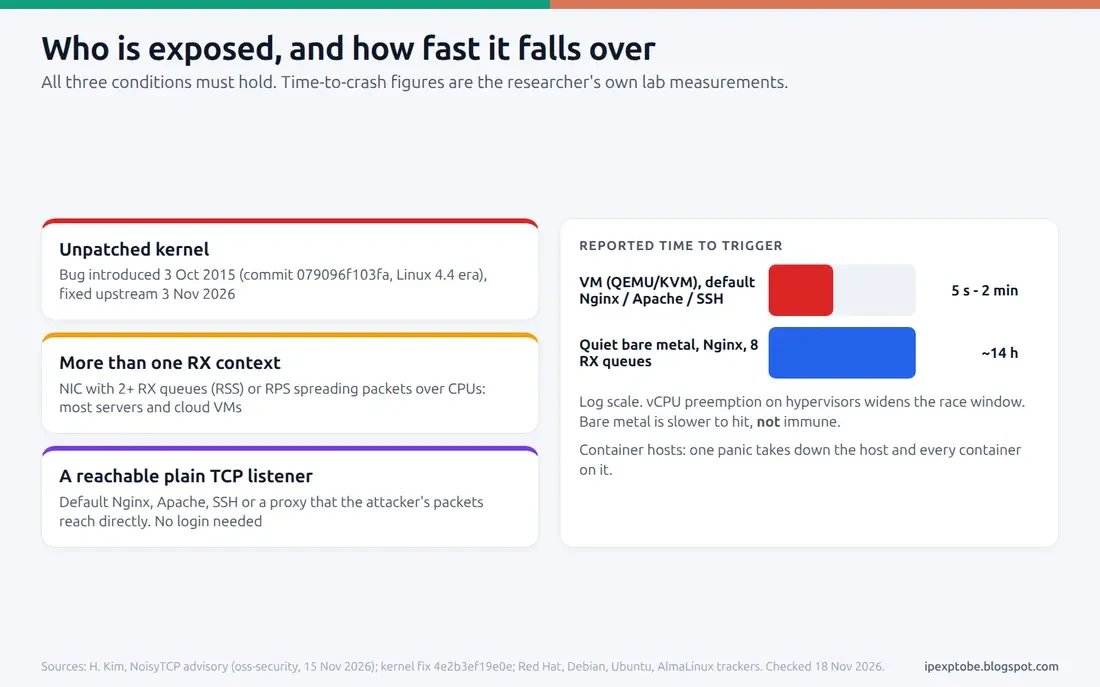
A host is exposed if three things are true. It runs an unpatched kernel from the affected range. It has two or more RX queues or RPS enabled. And it has a TCP listener that "TCP packets sent by an attacker can reach directly."[1] AlmaLinux notes that the multi-queue condition "describes most servers and cloud instances."[6]
How fast the attack works depends on where the target runs. Against default Nginx, Apache and SSH on QEMU/KVM VMs, "where vCPU preemption can occur," it took about 5 seconds to 2 minutes. Against default Nginx on a quiet bare-metal server with 8 RX queues it took about 14 hours, even with a PoC tuned for that environment.[1] iTnews gives the reason: hypervisors can pause a virtual CPU partway through an operation, which widens the race window.[7] So cloud VMs and virtualised appliances are the soft targets, and quiet bare metal holds out longer but is still vulnerable.
The blast radius is the whole host: against a containerised web server, "it takes down not only the web server application but the entire host."[1] On a Kubernetes node, that is every pod on it.
Severity scores disagree, so read the vector strings rather than relying on a single number. Red Hat gives 7.5 and rates the issue Important, while the cve.org vector shown on Red Hat's page scores 5.9 (AV:N/AC:H/PR:N/UI:N/S:U/C:N/I:N/A:H).[4] Ubuntu also shows 5.9 Medium but sets its own priority to High.[5]
Network engineers should also consider their own devices. Our view, not the advisory's: many routers, switches, firewalls and load balancers run Linux and expose SSH, BGP, gNMI or HTTPS listeners. Ask vendors whether their kernel is in the affected range, and keep management-plane listeners off reachable address space.
Patch status (as of 18 November 2026)

- Upstream stable: the fix is in 6.12.117, 6.18.63 and 7.3.4.[7] IT-Connect reported on 17 November that it had not yet reached the 6.6 and 6.1 branches.[8]
- Debian: fixed in trixie-security (6.12.117-1, DSA-6628-1) and bookworm-security (DLA-4906-1), and in forky/sid with 7.3.4-1.[3]
- Ubuntu: the CVE page lists the
linuxpackage as Vulnerable on every release from 16.04 to 26.10 (14.04 is not affected), with priority High.[5] - Red Hat: RHEL 8, 9 and 10 and OpenShift are affected.[4] IT-Connect reported no fixed Red Hat product listed as of 17 November.[8]
- AlmaLinux: patched kernels for 8, 9 and 10 were released to the testing repository on 16 November, with a call for testing.[6]
Remember that a kernel fix only takes effect after a reboot (or a livepatch, if your vendor ships one). Installing the package is not enough. Compare the running kernel from uname -r, not the latest package on disk.[6]
How to check your hosts
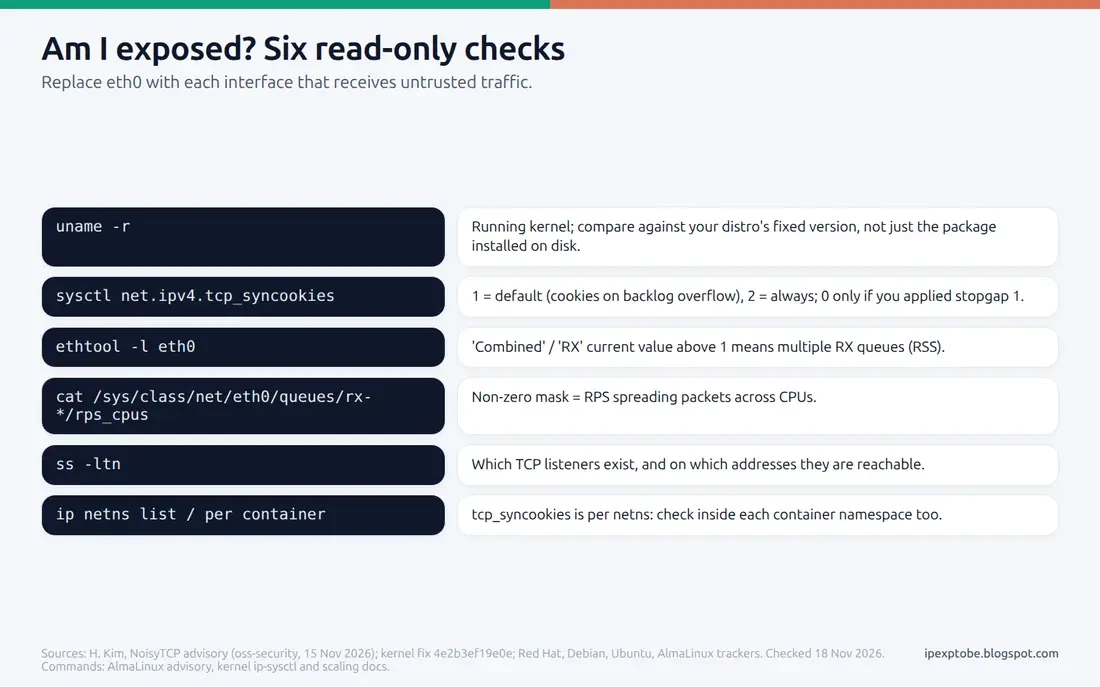
All of these are read-only and safe to run on production:
uname -r                                   # running kernel vs your distro's fixed version
sysctl net.ipv4.tcp_syncookies             # 1 = default; 0 only if you applied the stopgap
ethtool -l eth0                            # current RX/combined queues; above 1 = multi-queue
cat /sys/class/net/eth0/queues/rx-*/rps_cpus   # non-zero mask = RPS on
ss -ltn                                    # which TCP listeners exist, and on which addresses
ip netns list                              # sysctl is per-namespace: check containers too
Mitigations and their trade-offs
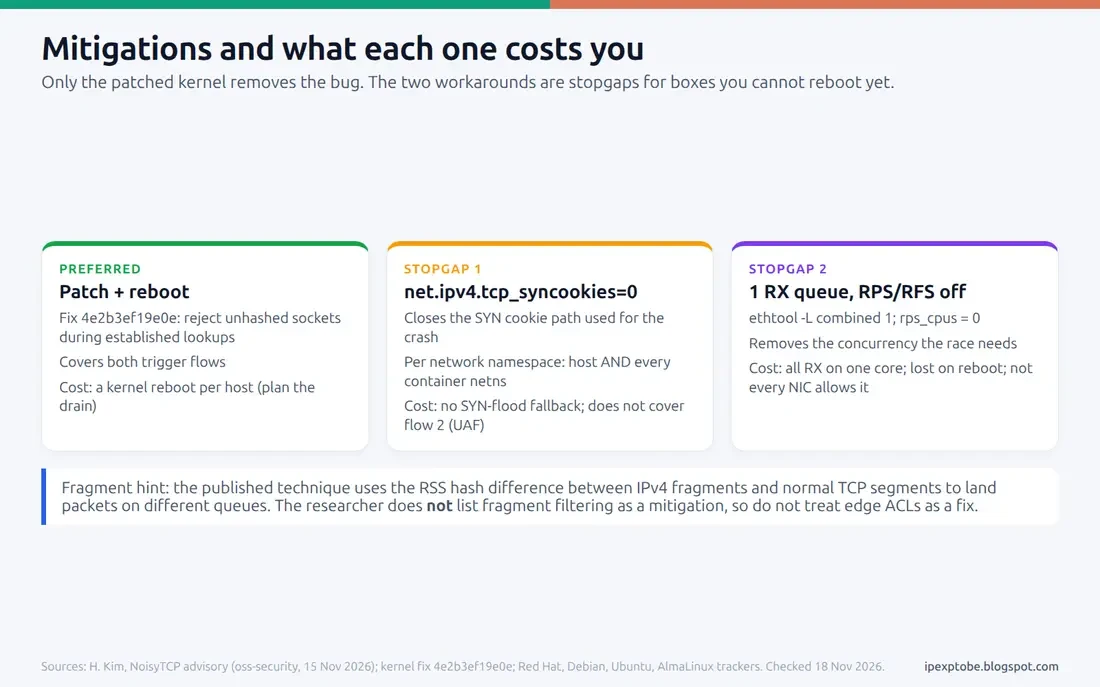
1. Patch and reboot (preferred). Kim says applying 4e2b3ef19e0e "is the priority."[2]
2. Disable SYN cookies. sudo sysctl -w net.ipv4.tcp_syncookies=0 closes the path where a request socket is rebuilt from a cookie. The setting is per network namespace, so it "has to be applied to 'each' container that uses a separate network namespace," and it "lowers the protection against SYN floods."[2] AlmaLinux puts the trade-off this way: "on an internet-facing server you trade one way to be knocked offline for another." It also notes that this does not cover the second, use-after-free variant.[6] The kernel documentation describes cookies as a "fallback facility," so before switching them off, check that your SYN backlog sizing (tcp_max_syn_backlog) and any upstream SYN-flood protection can cope without them.[10]
3. Serialise receive to a single queue. Reduce the external interface to one RX queue and disable RPS and RFS. AlmaLinux gives the commands as ethtool -L eth0 combined 1 (or rx 1), and writing 0 to rps_cpus and rps_flow_cnt and to net.core.rps_sock_flow_entries. The cost: all receive work lands on one core,[8] the settings do not survive a reboot, and "not every network card or virtual NIC allows changing its queue count."[6]
What not to rely on. Dropping inbound IPv4 fragments at the edge may look like a shortcut, since the technique uses them. The researcher does not list it as a mitigation and we have not tested it, so treat it as defence in depth only.
Timing: a week of outages and patch pressure
NoisyTCP arrived during an unusually bad week for infrastructure. Microsoft 365 went down for almost a day (our reading of Microsoft's PIR), the FAA ordered a nationwide ground stop (our post-mortem), and there were further outages at US banks, Apple and an NSA internal network. The Guardian reports that US officials say there is "zero" evidence the incidents are linked or malicious.[12] Senator Mark Warner said the outages came from attempts to shore up systems, not a "coordinated effort": "The evidence so far points toward legitimate efforts to secure our systems, not malicious activity."[12]
The lesson from Microsoft's outage applies to this patch too: a fleet-wide reboot is a load event. Reboot in batches that fit your capacity headroom, and do not take half a cluster down at once to close a DoS bug.
FAQ
What is NoisyTCP?
NoisyTCP is the name for CVE-2026-99288, a race condition in the Linux kernel's lockless TCP established-socket lookup. It lets a remote, unauthenticated attacker crash the kernel by sending TCP traffic to a listening port.[1][4]
Is NoisyTCP remote code execution?
The researcher says "Not yet. and basically, no." Remote DoS is the practical impact. He also describes a second use-after-free path, which he calls hard to trigger.[2] Red Hat says the flaw does not allow code execution.[4]
Does it affect containers?
Yes. The crash is in the host kernel, so it takes down the whole host. The SYN-cookie workaround also has to be applied in every container network namespace.[1][2]
Is it being exploited?
AlmaLinux said on 16 November it was not aware of attacks in the wild.[6] Researcher PoC timings show that VMs can be crashed within minutes, so do not wait for reports of exploitation.[1]
Sources
[1] H. Kim, "NoisyTCP: Linux Kernel TCP Pre-auth Remote Corruption (CVE-2026-99288)," oss-security, 15/16 Nov 2026.
[2] H. Kim, NoisyTCP advisory and FAQ, GitHub, Nov 2026.
[3] Debian Security Tracker, CVE-2026-99288 (includes the upstream fix description "inet: reject unhashed sockets during established lookups").
[4] Red Hat, CVE-2026-99288 (Important; CVSS and mitigation).
[5] Ubuntu, CVE-2026-99288 (status per release).
[6] AlmaLinux, "NoisyTCP (CVE-2026-99288): Patched kernels available in testing," 16 Nov 2026.
[7] iTnews, "Kernel-crashing NoisyTCP bug sat in Linux for 11 years," Nov 2026.
[8] IT-Connect, "NoisyTCP: 11-Year-Old Linux Kernel Flaw Can Crash a Server Remotely," 17 Nov 2026.
[9] W. Eddy, RFC 4987: TCP SYN Flooding Attacks and Common Mitigations, IETF, 2007.
[10] Linux kernel documentation, IP Sysctl (tcp_syncookies).
[11] Linux kernel documentation, Scaling in the Linux Networking Stack (RSS, RPS, RFS).
[12] The Guardian, "'Zero' evidence that recent cascade of tech outages are linked, says Rubio," 18 Nov 2026.
Try it: TCP Window Size Calculator - free, runs in your browser.
Related reading
- GPT-6 Cyber Explained: What OpenAI’s New Model Can—and Cannot—Do
- GPT-6 Cyber Red Teaming: Safe Scopes, Monitoring, and Human Approval
- GPT-6 Cyber, AI Agent Sandboxes, and the Limits of Containers
- Hugging Face AI-Agent Intrusion: What the Public Logs Show—and Why It Wasn’t GPT-6 Cyber
- Why Is Traffic Through a Firewall Slow? TCP Troubleshooting and Interview Answer
- TCP 3-Way Handshake Explained: TCP Flags and Firewall Troubleshooting


Comments
Post a Comment